College Talk

just like 1e said for ABET being key to an engineering program, if anyone is looking the business route, an AACSB school for business is a huge plus. nearly every college has a business school but there are far fewer, only 716 out of about 6,800 have the accreditation
 
I am little over half way through my undergrad pre requisites for Pharmacy school. This is true for me just being excited about what your doing, enjoying lectures that you attend in your field of study makes that thought of 5 1/2 years left of school seem like nothing. I am transferring to the University of Nebraska Lincoln in January, got all my pre reqs done at a community college SOO much cheaper! I know Mike Row did a couple of hour long videos on do what there is a market for and what your good at and money and being happy will come. I tend to role more with I love pharmacy and I can expect 70-100k first year practicing.
 
I go to Colorado State for Construction Management (and the riots :beer: jk). Crazy to see the support we have in this field from industry. I meet more owners of companies (big ones too: NOVO, JE Dunn, Parsons, Richmond American, DR Horton) in a day than I did in a year of Mechanical Engineering.

Only thing I will say is follow your passions, and dont go in with any preconceptions about what your degree will be. I "knew" I was going to be a Mech since I was 10 years old. A year into it I was on academic probation and hating every second of class. Transferred into CM and I love every day of it. Also have a 3.8 GPA since I swapped if you want some numerical proof.

Thank you for this post! Im doing Civil right now at UND and am basically in the exact same boat you were before you switched. I was actually looking at switching to CM or power plant next year or semester. Im glad I'm not the only one that doesn't like what they thought they were going to do for so long!
 
I wish I could find this info for every school but VA Tech puts out a report every year of what new graduates earn:

Virginia Tech Post-Graduation Report: Salaries reported

I sort of forgot the original point I was going to make to OP if he's still reading this. Apply to some safety schools. Ones you are confident you can get in to and that you can afford without a lot of loans. I know that NC State by law can only have 18% out of state students per class, so there's competition. Clemson admits 31% out of state. In VA they can have 25% out of state students. Most schools expect out of state students to pay full freight.

To the guy who went to JMU getting a CIS degree: Go to the job fairs. In discussing colleges a friend who's an executive level employee at Capital One was mentioning JMU and that they have hired some great recruits from there. They also recruit from Carnegie Mellon which is the #1 Computer Science school right now. It's private and the degree costs a lot more than JMU but both graduates would start at the same pay. So check Capital One if you get a chance.
 
I wish I could find this info for every school but VA Tech puts out a report every year of what new graduates earn:

Virginia Tech Post-Graduation Report: Salaries reported

I sort of forgot the original point I was going to make to OP if he's still reading this. Apply to some safety schools. Ones you are confident you can get in to and that you can afford without a lot of loans. I know that NC State by law can only have 18% out of state students per class, so there's competition. Clemson admits 31% out of state. In VA they can have 25% out of state students. Most schools expect out of state students to pay full freight.

To the guy who went to JMU getting a CIS degree: Go to the job fairs. In discussing colleges a friend who's an executive level employee at Capital One was mentioning JMU and that they have hired some great recruits from there. They also recruit from Carnegie Mellon which is the #1 Computer Science school right now. It's private and the degree costs a lot more than JMU but both graduates would start at the same pay. So check Capital One if you get a chance.

Capital One was here recruiting earlier in the year. I talked to them but ultimately timing wasn't right for what I wanted to do/when I wanted to do it/ and where.

Capital One, KPMG, Target, PWC, Deloitte, IBM, Norhwestern Mutual... the list goes on. They all come recruit in the College of Business lobby a few times a year. These guys love JMU grads. At least 75% of my friends with jobs had their first contact with the company in the lobby here or at the fall/spring career fairs.
 
A degree is very important. But, I've seen many of my co-workers have a degree but lack of "drive" in the real world working environment. A degree only get you to the door for an interview. You need hard work to advance in your career.

I have a BS in Computer Science and enjoy my job every second of it for 20 yrs now.
 
My $.02 on college...Have fun drink and smoke all you want and stay away from the bad drugs. No matter how bad the previous night was goto class on time and pay attention. Get your work done and then have fun. Try and work your schedule where you have a full day off during the week if possible. Drink and walk.:smokin::cheers:
edit.... Don't do dumb things
 
Last edited:
I wish I could find this info for every school but VA Tech puts out a report every year of what new graduates earn:

Virginia Tech Post-Graduation Report: Salaries reported

I sort of forgot the original point I was going to make to OP if he's still reading this. Apply to some safety schools. Ones you are confident you can get in to and that you can afford without a lot of loans. I know that NC State by law can only have 18% out of state students per class, so there's competition. Clemson admits 31% out of state. In VA they can have 25% out of state students. Most schools expect out of state students to pay full freight.

To the guy who went to JMU getting a CIS degree: Go to the job fairs. In discussing colleges a friend who's an executive level employee at Capital One was mentioning JMU and that they have hired some great recruits from there. They also recruit from Carnegie Mellon which is the #1 Computer Science school right now. It's private and the degree costs a lot more than JMU but both graduates would start at the same pay. So check Capital One if you get a chance.
Thanks for the link, those are some nice numbers for all the Engineering graduate salaries. I'm excited at that, and I know it will be hard work to graduate and then to be determined once in the workforce. I really hope my interests in MechE and the automotive aspect of it more specifically carries over into the future years of my life. Making good money doing something I like would be awesome.
As for the back-up schools, I'm not sure why I didn't apply to any but I didn't. I was thinking about university of Delaware, and Old Dominion University. Decided that I might as well push for the best though, so early decision to Virginia Tech it is. Their head of admissions visited my school this week so I hopefully made an impression. I might email her to express further interest, actually.
If I don't get accepted into the Engineering schools of any of these schools, I'll probably do a year of regular schooling of University Studies, or maybe even get the credits at community college and then transfer in. I would rather spend the time doing that so I can go to an excellent school that I also like. Opposed to a decent school that I never visited like ODU.
 
You guys want some truth about STEM, about LinkedIn, and about jobs in the tech field?
Here you go:

1. If you want to be an engineer, any type of engineer, go to a ABET (ABET -) certified school ONLY! if you get your BS(whatever initial here)E you WILL get a job no problem and you will make decent money starting out. High prestige universities usually mean high dollars too. There is very little difference between salaries from a big vs a small school as long as they are ABET certified.

2. The big difference between big engineering and small engineering colleges is really just contacts you make, not education. I work with a very diverse group of engineers that have graduated from every corner of the globe and from every size university. The key, and I mean key, point is "What you do with yourself AFTER you get your job." Everyone who graduates from an ABET certified engineering program starts out with basically the same knowledge. What you learn and do after that is what will make you a star, or not!

3. Don't let the bright lights fool you! Everyone dreams of designing a new car, or a new rocket, or a new tank, a new bridge, etc. Truth is most engineers (and 99% of the new grads) will start in a cubicle like Dilbert designing a widget for some sub-assembly of a project. That's OK. Some never advance past that and some do but let me tell you a secret OK? The cool new cars and trucks you see, the coolest new concepts, those sleek phones or hardware, etc are not designed by engineers like you or me. They are designed by a guy, with long hair on one side and shaved on the other, piercings everywhere, eyebrows waxed or shaved, makeup wearing, lots of jewelry, skinny jeans and $1K shoes, socks that don't match guy that graduated from a top flight Art School. Surprised? I was but its true. Those guys are the top 1% of the top 1% and could not work a simple algebra problem, but their mind is somewhere else and they can conceive things we can't. Case in point: A friend of mine I graduated with (BSME) just got a promotion at GM. He has been there 25 years. He now is in charge of windshield wiper arm and motor design. 25 years. He worked his first 10 years just doing cost savings design on existing wiper arms! Granted, he knows more about windshield wipers than about anyone on the planet but ???? Yes, I took a different route lol.

4. You want more money when you graduate with your undergrad in engineering? Take business classes too....and public speaking. So what if you can work DiffEq problems in your sleep. Everyone else with your degree can too. However, very few engineers know the true reason your company exists (to make money - shhhh, don't tell anyone) and the ones who can look you in the eye, give a firm handshake and actually can talk to a member of the opposite sex without her feeling dirty and needing to take a shower after speaking to one of you will go much farther than the guy who counts his steps while going to the water cooler. Better yet, get a MBA too. If you want more money and quicker promotions then be that guy, not the other guy. I know, you have a dream of designing that next big thing. Hold onto that dream, and while you might be that guy, chances are if you are reading this you will probably not be. Never fear though because you could be the BOSS of that guy! Like I said, take some business and public speaking classes with your engineering degree. You will thank me in about 10 years.

5. Social Media for STEM guys.
Those in the industry treat social media as a necessary evil. LinkedIn is Facebook for professionals. Don't get caught up in the hype. Do it, update it every so often and be done with it.

Parting words:
If you plan on going to work in Silicon Valley, or NASA, then where you graduate from matters. A small market, like aerospace, also matters. If you are going to work in the other 95% of the jobs aside from those niche players, then most ABET certified colleges and universities will be fine.

Last year, on average, for every 64 people who started in a certified BS engineering program, only seven finished with their degree. Think about that. Hope this helps some of you. BTW my son is a junior in BSME and has already started taking classes in prep for his MBA. I have been an engineer since 1989.

I'm not an engineer but, this was an awesome post/advice -- I loved the part about your friend at GM heading up wiper arms, made me chuckle :)
 
I always enjoy reading posts from [MENTION=66316]1engineer[/MENTION] and [MENTION=65101]BrianSD_42[/MENTION]

These two always seem to have good fact-based input.

Brian I listened to the NPR link you posted and found it very informative. Very good post. Sometimes it hurts to hear stuff like that but it needs to be heard. I wish I had majored in Petroleum Engineering... haha

It is almost impossible for a young 18 year old to decide on a major... all too often the young kid picks something "cool" or "exciting" cause he does not want to be a nerd or stuck in a cubicle. But all too often, what they do not understand is that one can work one of those well paying "nerd" jobs and use that solid economic foundation/stability/good earnings to springboard into doing all those cool things they wanted to do as hobbies instead of occupations.

Work hard early (college/education), play later (vacations, houses, cars, bikes, travel, etc...)... or play early(drunk college kid majoring in criminal justice/poly sci) work hard later (the rest of your life)...
 
Last edited:
My $.02 on college...Have fun drink and smoke all you want and stay away from the bad drugs. No matter how bad the previous night was goto class on time and pay attention. Get your work done and then have fun. Try and work your schedule where you have a full day off during the week if possible. Drink and walk.:smokin::cheers:
edit.... Don't do dumb things

I hope you are joking...

"I passed by the field of the sluggard, and by the vineyard of the man lacking sense, and behold, it was completely overgrown with thistles; Its surface was covered with nettles, and its stone wall was broken down. When I saw, I reflected upon it; I looked, and received instruction. "A little sleep, a little slumber, A little folding of the hands to rest," then your poverty will come as a robber and your want like an armed man."

work hard and prepare yourself for life. College was never meant to be a bachelor-pad for kids to hang out and have a good time. It is the time in life where you must build up your toolbox and equip yourself with the skills and qualifications you'll need to carry you through life. It is not the time to kick back and relax. It should be taken seriously.
 
It's hard choosing a major and following through. That's one of the reasons I'm so blunt about it.

I wish I had studied harder in HS, that I had done all the pre-reqs for an engineering degree instead of starting from scratch (TRIG) at 24. It all worked out but I think if I had been much more diligent in HS i would have been far more prepared for some of the STEM majors. Bioinformatics sounds very cool but its far too much work for someone who is just starting college math at 24.
 
It's hard choosing a major and following through. That's one of the reasons I'm so blunt about it.

I wish I had studied harder in HS, that I had done all the pre-reqs for an engineering degree instead of starting from scratch (TRIG) at 24. It all worked out but I think if I had been much more diligent in HS i would have been far more prepared for some of the STEM majors. Bioinformatics sounds very cool but its far too much work for someone who is just starting college math at 24.

Simply this.
I prepared for engineering college by NOT taking any college prep classes nor any math classes in high school besides algebra1. I took Vo-Tech and got my Carpenter's, Autobody and Welding certificates instead. I do not recommend this path to anyone ever. I feel it made me a better engineer but man, it was absolutely the wrong way to do it and I quit one thousand times in my head the first year of college.
 
Last edited:
I went to college once, wasn't impressed. They took my money and a lot of my time before I realized I've learned(and retained) a lot more from the History and Science channels.

At least its good to see you all pursuing specific fields. DON'T get a degree in some general bullsh*t liberal arts field. It wont help you get a job and you'll be out roughly the same amount of money....pretty much what BrianSD42 said, but I don't feel like retyping my response now.

I have a History and German degree and have never had any problems getting jobs. I have colleagues whose experiences are similar to my own. A lot of it depends on what you want to do and what job field you're looking at.

That's why I never give out 'absolute' advice to anyone.
 
[MENTION=65101]BrianSD_42[/MENTION]
I hear what you're saying. I'm taking physics, AP Calculus, AP Chem(last year) and even I wish I had put some more effort throughout HS. Since now I'm only applying to 3 schools and I have about a 50-60% chance of getting accepted straight into the engineering programs (according to my counselor).
 
[MENTION=67598]RandyDaytona[/MENTION]

I'm aware liberal arts degree are common among the military and police force, many have them and many find work in their field without issue.

In the private sector it is a totally different story and very very hard for 22 year old kids to find any kind of "great job" with just a BA in liberal arts.

And since not everyone can be a cop / military, in fact many simply wouldn't qualify, aren't cut out for it, or there just aren't enough jobs, I'd say that for most people it is a very risky path, especially since the cost of college is so high.
 
I have a History and German degree and have never had any problems getting jobs. I have colleagues whose experiences are similar to my own. A lot of it depends on what you want to do and what job field you're looking at.

That's why I never give out 'absolute' advice to anyone.

[MENTION=67598]RandyDaytona[/MENTION], my comment was more of a generally cynical gripe than giving specific advice. I won't dispute that you CAN find a good job with a general BA degree, but(and this is an assumption of your age) the number of kids attending college today is so prolific that a typical 4 year degree is not really a leg up in the job market as it used to be. I've had more than a few of my professors strongly insist I go back for my Masters(in business) in order to make myself more 'marketable,' and if I had stayed around the saturated Front Range market to get a job, they would have been right. Because of the sheer number of applicants with 4 year degrees, that diploma is worth less and less each year. Just holding the paper means almost nothing, so employers typically look for the following in interviews:

- Personality/Connections
- Real world experience
- Job specific degrees
- Advanced degrees
- University brand name

I suppose my point is that, especially with the skyrocketing cost of higher education today, investing in a 4 year school is offering diminishing returns to the point where a lot of kids are effectively throwing their money away.

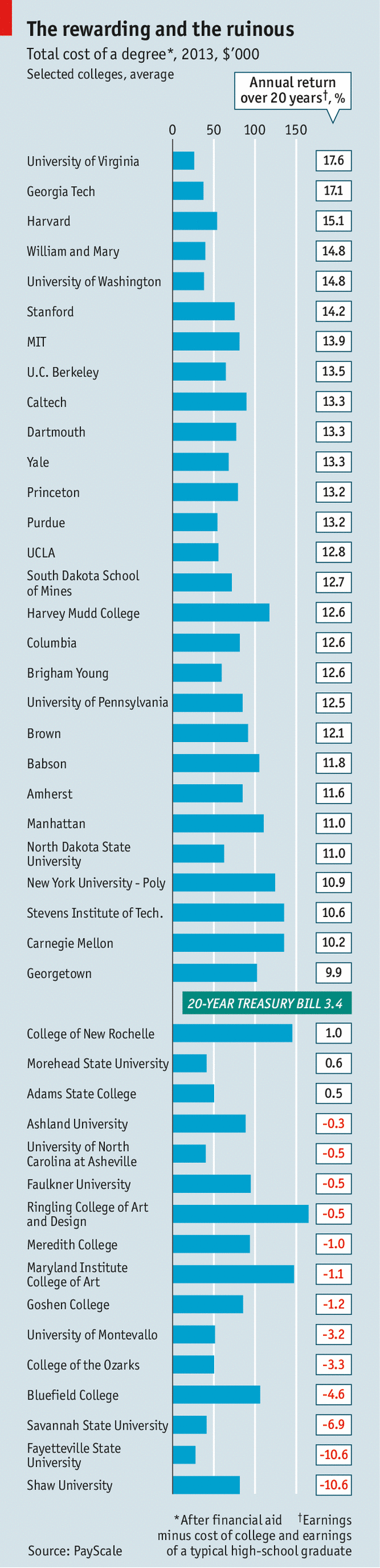
The Economist has an interesting article about ROI from various degrees and universities. Here is an excerpt concerning BA degrees: "Arts and humanities courses are much more varied. All doubtless nourish the soul, but not all fatten the wallet. An arts degree from a rigorous school such as Columbia or the University of California, San Diego pays off handsomely. But an arts graduate from Murray State University in Kentucky can expect to make $147,000 less over 20 years than a high school graduate, after paying for his education. Of the 153 arts degrees in the study, 46 generated a return on investment worse than plonking the money in 20-year treasury bills. Of those, 18 offered returns worse than zero."
http://www.economist.com/news/unite...-return-higher-education-would-be-much-better

Here is the graphic from that article:
20140405_USC662_0.png
 
Last edited:
To the OP: if you are taking those high level classes, your transcript should shine a little brighter than most others. I had a choice to take both AP English and AP History for my senior year, declined to do both and regret not doing such.

The reason I say to plan the trips to visit the schools is to speak with an admissions counselor at Clemson, NC State and VT about your current selection of courses, tell them what your goals are during your matriculation there, and hopefully come away with a better understanding of what they offer. Tour the engineering schools, and it never hurts to meet professors. When it comes down to acceptance time, and those in charge can put a name to a face, it may just help you get in.

Good luck, though I don't think you need it.
 
An arts degree from a rigorous school such as Columbia or the University of California, San Diego pays off handsomely.

This I disagree with a bit. I don't think that on average an ARTs degree from UCSD or CAL or Standford or Harvard or anywhere pays off well for most graduates.

Yes I agree that there are a few students who graduate in the arts and find good jobs without going to grad school to study something else, BUT overall I believe that 75% (at least) of the "arts" majors will have a REALLY REALLY hard time finding gainful employment as new graduates in the 2015 market.

There may be a few who find something but overall it matters a lot more what degree you choose then what school you went to. A good school is great but the major is really what employers - for the most part - are looking for.

It wasn't always this way. Many of the people who graduated in the 1990s and 2000s with BAs found work without issue. The economy has changed though and majors matter now more than ever. One could always learn a skill like coding and be set despite their degree but few go down that path.
 
Last edited:

Members online

Forum statistics

Threads
278,310
Messages
3,554,077
Members
248,016
Latest member
Advally Service

Trending content

Back
Top
