Confused on Brake Upgrade

FYI Everyone

FROM: LINK > eBay Guides - Drilled vs slotted rotors, what is better


see a paper "The Effect of Rotor Crossdrilling on Brake Performance" by two GM engineers published in 2006. They examined three vehicle platforms with cross-drilled rotors vs standard rotors to measure convection cooling capability, fade characteristics, wet braking, pedal feel and lining wear. The result is summarized as follows:

For the sports sedan, the coefficient of friction was 21% higher for drilled rotors than standard front rotors at 340F and higher using 15 brake snubs at 62mph. The track simulated 124 mph fade test showed 37% better brake output for drilled rotors. The drilled rotor brake temperature was about 150 degrees cooler.

For the performance car, the coefficient of friction was significantly higher for drilled rotors especially at high temperature.
Wet braking at high pedal pressure was the same for drilled or standard rotors. Wet braking is not significantly improved by drilled rotors.

Pedal force was much more consistent with drilled rotors over the brake temperature range. That is, to stop at the same deceleration rate, the driver does not need to modulate pedal pressure based on different brake temperatures. This reduces driver fatigue and improves brake response.


/**** ALSO SEE ****/


LINK > causes of brake pulsation | Brake Fade | Drilled vs Slotted Rotors.

Slotted rotors do not improve any heat transfer. However, the slots can improve brake output by removing gas and dust that is trapped between the pad and rotor. This gas and dust reduces the friction force by preventing the pad from fully contacting the rotor.

Given the choice between drill holes and slots, the drill holes will give you better braking power over slots for normal city/highway driving. This is why high end BMW, Porsche, Corvette, and Mercedes rotors are drilled, not slotted. However, for track racing (high speed stops), slotted rotors are the better choice.

:thumb3:
 
Last edited:
I appreciate the differences in rotor types and the different ways to seat them and break them in BUT I still contend that the quality of "average to mid level" steel products has decreased in recent years and advise people to stay away from the bottom-barrel parts, especially something like rotors.

You will get what you pay for! The cheap rotors at AutoZone are made from the cheapest steel in CHINA and despite being drilled or non-drilled, I think you will have issues with them.

I assume the pics of cracked rotors, are from cars that underwent extreme use (ie racing) or were just cheap rotors made with cheap steel. Those pictures (prev page) we not off of any 4Runner or Tundra btw.

It is just my opinion but I think that low quality steel and manufacturing is quickly becoming the NORM in America and it is a good idea to go with a higher quality rotor. I choose Brembo which is a *very* reputable brand; my 2nd choice would be doing the full Tundra upgrade with Toyota rotors.

:hello:


I believe that the holes actually increase the grip the pads have on the discs. To me it seems like basic physics, a smooth flat surface will have less resistance/grip.
.

sorry but you are wrong on almost all accounts, if anything the advances in technology has made it cheaper and easier to give todays "standard parts" or "budget parts" the same thing offered only to high end and racers ten years ago. auto parts are not going down hill, quite the opposite they are advancing by leaps and bounds. did you not read the link i posted... do a little research, you will find that no one outside of pure race teams that can afford $10-15 per brake set will use drilled rotors. i think you need to go back and re take a physics class my friend, more surface area will give you more braking power not more holes "gripping" the pad. a constant surface has more surface area there for more friction is built up, resulting in better braking performance. and the rotors were not raced, but daily driven BMWs -and let me assure you that BMW doesnt skimp on quality of parts. one of the rotors(the one with rust, #2) was off of a tacoma, and it wasnt a race truck or one that someone drove the **** outta, it was off my grandpas truck. when i worked for an major ambulance co in the portland metro area a few years ago in their shop, we tryed using drilled rotors to dissipate the heat faster to see if we could get longer life out of the rotors. it didnt work, infact just the opposite, we had 3 ambulances shatter rotors before it was time for a brake job (we changed out pads every 10k and would swap put on new rotors every other brake job). so we pulled all the rest of the rigs with drilled rotors(all of which looked like they had about 30-40k on them) and went back to ford oem rotors. sure its a 10,000lbs emergency vehicle that is driven hard all the time, but in less than 10k mi we had rotors literally breaking into pieces, where as you could get at least 20k outta a set of stock rotors, the cost issue alone was saying no-go with drilled not to mention the risk of injury to not only the crew but patient and other people if that cause an accident.

im telling you drilled rotors are no win idea they will fail and give you no better braking
 

you dont want cooler!!! heat is friction, friction is your stopping power!!! you want to be able to dissipate that heat evenly through out the rotor and have enough material(rotor and pad) to soak up that heat to slow you down and stop you as fast as possible -hence why we all want to do the tundra brake up-grade, its a bigger diameter and thicker walled and more space in the vents rotor! take a lesson in physics man, and know what you are talking about before you dig yourself any deeper...
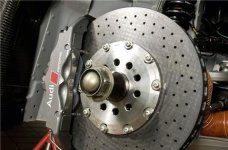
just cause you wanta look cool like this,
audi-gt3-r8-customer-race-car-brakes.jpg
doesnt mean your gonna be able to stop like
r10 glowing.jpg


there read this What Kind of Rotors Should I Get?
 

Attachments

  • audi-gt3-r8-customer-race-car-brakes.jpg
    audi-gt3-r8-customer-race-car-brakes.jpg
    27.5 KB · Views: 1,258
  • r10 glowing.jpg
    r10 glowing.jpg
    101.4 KB · Views: 889
The_Kid, I did see the links and read that forum post. I also did some research on the net and found plenty of support for drilled rotors. I really only decided to chime in because most people just go with the Tundra rotors and don't know about the other options out there. I already have Brembo rotors and have never said they are better than the Tundra rotors, just that this setup works and you don't have to swap calipers, at least I didn't.

I did say that my setup is awesome and the brakes far out-perform the BFGs so anything better would be wasted unless I switched tires. When I say the setup out-performs the BFGs 275s, that is because when I step on the brakes, I stop extremely fast. The BFGs will actually start to "shred or burn" but NOT lock up. I concluded that now the tires are the biggest limiter on my stopping power.


we had 3 ambulances shatter rotors before it was time for a brake job (we changed out pads every 10k and would swap put on new rotors every other brake job). so we pulled all the rest of the rigs with drilled rotors(all of which looked like they had about 30-40k on them) and went back to ford oem rotors. sure its a 10,000lbs emergency vehicle that is driven hard all the time, but in less than 10k mi we had rotors literally breaking into pieces, where as you could get at least 20k outta a set of stock rotors, the cost issue alone was saying no-go with drilled not to mention the risk of injury to not only the crew but patient and other people if that cause an accident.

I think you have a good point here and agree that people should avoid cheap cross-drilled rotors. I only have 35k on mine but they work great and they are from a premium brand, not the cheapest. I am hoping they last a lot longer, I just had them checked.


i think you need to go back and re take a physics class my friend, more surface area will give you more braking power not more holes "gripping" the pad.

With all respect, No I don't and there isn't much to debate. :)


im telling you drilled rotors are no win idea they will fail and give you no better braking

Dude, I already have drilled rotors and my braking is great. I feel like we are going in circle so I will take a break from this thread and let others speak.


I posted two links above that go through the physics. There isn't much to debate. See the detailed links I posted, they are to industry white papers.
 
Last edited:
Hey The_Kid,

most of the information in the links see posted against drilled rotors either 1) mention cheap drilled rotors; I have $Brembo$ 2) don't mention any real numbers or physics. The links I posted are to industry white papers. That said I am not a mechanical engineer, I work in a different field (CS & IT) and I think it is good to have lots of posts with lots of links others can make up their mind.

on a final note, if you were in San Diego we could meet up for a "stop off" braking test.

BTW my 4Runner does stop like an F1 racer, sorry to hear yours doesn't.
[Edited for clarity: friendly sarcasm here]


:beer:
 
Last edited:
you drive around in a two ton truck, with undersized brakes, you dont stop like a race car and you never will dont be a fool. i dont need to show off to anyone thats for mall crawlers and ricers
 
I believe that the holes actually increase the grip the pads have on the discs. To me it seems like basic physics, a smooth flat surface will have less resistance/grip.
.

I still don't understand the logic here. By this rationale, If holes increase grip you would stop better if you had no rotors at all. I've had OE and Powerslot rotors. I found no benefit to the slotted type other than less fade when driving long distances through the mountains. And yes I've warped them both.
 
This is why high end BMW, Porsche, Corvette, and Mercedes rotors are drilled, not slotted.

In response to this, high end sports cars with "cross drilled" rotors, actually have rotors with those holes cast in, not drilled. They are a totally different animal in terms of performance and ability to handle abuse compared to cross drilled rotors, and the price reflects that as well.

Friction decreases as swept area of the pad decreases (a side effect of cross drilling), there is just less rotor surface for the pad to act on. Heat is a by-product of friction, and the rotor/pad/caliper act as a heatsink, so the more mass of the braking system, the better it is able to handle the heat, spread it across the entire mass, and disipate it without risking warping the rotor, or boiling the brake fluid in the caliper.

Back in the day, brake pad technology was not what it is today, and pads would create gasses during braking which would seperate the pad from the rotor surface, in this scenario slots or holes would help evacuate these gasses and improve braking. With today's brake pad chemistry, this isn't an issue anymore. Cross-drilled rotors are just for looks these days. Your brembo rotors would perform as well or better if they were blanks.
 
Friction decreases as swept area of the pad decreases (a side effect of cross drilling), there is just less rotor surface for the pad to act on. Heat is a by-product of friction, and the rotor/pad/caliper act as a heatsink, so the more mass of the braking system, the better it is able to handle the heat, spread it across the entire mass, and disipate it without risking warping the rotor, or boiling the brake fluid in the caliper.

Back in the day, brake pad technology was not what it is today, and pads would create gasses during braking which would seperate the pad from the rotor surface, in this scenario slots or holes would help evacuate these gasses and improve braking. With today's brake pad chemistry, this isn't an issue anymore. Cross-drilled rotors are just for looks these days. Your brembo rotors would perform as well or better if they were blanks.

X1 :biggrin2:
 
In response to this, high end sports cars with "cross drilled" rotors, actually have rotors with those holes cast in, not drilled. They are a totally different animal in terms of performance and ability to handle abuse compared to cross drilled rotors, and the price reflects that as well.

Friction decreases as swept area of the pad decreases (a side effect of cross drilling), there is just less rotor surface for the pad to act on. Heat is a by-product of friction, and the rotor/pad/caliper act as a heatsink, so the more mass of the braking system, the better it is able to handle the heat, spread it across the entire mass, and disipate it without risking warping the rotor, or boiling the brake fluid in the caliper.

Back in the day, brake pad technology was not what it is today, and pads would create gasses during braking which would seperate the pad from the rotor surface, in this scenario slots or holes would help evacuate these gasses and improve braking. With today's brake pad chemistry, this isn't an issue anymore. Cross-drilled rotors are just for looks these days. Your brembo rotors would perform as well or better if they were blanks.

and most of their rotors are carbon ceramic rotors anyways... -and Porsche still has had, and is having issues with their rotors cracking under hard usage.
 
Around how much will this mod cost. Trying to build a budget

I spent $206 on 2 Raybestos "loaded" calipers - came with all the clips and brake pads. Got them from Midwest Auto Parts thru their EBay auction -- a "buy it now" price of $103 each with free shipping & no core charge.
Got the rotors from Amazon -- they are also Raybestos and were $80 for the pair with free shipping. So I spent $286 plus brake fluid. I looked EVERYWHERE for 2 weeks and these were the best deals I found on good parts -- I looked at some junkyard stuff in a couple of places and it looked like junk -- not something I wanted on my truck.
 

Members online

Forum statistics

Threads
278,312
Messages
3,554,085
Members
248,016
Latest member
Advally Service

Trending content

Back
Top