Driveshaft Clunk Thud

cj80cruiser

Senior Member
I believe my driveshaft is sticking and needs to be greased. I get that clunk after hard braking. I know this is regular maintenance but just wondering if 4runner driveshafts have the same tendency that landcruisers do to get gummed up and NOT allow the excess grease to ooze out therefore causing the shaft to put pressure on the Tcase.
 
Register to hide this ad
I have a "kink" sound somewhere in my rear drive line. I pulled my rear driveshaft to check for play in the U-joints, all were tight. So I drove in 4Hi and had zero sounds.

I pumped ~12 pumps of grease into mine (the slip yoke), the driveshaft does extend. It finally did ooze grease out. I wiped the excess off. While driving, the suspension travel will cause the SY to collapse and will relieve the pressure.

(my sound is still there)
 
I have a "kink" sound somewhere in my rear drive line. I pulled my rear driveshaft to check for play in the U-joints, all were tight. So I drove in 4Hi and had zero sounds.

I pumped ~12 pumps of grease into mine (the slip yoke), the driveshaft does extend. It finally did ooze grease out. I wiped the excess off. While driving, the suspension travel will cause the SY to collapse and will relieve the pressure.

(my sound is still there)


Im just a little paranoid because those landcruiser ones would get clogged up and not release the pressure for nothing unless you took the driveshaft off and cleaned it out. I'll just have to fill it up and see if it will come out or if it extends the driveshaft out. If so then I will just have to remove the zirk and flex the suspension to force the excess back out
 
Last edited:
I was a little concerned also when I saw the driveshaft extending. Hydraulics are amazing, they will move huge loads. It will also find the path of least resistance, the seal.
 
I was a little concerned also when I saw the driveshaft extending. Hydraulics are amazing, they will move huge loads. It will also find the path of least resistance, the seal.

That's what you would think...me too. but those landcruiser guys swore it would hold and possibly damage the Tcase. The 4runner Tcase is much smaller which has me a little more concerned. I'll just have to pay close attention when i do grease it up.

Just wondering how often the 4runner driveshafts get gummed up....seemed to be quite a few landcruisers had that problem.
 
Gerdo, Did you try pulling the driveshaft apart, cleaning it, and greasing it by hand? I may try that if filling through the zirk doesn't work.
 
It's a common sound from 4R's and completely normal.

After almost 10 years, I've only heard a clunk in mine once and that was after ~15K without lubing it. I'm not sure normal is the right word honesty. That sound is a warning that the driveshaft is binding up and needs lube - and that's not good if you wait too long.
 
After almost 10 years, I've only heard a clunk in mine once and that was after ~15K without lubing it. I'm not sure normal is the right word honesty. That sound is a warning that the driveshaft is binding up and needs lube - and that's not good if you wait too long.

That's right. It's a common sound in Landcruisers also. Lubrication will fix it but the filling from the zirk wouldn't always be enough. I'm hoping mine will be solved with that simple procedure. Will find out today and hope my seals aren't blocked up to release excess.

Brian have you heard of any issues like the one I was speaking of about putting too much pressure on the Tcase?
 
That's right. It's a common sound in Landcruisers also. Lubrication will fix it but the filling from the zirk wouldn't always be enough. I'm hoping mine will be solved with that simple procedure. Will find out today and hope my seals aren't blocked up to release excess.

Brian have you heard of any issues like the one I was speaking of about putting too much pressure on the Tcase?

When mine clunked that one time, I lubed the zerks and drove it for a day or 2 and then I heard it just strarting to clunk again so I lubed it once more and it stopped making noise for good. I just fill the zerks until it starts coming out. Sometimes you have to drive it a little bit afterwards and then it'll take more grease after a day or 2.

The slip yokes can be overfilled (they won't expel grease like the other zerks will when they can't take any more). So I always just pump 7 or 8 pumps and call it done. I have over-filled mine in the past before and it just pushed out a glob and flung it onto something hot under there because I could smell it while driving. So, it's designed to push the excess grease out when you compress that slip yoke so it shouldn't put strain on the t-case. I have never heard of the Landcruiser issue happening on a 4runner.
 
My rig had the issue when I bought it from the dealership manager with ~16K on the clock. I drove it that way for over 100K more miles before I researched the problem and realized it was a lube issue.
I had to pump the shiat out of the slip yoke and repeat the process twice before the clunk went away. It still makes an appearance every now and again.
I just read that the recommended lube for the u joints is a Moly-based lube, so I will try that on the slip yoke anyway. Maybe it will work better than the regular general purpose grease I use.
 
My rig had the issue when I bought it from the dealership manager with ~16K on the clock. I drove it that way for over 100K more miles before I researched the problem and realized it was a lube issue.
I had to pump the shiat out of the slip yoke and repeat the process twice before the clunk went away. It still makes an appearance every now and again.
I just read that the recommended lube for the u joints is a Moly-based lube, so I will try that on the slip yoke anyway. Maybe it will work better than the regular general purpose grease I use.

As far as I know the recommendation is moly is used for the slip yoke and non moly for the ujoints. I'm using moly on all but just for the sake of arguement moly is supposed to let things slide past rather than roll which is why I've heard not to use moly on the ujoints. It's said to cause flat spots on the needle bearings but I'm not switching grease tubes and moly will have to work for my ujoints also.
 
The clunk after hard braking IMO is normal, my Surf has had it since I got it. I have 71k kms (44k miles) and the driveshaft is lubed properly.
 
As far as I know the recommendation is moly is used for the slip yoke and non moly for the ujoints. I'm using moly on all but just for the sake of arguement moly is supposed to let things slide past rather than roll which is why I've heard not to use moly on the ujoints. It's said to cause flat spots on the needle bearings but I'm not switching grease tubes and moly will have to work for my ujoints also.

It seems there is some confusion on this topic.
Reference post number 15 on this thread:
Don't ignore your Zerk fittings! (I did) - YotaTech Forums
There is a Toyota TSB posted which specifies GP on the slip yokes and Moly on all the u-joints. The Moly base retains some anti-friction capabilities even when the grease runs dry or gets dirty or something like that is what I understand.
Further reading in that thread states that the spec is different from what appears in the FSM and the owners manual.
Not really sure what to believe at this point, but I am switching to Moly anyway. It is still an NLGI2 grease for chassis components, it just appears to have extra protection. I got the Mobil grease referenced in that thread.
 
yeah, I can post threads from Ih8mud that state the contrary. But i know for 100% sure that moly was advised for slip yoke and filling knuckles there and those guys don't let anything slip by. It was not recommended for wheel bearings and u-joints. But to be honest any grease as far as the driveshaft is concerned is better than no grease. I'm putn moly all around on mine too.
 
Last edited:
OH JEEzus,
Check out this quote from the afore mentioned thread, referencing a Tundra Solutions thread:
Moly additized greases are excellent lubricants,however, should only be used in limited applications as the moly can actually cause early failures in most uses. Never, ever use a moly additized grease in a wheel bearing or universal joint application. Moly additized greases are primarily indicated only where extreme pressure sliding action occurs. When Moly is used in non-friction bearings the moly causes accelerated surface degradation (frosted mug appearance) of the rolling surfaces and premature bearing/race failure. The moly is actually harder than the hardened bearing surface and does not crush when the bearing rolls over it. In universal joints, in addition to surface failure, the moly centrifuges to the extremes of the bearing, blocking oil flow, causing accelerated bearing end wear.
If a single grease is being considered a non-moly grease is the safest primary recommendation. The use of both moly/non-moly specific for sliding/bearings application is ideal.
I currently have 5 failed universal joints sitting on my lab table with very low time; all were regularly greased with a moly additized grease and each failed due to the use of the moly grease.
George Morrison

Damn. I guess I will stick to the gen purpose grease for the u-joints AND slip yokes. I might just buy another grease gun just for the specified Moly fittings (the double cardan joints ONLY). It is hard to believe that something so critical could be left up to interpretation like that.
 
OH JEEzus,
Check out this quote from the afore mentioned thread, referencing a Tundra Solutions thread:


Damn. I guess I will stick to the gen purpose grease for the u-joints AND slip yokes. I might just buy another grease gun just for the specified Moly fittings (the double cardan joints ONLY). It is hard to believe that something so critical could be left up to interpretation like that.

Crap!! I guess I'll Favre back over to gen purpose in the ujoints again. I'm just gona buy a cheap grease gun to fill my u joints now.
 
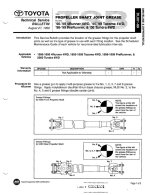
Is this how everyone else is lubricating with moly only in 4, 5, and 6?
The slip joint requires multi-purpose nlgi 2?

I ask because I didn't do it this way the first time...I put moly in the slip joint I believe.
viewer.jpg
 

Attachments

  • viewer.jpg
    viewer.jpg
    106.1 KB · Views: 1,808

Members online

Forum statistics

Threads
278,307
Messages
3,554,050
Members
248,016
Latest member
Advally Service

Trending content

Back
Top