Effectiveness of airing down for beach driving???

Ltn369

New member
I am seeking advice on beach driving.
My question is whether it makes a difference to air down my 20" tires. My 2010 Limited did well on the beach during my trip to Cape Hateras last summer. I aired down on some ramps and not on others. It was dicey at one point (aired down) when I was hub-deep in soft sand. I rocked back and forth as if in snow and got out.
Transmission was kept in normal mode the entire time. I.e. Atrac not activated.
Given the "thin wall height" of the 20" stock tires, I did not notice any significant spread of the tires when aired down to 18psi.

What's you take? Airing down is still better? Should I have Atrac on?

Thanks much,
Jack
 
Register to hide this ad
I'm a firm believer that if you're going to do one thing when driving on sand it should be airing down. I see you point about the contact patch change on the 20"s. I would air one down to 15 at home and measure the difference. I've never used A-Trac on sand as airing down was enough.
 
Even on 20's airing down will help. It may be hard to see in sand, but it could decrease your surface pressure by 30-40% I'd guess.

My biggest concern would be losing a bead. You can't go very low without risking it.

You could always do a test. Air down one side and not the other and compare.
 
"Losing a bead"?
The 2 sides of the tire are called beads, they are seated to the inside of the rim. At very low pressure, it is possible to pull the bead away from the rim and be undriveable. You would need a decent compressor (or ether and a match) to get it re-seated so it could be re-inflated. In sand you are at little risk of losing a bead so I wouldn't worry too much.

Airing down 20s will be effective. The contact patch width does not change on any radial tire (to any meaningful degree), the contact patch gets longer.
 
You should air down to about 15 psi. The sand at Hatteras is like sugar and softer = lower psi. The ramps are the most difficult spots for getting stuck. I usually kind of stop so the person in front of me clears the ramp and then haul a** down the ramp and stop for nothing. Those who do not air down create a wash board effect in the sand.

If you go to Corolla, the Currituck Co. Police will ticket you for not airing down. The beach to Carova is a state road and all traffic laws apply. They were cracking down last summer due to the increase in beach drivers since the south beaches now require a permit.

I have a lowly 4th gen so I know nothing about Atrac. I've always heard that trucks with AWD are no good in the OBX sand though.

This is the 7 minute video you have to watch to get a permit. They do inspect for equipment. Beach driving tips begin at minute 5:

http://youtu.be/D3pCUAw1nEw
 
Last edited:
I am seeking advice on beach driving.
My question is whether it makes a difference to air down my 20" tires. My 2010 Limited did well on the beach during my trip to Cape Hateras last summer. I aired down on some ramps and not on others. It was dicey at one point (aired down) when I was hub-deep in soft sand. I rocked back and forth as if in snow and got out.
Transmission was kept in normal mode the entire time. I.e. Atrac not activated.
Given the "thin wall height" of the 20" stock tires, I did not notice any significant spread of the tires when aired down to 18psi.

What's you take? Airing down is still better? Should I have Atrac on?

Thanks much,
Jack

Yes, it'll help. Not as much as a tire with a thicker sidewall, but it'll help.

It's intuitive to think that the big benefit of airing down is the contact patch getting wider. What isn't near as obvious is the contact patch getting longer, and that happens much earlier and to a greater extent than the patch getting wider. Airing down helps even if you don't see giant sideways bulges in your tire.

edit - or what Jeremy said, lol.
 
Last edited:
The 2 sides of the tire are called beads, they are seated to the inside of the rim. At very low pressure, it is possible to pull the bead away from the rim and be undriveable. You would need a decent compressor (or ether and a match) to get it re-seated so it could be re-inflated. In sand you are at little risk of losing a bead so I wouldn't worry too much.

Airing down 20s will be effective. The contact patch width does not change on any radial tire (to any meaningful degree), the contact patch gets longer.

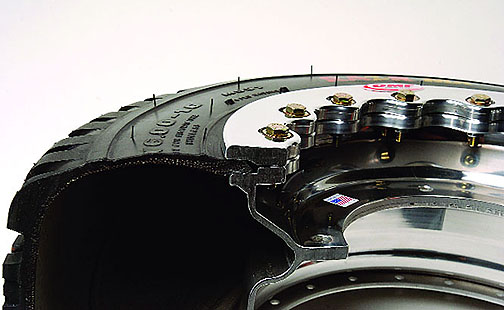
Sorry to threadjack, but what is different about beadlock wheels that work to prevent this from happening? How common of an occurrence is it?
 
Sorry to threadjack, but what is different about beadlock wheels that work to prevent this from happening? How common of an occurrence is it?

Beadlocks have a locking ring that pinch the tire's bead to keep it from moving, allowing lower pressures with lower risk of losing a bead.
Beadlock_Cutaway_2.jpg


Not sure how common it is, and it is highly dependent on the circumstances (vehicle weight, lateral load, tire pressure, tire construction, tire size, etc). I run mostly 8*-12 psi rock crawling and have not lost a bead yet, though a few times it sure looked like I was about to. Mostly climbing steep inclines with a side slope that basically put most of the vehicle weight sideways onto one rear tire, the tire sidewall would be sideways and the rim being very close to the ground. Looks sorta like those idiot ricers that mount narrow tires on way too wide wheels.

I carry tie downs, dual compressors pushing out over 5 cfm, and starter fluid to be able to reseat a bead if needed.

* not on purpose - my gauge broke for a while before I realized it, showing 4psi higher than actual. Because of the lack of problems at 8psi, thinking I was at 12, I have now change my go to pressure for technical trails to 10psi.
 
Last edited:
Sorry to threadjack, but what is different about beadlock wheels that work to prevent this from happening? How common of an occurrence is it?

Good question. Beadlock wheels have disks That bolt on from the outside and sandwich the tire bead area so it can't come off. The lower the tire pressure the greater the risk. Most times it woll come off on a sidehill or driving too aggressive.
I usually run around 6-10 psi in sand and way down to 2-4 in snow in my land cruiser. At those pressures youd lose a bead right away with 20" wheels and low profile tires. With 39" tires on 15" rims, I'd probably lose a bead once every trip. I do have a York compressor (engine belt drive - 12CFM) so re-seating beads is no problem. I would not want to do it on my 4runner with an electric compressor.

Id stay above 15 if it were me.
 
Last edited:
I have a lowly 4th gen so I know nothing about Atrac.

Your 4th gen has atrac. It does not have an atrac button like the 5th gens but it works by putting the brakes on just the same. My old 4th gen atrac worked great. If you want the tires to spin fast in sand and do not want the brakes to be applied lock the center dif. The 4th gen give you a lot more options in this area than the 5th gen.
 
Airing Down

I'm still on my oem Dunlops and I air down to 20 for trails and 15 for beach/dunes. It seems to work well and on trails softens the ride to lessen the force on the suspension, wheel bearings and tires. I'm on 265/70/17s.

You will need a good compressor - ARB or VAIR to air up, small ones may take 4 minutes per tire. That's a long time waiting beside each tire. I put together a home brew CO2 system and it only takes 30 seconds per tire.

If you don't already have them, get a set of deflators. I use Trailhead, but Staun, Smittybuilt and ARB have some good stuff too.
 
If you don't already have them, get a set of deflators. I use Trailhead, but Staun, Smittybuilt and ARB have some good stuff too.
I have Stauns and the ARB deflator, but unless it is raining, cold as hell, or swarming mosquitoes, I just remove 1 valve core, wait 10 seconds, remove another one, go back to monitor the first tire's pressure and reinstall the core, then go to the 2nd tire, and repeat. It's much faster than deflaters, but you have to be careful not to lose a valve core. I carry 20ish spare cores in my tire repair kit.

Both the stauns and the arb deflator's threads wore my aluminum TPMS valve stem threads almost down to nothing, which is why I started removing the core and realized how much faster it is.
 
Looks like I need to invest in a compressor. An ARB may be out of my price range. Which VAIR would you guys recommend?
 
Looks like I need to invest in a compressor. An ARB may be out of my price range. Which VAIR would you guys recommend?

I run the beach a lot, airing down makes a big difference. Been using same Viair comp for a decade.
 
Basically none of the electric compressors without a tank will "seat a bead". The issue with seating beads is that the tire isn't usually touching the bead surface area - meaning there's a gap where air flows out between the wheel and tire. So you need a LOT of air in a burst to get the tire to move out and seal up. Usually if you really want to have this capability you're going to need both a tank and a higher pressure compressor along with larger diameter air hose. For a casual use like you're describing, I would forgo the need for big volume and big pressure.

There are better compressors for tires than ARB compressors - that also happen to be a lot less expensive.

The most common one is the Q industries MV50. They are a great little compressor for pretty cheap and have high volume (much more important for airing up than high pressure). They used to be $30ish, now they go for more like $50. Costco often has them here. I have one and it works great for a small portable.
mv50_1.jpg~original


My personal favorite at the moment for value is the PUMA. It has a tank and air pressure switch that are nice features.
$_12.JPG~original


The more capable options then are engine mounted and belt driven converted air conditioner compressors. They are great to have, but not necessary for what you're wanting. The big advantage is that they are usually more powerful than most home shop compressors, so air tools work great, and you can air up multiple tires at a time as they can produce more air than you can flow through a tire valve. 10 years ago this was the defacto standard. Every trail rig had one. Mostly because there weren't other good reliable 12v compressor options. Now that there are so many better 12v options, these are a lot less common. They are also pretty $ if you don't do your own fab work. (It's the black unit on the upper right)
000_0235.jpg~original
 
Last edited:
I'm in the market for one as well, I was thinking about a Viair 88P for $65, any feedback? But I do like the idea of having a built-in tank 1.5gal ($165) as well. Any reasons you could not use a small 2gal home compressor (<$80) and plug it in the outlet other then size?
 
The MV50 is crap, I've had like 4 or 5 of them. When they work, they work pretty good, but not long term. They look like a Viair but the materials and tolerances are completely different if you tear them down.
 

Members online

Forum statistics

Threads
278,316
Messages
3,554,114
Members
248,016
Latest member
Advally Service

Trending content

Back
Top