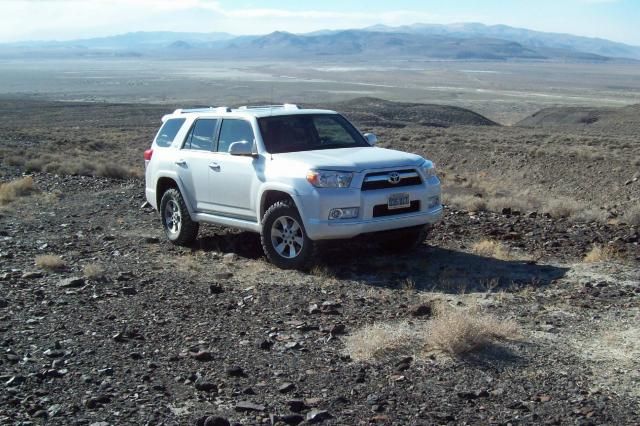
Effectiveness of airing down for beach driving???

My experiences a bit different than you guys.

*1. I don't drive on beaches. I'm in the desert.
*2. The sand here is generally like talcum powder.
*3. Sand is usually extremely dry.
*4. I tend to avoid driving in deep loose sand unless there has been a bit of rain or snow in the previous week.
*5. When I do venture into the sand I'm always on 4LO, generally in 1st, 2nd or 3rd gear.
*6. In sand I keep the A-Trac ON all the time.
*7. never use the brakes!
*8. Don't Stop!
*9. Don't turn sharply!

With that stated:
I run 10ply M/Ts.
I will occassionaly drop the pressure to 20psig. With the A-Trac and the M/Ts it really doesn't seem to be much of an advantage. REMEMBER - I'M TALKING ABOUT DESERT SAND, NOT A BEACH.

My previous truck, a 2004 Land Rover Discovery, was about the same weight; approximately the same sized tires (Toyo 10ply M/Ts), gear ratios just slightly higher; same A-Trac (though LR calls it 4-ETC) and solid axles both ends. So I've got about 11 years of experience with this system (268 off road treks)

So let's conclude by saying, in my situation, using either the '04 LR or the '13 T4R on the TOYO M/ts I can 99% of the time do sand at 44psig in the tires - using the previous caution of running in sand when there is about 5% moisture in it.........
 
Just out of curiosity, have you ever tried running lower? I've never driven on desert sand so I don't know how exactly it behaves or why higher pressure would be better.

The tires at 44psig seem to run the best, on road, off road; sand, dirt; rocks; gravel; up or down hill; doesn't seem to matter. At 20psig the tread length doesn't seem to increase much at all. At 15psig almost exactly the same. So I just keep it at 44psig.

Plus I'm many times running alone - If I were too ever drop a bead the only way to get a 10ply/E-rate back on the bead is in a tire shop. Even at the tire shop they have trouble mounting the things.

Walking from the Black Rock Desert back to Fernley ain't no fun.
 
The tires at 44psig seem to run the best, on road, off road; sand, dirt; rocks; gravel; up or down hill; doesn't seem to matter. At 20psig the tread length doesn't seem to increase much at all. At 15psig almost exactly the same. So I just keep it at 44psig.

Plus I'm many times running alone - If I were too ever drop a bead the only way to get a 10ply/E-rate back on the bead is in a tire shop. Even at the tire shop they have trouble mounting the things.

Walking from the Black Rock Desert back to Fernley ain't no fun.

I do not see how you can handle the rough ride in the desert at 44 psi. My BFG KO2 tires really smooth out the ride at 25 psi or less. 44 psi would be more punishment than fun for me.
 
How fast do you go when off road?

When the country is full of rocks to dodge, ditches and washes to cross I'm generally doing less than five miles and hour. If I'm in fine sand and gravel I go faster.

This truck is such a gentle ride after my years in the LR Discovery with its solid axles both ends and much stiffer springs that the 4Runner at 44psig is nothing.
 
How fast do you go when off road?

When the country is full of rocks to dodge, ditches and washes to cross I'm generally doing less than five miles and hour. If I'm in fine sand and gravel I go faster.

This truck is such a gentle ride after my years in the LR Discovery with its solid axles both ends and much stiffer springs that the 4Runner at 44psig is nothing.

On long stretches of graded type trails like this http://www.toyota-4runner.org/5th-g...ride-trying-warm-up-freezing-norhterners.html definitely more than 5 mph. Sometimes 25-35 or more depending on conditions and terrain. On rough rockier sections 5 mph or less. If I went 5 mph on long trips I would not get very far. Airing down really takes the harshness out on any vehicle from my atv to the Jeep I used to own. It makes it much more comfortable and I would think easier on the suspension componets.
 
On long stretches of graded type trails like this http://www.toyota-4runner.org/5th-g...ride-trying-warm-up-freezing-norhterners.html definitely more than 5 mph. Sometimes 25-35 or more depending on conditions and terrain. On rough rockier sections 5 mph or less. If I went 5 mph on long trips I would not get very far. Airing down really takes the harshness out on any vehicle from my atv to the Jeep I used to own. It makes it much more comfortable and I would think easier on the suspension componets.

OK - On a road like that I'm in 2HI and cruising along at 35. The SR5 and the M/Ts roll along very sweet at 44psig.

Too bad I'm nearly 500 miles north of you; would be fun to get together some time.

Furthest south I tend to get is tonopah, Gold Field, Lunar Craters, etc.

WHOOPS! OFF TOPIC - SORRY.

26511-ontopofplateau_zps587b681f.jpg~original
 
Last edited:
The tires at 44psig seem to run the best, on road, off road; sand, dirt; rocks; gravel; up or down hill; doesn't seem to matter.
I wouldn't recommend that anyone run their tires at 44psi off road on a technical trail, especially on rocks. You're way more likely to puncture a tire at 44psi on sharp rocks than you are to lose a bead at 15psi. I'm sure it works for you on the trails you're running, but I'd hate for a noob to see this and think they don't need to air down on rocks.
 
OK - On a road like that I'm in 2HI and cruising along at 35. The SR5 and the M/Ts roll along very sweet at 44psig.

Too bad I'm nearly 500 miles north of you; would be fun to get together some time.

Furthest south I tend to get is tonopah, Gold Field, Lunar Craters, etc.

WHOOPS! OFF TOPIC - SORRY.

26511-ontopofplateau_zps587b681f.jpg~original

I have been in your area but never off road there. I will let you know if I get up your way in the future, let me know if you get to my area. Just remember it is to hot to off road here in the summer unless you are in Flagstaff or other higher places.
 
ALL of the tires I've lost on trails have been due to rocks going through the sidewalls while aired down.

Perhaps the broken andesite and basalt around here acts a bit different than the shale in the Canadian Rockies.

I think where I get the most advantage while aired down is when climbing steep on slickrock. On that the tread sort of forms around the ledges.
 
ALL of the tires I've lost on trails have been due to rocks going through the sidewalls while aired down.

Perhaps the broken andesite and basalt around here acts a bit different than the shale in the Canadian Rockies.

I think where I get the most advantage while aired down is when climbing steep on slickrock. On that the tread sort of forms around the ledges.

Most of the tires I have seen cut off road in Arizona have been in the sidewall of stock P type tires aired not aired down. It seems like any decent all terrain aired down or not holds up pretty well. I think it is just a matter of luck if a sharp rock hits your tire just right. I generally do not need more traction but just like the tire to conform to the rocks like in the 5th picture here. http://www.toyota-4runner.org/5th-gen-t4rs/181948-some-desert-pictures-my-new-ko2s.html At full pressure this would make for a brutal ride. This picture was at 25 psi. This is why I like a good 3 ply tire with some sidewall protection.
 
ALL of the tires I've lost on trails have been due to rocks going through the sidewalls while aired down.

Perhaps the broken andesite and basalt around here acts a bit different than the shale in the Canadian Rockies.

I think where I get the most advantage while aired down is when climbing steep on slickrock. On that the tread sort of forms around the ledges.

Yeah, I don't think there's much to protect sidewall either way unless you're running kevlars or something for added protection. Some sidewalls are also more prone to getting slashed - Duratracs have a reputation for weak sidewalls. What I mean is that on rocky trails you have more chance of cutting through the tread driving over sharp rocks fully aired up. When you're aired down the tire is more likely to deform over the rock than when you're fully aired up. Of course there's always a chance of shredding a tire even at 6 psi, you're just reducing the chances by airing down.

The other thing is that airing down is easier on the trail since you're less prone to spin your tires. That means fewer ruts on the trail, especially in front of obstacles. Like I said, 44 psi might be fine for the trails you're doing but I wouldn't recommend it for all trails.

I think I posted this earlier in the thread, but it's worth posting again because it's the best article I've seen on airing down.
https://arbusa.wordpress.com/2011/10/26/the-lowdown-off-road-tire-pressures/
 
OK - Just one more observation - - -:juggle:

That's a great article that you put up on your previous post and there is a lot of truth in the statistics. But statistics doesn't explain everything.

When the ARB USA was talking about contact patch on a hard surface he is not quite matching a real world off-road surface.

In the chart showing the tread contact patches and calculating the differences between a tire at 40psig and one at 25psig (those are the two extremes that I am normally running at) the 40psig patch is 450 sq-cm (69.7 sq in) and the 25psig patch is 587 sq-cm (91.0 sq in). Figuring that the weight on each of the 4Runners four wheels equals about 1100 pounds. You then have about 15.9 pounds of force per square square inch at 40psig and 11 pounds of force per square inch at 25psig.

Assuming that the pointy end of a sharp rock is about 1 inch square ,the part trying to get thru almost an inch of rubber, polyester and steel belts of an e-rated tire; it just isn't going to do it in either case. It might though get thru the sidewall.

The next thing that comes to mind is that the sand or soft dirt that is being depressed by the weight of the car has already elongated the contact patch by almost double its length. The sand is wrapping around both ends of the tire (unlike pavement).

Food for thought, eh?

24608-Nice_zpsa1021efa.jpg~original


26521-SimpsonPasssummit_zps2b962d7a.jpg~original
 
The next thing that comes to mind is that the sand or soft dirt that is being depressed by the weight of the car has already elongated the contact patch by almost double its length. The sand is wrapping around both ends of the tire (unlike pavement).

Food for thought, eh?

The aired down tire will depress less into the surface.

You know how you can feel a difference in tire drag on pavement with high vs low psi? On a soft surface you can feel the same thing in reverse.

I honestly don't know how you do it. It's not something I would even consider.
 
The aired down tire will depress less into the surface.

You know how you can feel a difference in tire drag on pavement with high vs low psi? On a soft surface you can feel the same thing in reverse.

I honestly don't know how you do it. It's not something I would even consider.

I cant think of a time id ever put 45psi in a 4runner other than towing. My trail rig never goes above 20 under any circumstances that i can think of. Since i run bias ply tsls sidewalls are not a concern. Even with radials they should be harder to puncture at 20 than 40. Just try to pop a half full balloon. Its not until you start exposing the sidewalls that you tend to run into trouble.
 
OK - Just one more observation - - -:juggle:

That's a great article that you put up on your previous post and there is a lot of truth in the statistics. But statistics doesn't explain everything.

When the ARB USA was talking about contact patch on a hard surface he is not quite matching a real world off-road surface.

In the chart showing the tread contact patches and calculating the differences between a tire at 40psig and one at 25psig (those are the two extremes that I am normally running at) the 40psig patch is 450 sq-cm (69.7 sq in) and the 25psig patch is 587 sq-cm (91.0 sq in). Figuring that the weight on each of the 4Runners four wheels equals about 1100 pounds. You then have about 15.9 pounds of force per square square inch at 40psig and 11 pounds of force per square inch at 25psig.

Assuming that the pointy end of a sharp rock is about 1 inch square ,the part trying to get thru almost an inch of rubber, polyester and steel belts of an e-rated tire; it just isn't going to do it in either case. It might though get thru the sidewall.

The next thing that comes to mind is that the sand or soft dirt that is being depressed by the weight of the car has already elongated the contact patch by almost double its length. The sand is wrapping around both ends of the tire (unlike pavement).

Food for thought, eh?

Ron, I know we are not going to change your mind. You are 74 years old lol and have the mindset "It has worked for me for the past several years so my way has to be correct." I will say a few things about your post though:

There is a huge difference between 11 lb-f and 15.9 lb-f. You and I (and every other person reading this with half a brain) both know that depending on the rock, the edges of the rock, the type of rock, the angle of rock, etc that the rock could puncture the tire like a knife through hot butter - or not. It just depends. Lower ground pressure typically will allow the tire to deform around the rock and reduce the possibility of punctures.

On the statement "...is that the sand or soft dirt that is being depressed by the weight of the car has already elongated the contact patch by almost double its length. The sand is wrapping around both ends of the tire... " you made. The CONTACT with the tire has been elongated sure. Simple physics and force vectors will tell you different. What is going on there is your original contact patch (69.7 sq. in) is still supporting the bulk of the 1,100 lbs and the "wrap" of the tire against the sand is supporting very little because of gravity and the properties of sand. If you place your palm on the sand and press straight down you have the same force countering your force. If you take your palm and put the same amount of force downward but now you move it side to side it is easier to do than forcing it straight down right? Same with a tire. Contact patch is key.

It seems to me you have either really been lucky or you make sure you don't go anywhere that your tires at 40 psi can't get through. Pretty sure it's the latter and that's fine. Every one of us (again those of us with half a brain) who goes off road evaluates the conditions and the terrain and determines whether we want to go through, around or turn back from an area.

Bottom line is a larger contact patch (aired down) will take you more places with less risk of puncture than a small contact patch (aired up) will. If you ever get stuck, don't be stubborn. Air down and you will probably get out.

Lastly, I'm sorry but statistics CAN explain everything depending on who is manipulating the numbers! I see it every day lol..
 
I cant think of a time id ever put 45psi in a 4runner other than towing. My trail rig never goes above 20 under any circumstances that i can think of. Since i run bias ply tsls sidewalls are not a concern. Even with radials they should be harder to puncture at 20 than 40. Just try to pop a half full balloon. Its not until you start exposing the sidewalls that you tend to run into trouble.
Stock size 265/70/17 LT tires need 44psi to have the same load rating as the stock size P metric tires.
 
1Engineer.

I agree with you whole heartedly.

I am not really arguing against airing down.

I do sometimes air down.

I have blown tires (however always a sidewall)

My point is to just get people to think about what is going on.

I'd like them to realize that this is a discussion - not an argument.

- - - -

It all started out about BEACH SAND - then it migrated to rocks (not many on the beach.

In rocks the most important rule is to run on a very robust tire (an e rated is best) with really beefy sidewalls. BFG TA/KO and Toyo M/T both in E come to mind.

Yes in soft beach sand airing down increases the patch and thus the weight of the car does float as there is less mass per square inch of sand surface.
 
I've always enjoyed watching people who don't air down their tires get stuck on the most mundane obstacles! And, like some great savior, I swoop down, spin my deflators onto their tires, bring the pressure down to ~14psi, and tell them to ease on over said obstacle! They are confused, thankful and most annoyed that something so simple got them through!

I see the "trails" that 4 runner and LandRover is on in those pics, and that's not "trails", that's just a sandy road with a hard base. You want sand? try wheelin' on the beach in Honolulu! Turn up some of the lava rock trails and watch your tires get shredded! Loved watching tourists take their rental jeeps and Geo Trackers where they shouldn't be going, only to get stuck a whole 7 feet from a paved road!
Airing down is an important step to true wheelin'! I've been stuck on a tiny mound of silt-covered rock and just spun tires (which actually cuts the tires up much more than when aired down). Realized I forgot to air down, dropped the pressure and VOILA! Right over in 2wd, no spinning!

Aside from all of this, driving down a rutty dirt road with full pressure just beats the daylights out of the suspension! Next time any of you are on a rutted road and its beatin' the crap outta you, stop, air down to just 20psi, see for yourself what difference it makes! I've aired my 35's with no beadlocks down to 8psi and have never, EVER, lost a bead! I also don't beat the shit out of my truck when I'm on trails either! I realize that my truck is NOT a dirt oval race car, nor am I running a track in the WRC!
Follow that mindset and you shouldn't cut your tires up to the point of having to replace them, your suspension will last longer, especially your shocks, you won't be as fatigued when you get to wherever you're going, and you'll have better traction in almost all offroad situations.
 
I probably should have posted this in the first place. [MENTION=78273]Jeremy556[/MENTION] and all guys who go in the sand off road will hate me because I will give you more useless knowledge to depress your friends and family lol.

I worked on a project awhile back that was for a new vehicle that will be used in sand mining all over the world. Suffice to say it is an off highway vehicle and rubber tired to boot. It's top speed is only around 30 mph and one of the requirements was flotation over all types of sand. When hearing the initial presentation and specs I thought to myself "Alright, different types of sand?" "Sand is sand right?" Sadly I was mistaken as I was about to find out! I will not bore you with the esoteric details of types of sand but suffice to say there are a LOT of different sand types and especially SHAPES of sand grains that absolutely influence the "pack-ability" of sand. We have all heard of sugar sand and glass sand (Hawaii) but that is just a few types. My part of the project was torque distribution and ways to limit said torque. Sort of a electro-hydraulic "Crawl Control" (way different than the TE though) that would give the operator different settings depending on where in the world he (and the machine) is located. Of course tires and ground pressure were extremely important but I did not work on that portion. There are several different tire shapes, types, compounds and sizes depending on what type of sand this machine will see. Anyway, I learned way too much about sand so now I will share some of that pain with you. Here are two elementary links that will briefly describe the type and shapes of sand. Have fun!

Oh, shape of sand grains is a bit more important than types of sand.

Sand Types - Sandatlas

World Atlas of Sands » Blog Archive » Shape of sand grains

No wonder nobody ever wants to talk to me at a party. This is the type of crap I babble on about...
 

Members online

No members online now.

Forum statistics

Threads
278,316
Messages
3,554,120
Members
248,016
Latest member
Advally Service

Trending content

Back
Top