frame mounted hitch??...Toyota/Lexus??

I see no reason whatsoever that an Airlift 1000 kit wouldn't work on a 2wd 4Runner. What's the reasoning behind that? Seems like that would solve your problems...

I called both air lift and firestone,there is no listings for 2011 2wd for 4runner,only 4wd...I asked why,and both said rear spring is different??..
I might go to a Toyota parts listing to verify...so instead a bought Timbrens...see how they work out.
 
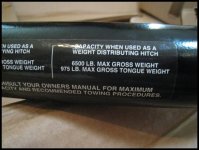
drnick and any others still wondering if the lexus frame mounted hitch will work, notwithstanding AlamoRunner's somewhat cryptic post,(see this thread, post #3), I am very confident the final answer is no. I have no idea about after market or maybe other model hitches, but this one, PT228-60100 won't go.

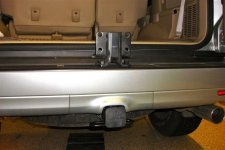
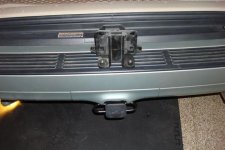
A couple of things I discovered in my research. First, even the Lexus Gx 460 has a trailer hitch like ours. It is called an "Intregal" hitch. They of course, had a choice. No hitch, Intregal or Frame mounted. Their Intregal hitch, same rating as ours, 5k and 500lb tongue ratings. If the vehicle did not have a hitch, but had the pre-towing option (I think), everything was there to install a hitch later, including a spacer plate/bracket that covered the mounting holes of the rear frame cross member, just like on our 4runners.

If installing the lesser hitch, you take that part off. (See Photos) If installing the full frame hitch, that plate/spacer or whatever is required. This is the part that I think AlamoRunner had trouble with at the bottom of his post, causing the whole project to fail.

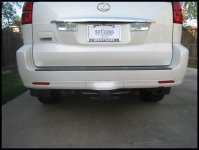
Here is the photo of the Integral hitch for the Lexus. Notice the similarity?
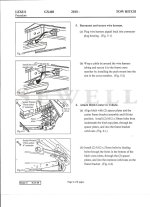
The 3rd and 4th photos shows that spacer/bracket or whatever you want to call it, removed. The 5th 6th and 7th photo shows the actual frame mounted hitch itself. I got these photos from Lexusclub.com and thier members made it very clear, if you had oversized tires and KDSS, this hitch mount WOULD NOT fit thier rigs. The last attachment is a page from the install PDF for the Lexus. Go to Figure or drawing 6-1. This is where I think AlamoRunner could not match up the hitch to the bracket and the cross member. Just a guess, but it fits his description of the problem. Be safe.
 

Attachments

  • DSC04853 (Small).jpg
    DSC04853 (Small).jpg
    47.6 KB · Views: 2,295
  • DSC04854 (Small).jpg
    DSC04854 (Small).jpg
    56 KB · Views: 3,027
  • DSC04855 (Small).jpg
    DSC04855 (Small).jpg
    42.9 KB · Views: 4,470
  • DSC04856 (Small).jpg
    DSC04856 (Small).jpg
    45.7 KB · Views: 2,307
  • OOEMhitch1 (Small).jpg
    OOEMhitch1 (Small).jpg
    46.5 KB · Views: 2,217
  • hitchinstalled (Small).jpg
    hitchinstalled (Small).jpg
    38.4 KB · Views: 3,991
  • scan.jpg
    scan.jpg
    132.3 KB · Views: 2,301
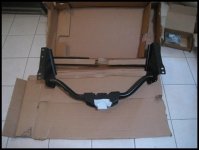
Apparently one of the photos did not make it in my post above, here it is. The photo of the Frame mounted hitch.
 

Attachments

  • OOEMhitch (Small).jpg
    OOEMhitch (Small).jpg
    33.8 KB · Views: 2,133
Last edited:
Jtraskell,Hmmm,those holes on the frame hitch look pretty similar to the holes in my 5th gen 4runner frame rails...other then having to remove the bumper fascia for install,and removal of the OEM hitch, I wonder???...why do you say it won't fit?? P.S. Alamo-runner's post,was somewhat confusing,but I thought he said it bolted on,and the spacer plate was rather confusing about install,but overall
I thought he's post said that the lexus hitch would work on the 5th gen 4runner??...I'm I reading his post wrong??
 
Last edited:
If I'm reading everyones posts correctly. The Lexus frame mount hitch attachs to the frame as well as the crossmember. And on the 4runner the cross member is closer to the axle than the Lexus, thus not allowing the mounts to line up at the crossmember. The frame lines up the crossmember does not.
 
If I'm reading everyones posts correctly. The Lexus frame mount hitch attach to the frame as well as the cross member. And on the 4runner the cross member is closer to the axle than the Lexus, thus not allowing the mounts to line up at the cross member. The frame lines up the cross member does not.

Yea, you are spot one. drnick, re-read the last couple of sentences of AlamoRunner's post. Then look at at the PDF page I posted above. What I got out of Alamo's post is that the frame mount did fit on the frame rails, but when it came time to bolt on the "center" of the hitch to the cross member between the frame rails (where our OEM hitch is already attached), it did not match. Do not know how to explain it any better then this. Just study what I have presented for awhile, it should become clear.
 
Frame Hitch

Lots of discussion on this while I have been out playing... towed multi kayak trailer to the lake for some R&R.

To hopefully clarify my earlier post, the GX frame mount hitch is installed and being used on my TE with only the side bolts (4 on each rail, 8 total). The center bracket/spacers/hitch is what does not line up on my vehicle. Could be OE difference between 4R and GX or could be deflection of crossmember on my from towing at max rating with a equalizing/sway control hitch.

During off-forum exchange with Leza he suggested welding the spacers in place thus linking the hitch/spacers/bracket all together and ending up with the original intent of bolting the items together. I will be getting this set up in the next couple of weeks since it will improve the integrity of what I have now which is already much improved over OE.

I am not techie enough to post photos to forum, but will be happy to supply via email to anyone who wants to send me a message with email address.

BTW, I also observed a little cracking of the black powdercoat on my TE's OE Toyota bracket hitch when using my WD setup, so I am glad that I have pursued going with the GX frame hitch and it's 650/6500 rating.
 
Thanks for the clarification. Now, I may be wrong on this, but I do not think so. There is a lot more criteria involved in "tow ratings" then just the hitch. Be careful. Just because a certain hitch on a certain vehicle will achieve a 650/6500 tow rating, does not mean that by JUST getting that hitch, YOUR vehicle will qualify for such a rating. You might want to do some more research before towing more then 5K in your 4runner. (And until that center is welded up or something, any tongue weight would be an issue in my mind).

Be Safe
 
Im out of town with work, but if people are interested I could post the pics. They clear up a lot of confusion when trying to picture it in your head.
Basically what it comes down to is the 4runner crossmember Is 1-1/2in to far back which makes the 4 factory bolts unreachable as the spacer plate does not line up. My suggestion was to put the spacer plates in place (or suitable material) and have them welded in.

I completely agree that this in no way will or should change the tow rating of the vehicle but IMO this is a way beefier and secure towing platform.
 
Im out of town with work, but if people are interested I could post the pics. They clear up a lot of confusion when trying to picture it in your head.
Basically what it comes down to is the 4runner crossmember Is 1-1/2in to far back which makes the 4 factory bolts unreachable as the spacer plate does not line up. My suggestion was to put the spacer plates in place (or suitable material) and have them welded in.

I completely agree that this in no way will or should change the tow rating of the vehicle but IMO this is a way beefier and secure towing platform.

I think all of us on this thread would like to see pictures.
 
There's something wrong with my hitch then, looking at Dewfang's picture. I have the wdh set up for 1/2 frear 1/4 in front and my hitch is definetly angeld up alot where yours is flat.

That's likely. Post pics or something. Mine angles up slightly (less than 10 degrees) because my travel trailer rides lower, so the hitch is lower, etc, etc.

My setup also sags a bit more, because sag is not a bad thing, and because my chains on the torsion bars have no half-way setting. I drove all the way to FL set one chain link higher, and on some of the highway waves and expansion joints, the traction control would kick off because there wasn't enough force on the rear axle.
 
I think I'm going to jump in the boat with Dewfang on this topic. I think we are making too much about this and how the T4R bolt on hitch is inferior to the Lexus one.

But my position on this just changed last night when I was looking at the hitch on my 2004 Dodge 3/4 ton 4x4 Cummins desiel which is rated at something like 1,000lbs tongue and 12,000 capacity using weight distribution hitch. Because the hitch is basically the same as the one on the T4R, as it bolts on to the tubular cross member that mounts to the frame.

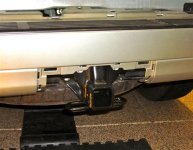
Here is a picture of the Dodge bolt on hitch and as you can see, the majority of the weight is secured by the vertical 2 bolts and the T4R's bolts aren't vertical so they aren't relying on the threads but on the thickness of the horizontal bolts. Granted the bolts on the Dodge are larger but we are talking about over 2 times the towing capacity.

So I think the stock hitch is just fine for the rated capacity, 5,000lbs, and it's fine to use a WDH like Dewfang mentioned.

Hitch2.jpg
 
I think I'm going to jump in the boat with Dewfang on this topic. I think we are making too much about this and how the T4R bolt on hitch is inferior to the Lexus one.

But my position on this just changed last night when I was looking at the hitch on my 2004 Dodge 3/4 ton 4x4 Cummins desiel which is rated at something like 1,000lbs tongue and 12,000 capacity using weight distribution hitch. Because the hitch is basically the same as the one on the T4R, as it bolts on to the tubular cross member that mounts to the frame.

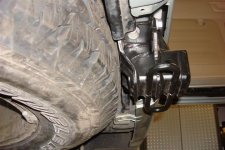
Here is a picture of the Dodge bolt on hitch and as you can see, the majority of the weight is secured by the vertical 2 bolts and the T4R's bolts aren't vertical so they aren't relying on the threads but on the thickness of the horizontal bolts. Granted the bolts on the Dodge are larger but we are talking about over 2 times the towing capacity.

So I think the stock hitch is just fine for the rated capacity, 5,000lbs, and it's fine to use a WDH like Dewfang mentioned.
Hitch2.jpg

Agreed. No offense to anyone, but I think there are a number of people here who, in spite of their education, have rather dated views based on the materials science of 30 years ago.

The number of alloys invented and the amount of research that has gone into metallurgy, including heat treatments and our understanding of material fatigue, in the last 10 years has been staggering.

My T4R hitch has 4 bolts holding it on, two from the bottom up, and two in the back there, you can barely see them.
 
Thanks for posting the pics!:hatsoff:

It looks to me like the factory threaded holes line up perfectly with the holes in the hitch. What am I missing? Looks like you can throw that space in there, thread the bolts and you are good to go.

Maybe some more pics puh-lease?

Under the truck, frame bolts, looking up under hitch, and farther away (back of truck)?
 
One thing I do like about the hitch is that the 2" square tube is fully enclosed by another tube to increase the lip strength. While I doubt it's really necessary, I would feel that that it's less likely to go out of square should it be over-stressed somehow.
 
Agreed. No offense to anyone, but I think there are a number of people here who, in spite of their education, have rather dated views based on the materials science of 30 years ago.

The number of alloys invented and the amount of research that has gone into metallurgy, including heat treatments and our understanding of material fatigue, in the last 10 years has been staggering.

My T4R hitch has 4 bolts holding it on, two from the bottom up, and two in the back there, you can barely see them.

I don't know what is worse: You calling me old with this post or you calling me out of touch lol.
 
Agreed. No offense to anyone, but I think there are a number of people here who, in spite of their education, have rather dated views based on the materials science of 30 years ago.

The number of alloys invented and the amount of research that has gone into metallurgy, including heat treatments and our understanding of material fatigue, in the last 10 years has been staggering.

My T4R hitch has 4 bolts holding it on, two from the bottom up, and two in the back there, you can barely see them.

In the case of body on frame vehicles, manufacturers will typically use lower tech (in other words, older) High Strength Steel (HSS) because it is repairable by cold straightening. Heated repair (hot straightening) is not advised as you can remove the properties that give it strength. These are used in the frame so the repair costs are minimized (e.g. you can straighten the frame on a rack, avoiding disassembly of the vehicle to replace the bent frame). Newer advanced steels such as some newer HSS and Ultra HSS have been developed in order to allow reduction in weight while maintaining crash safety. Since it is not advised to attempt a repair on these newer steels by cold straightening or hot straightening, these new HSS are typically only used in the body structure, where replacement is much easier and less costly.


Now Unibody is totally different. For the same reasons discussed above, typical attempts to realign unibody vehicles results in a vehicle that statically looks straight, but it never drives the same.
 
I don't know what is worse: You calling me old with this post or you calling me out of touch lol.

Since my birthday is a week away... I am old too.

In the case of body on frame vehicles, manufacturers will typically use lower tech (in other words, older) High Strength Steel (HSS) because it is repairable by cold straightening. Heated repair (hot straightening) is not advised as you can remove the properties that give it strength. These are used in the frame so the repair costs are minimized (e.g. you can straighten the frame on a rack, avoiding disassembly of the vehicle to replace the bent frame). Newer advanced steels such as some newer HSS and Ultra HSS have been developed in order to allow reduction in weight while maintaining crash safety. Since it is not advised to attempt a repair on these newer steels by cold straightening or hot straightening, these new HSS are typically only used in the body structure, where replacement is much easier and less costly.

I love the academics of this discussion, as sort-of off-topic as it is. Must ... resist ...

Okay, I failed:

To a point, I agree with you, but trends on light duty and medium duty vehicle designs have headed in the fully-boxed frame direction, where one will need to temper to de-stress the steel after forming, and possibly again after welding. Given that the milder steels don't take well to repeated treatments (case in point, the early Tacomas, early Dodge Cummins Turbo frames) without being alloyed somewhat differently, one would surmise that Toyota would use a more modern steel than they used in the 90's unless they felt like doing what they did with the Tacomas for us.

And boxed designs are also much harder for frame people (see below) to get straight again compared to U frames.

Now Unibody is totally different. For the same reasons discussed above, typical attempts to realign unibody vehicles results in a vehicle that statically looks straight, but it never drives the same.

Most certainly true, unless you have a body shop frame guy that isn't a total idiot. I got lucky - my maxima got clipped by someone doing 50, and it drives the same today as it did then. Of course, it's also worthless now.
 

Members online

Forum statistics

Threads
278,316
Messages
3,554,120
Members
248,016
Latest member
Advally Service

Trending content

Back
Top