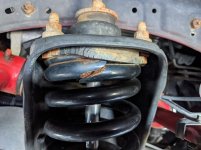
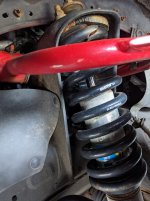
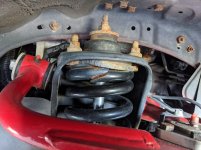
Has anyone seen this happen? Defective Bilsteins 6112

manofsteele2003

New member
Hey guys, I've had these 6112's installed for a little over 4 years and only about 20K miles and I just noticed this yesterday. I've never seen a broken spring like this and I've been working on cars for a lot of years.
 

Attachments

  • PXL_20210920_155829558.jpg
    PXL_20210920_155829558.jpg
    102.9 KB · Views: 431
  • PXL_20210920_155836399.jpg
    PXL_20210920_155836399.jpg
    130.8 KB · Views: 436
  • PXL_20210920_154121957.jpg
    PXL_20210920_154121957.jpg
    120.6 KB · Views: 419
Register to hide this ad
This has the appearance of wear (and/or corrosion) torsional fatigue failure. The second coil wrap was exposed to wear and corrosion from the coil wrap above, exposing the metal and forming a crack initiation site, after which cyclic fatigue produces a classic 45 degree break.

An engineering technical paper is published here. Failure analysis of a motor vehicle coil spring - ScienceDirect Zoom in on Figure 2a to view the wear and subsequent break. Text above the figure explains the cause of failure. Note, corrosion doesn't have to be as bad as shown in this technical paper to produce failure. In your case, contact wear through the protective coating probably initiated a crack, and corrosion accompanied and perhaps contributed. Failure analysis of a motor vehicle coil spring - YouTube is a video when this technical paper was presented at a conference.
 
Last edited:
Throw some JB weld on it and call it good. :D

How is your bump stop on that side? Also wonder if your top hat is gone up and to the right of where it broke. Notice it broke just past the end of the spring, so it might be flexing around that if the top hat is not in good shape just past the end.

Either way, most likely a defect that got worse over time. It's really rusty so could've even started out as a tiny split that corroded and grew more and more.
 
broken springs are not too uncommon in the automotive world. 20k miles of use is definitely premature though.

im curious who manufactures the springs for Bilstein. I tend to prefer running Eibach springs because i have yet to see one of them break.
 
Everything was new when installed (I bought the preassembled units from Wheelers) and I do believe that the springs are produced by Eibach.
 
Another question, is this safe to drive with for a little while? I'm not sure how long of a warranty process this is going to be and I don't want to buy something else if this is going to be replaced under warranty.
 
This has the appearance of wear (and/or corrosion) torsional fatigue failure. The second coil was exposed to wear and corrosion from the coil above, exposing the metal and forming a crack initiation site, after which cyclic fatigue produces a classic 45 degree break.

An engineering technical paper is published here. Failure analysis of a motor vehicle coil spring - ScienceDirect Zoom in on Figure 2a to view the wear and subsequent break. Text above the figure explains the cause of failure. Note, corrosion doesn't have to be as bad as shown in this technical paper to produce failure. In your case, contact wear through the protective coating probably initiated a crack, and corrosion accompanied and perhaps contributed. Failure analysis of a motor vehicle coil spring - YouTube is a video when this technical paper was presented at a conference.


So translated to plain english, does he have a chance of a warrantee claim? lol.
 
I'm trying to figure out what corrosion and wear are you looking at? There's a little surface rust but that's about it, there had to have been a defect in the steel or manufacturing process. Just me, but these haven't been abused beyond what they were intended for and for them to break is crazy to me.
 
So translated to plain English, does he have a chance of a warrantee claim? lol.

After reading the warranty, I think it should be covered. The failure is attributable to a defect that failed within the 5 year warranty period. If it had failed after 5 years, then it would not be covered.
 
Last edited:
Another question, is this safe to drive with for a little while? I'm not sure how long of a warranty process this is going to be and I don't want to buy something else if this is going to be replaced under warranty.

If this was mine, I would drive on it until the warranty process is resolved.
 
The corrosion where the break happened is probably from exposure after the break. I've seen springs with way more corrosion and they didn't snap like that. Should be covered under warranty. manufacture, material defect. You should be okay driving carefully as long as the spring is wedged in. I've driven with a busted shock but not a spring so not sure what would happen if you hit a pot hole and the spring dislodged taking the shock with it and the truck riding on the tire or the bump stops.

Edit: looked at your pic again and the broken tip is wedged in the rubber. you should be OK avoid full droop.
 
Last edited:
After reading the warranty, I think it should be covered. The failure is attributable to a design defect that failed within the 5 year warranty period. If it had failed after 5 years, then it would not be covered.

The rep at Bilstein said they were a limited lifetime warranty, so either way I should be covered.
 
I'm trying to figure out what corrosion and wear are you looking at? There's a little surface rust but that's about it, there had to have been a defect in the steel or manufacturing process. Just me, but these haven't been abused beyond what they were intended for and for them to break is crazy to me.

You will not be able to see a crack initiation site without removing the spring and carefully examining the fracture surfaces. Do not clean or disturb the rust or coating in case Bilstein wants you to return the spring for analysis.

The topmost coil is ground and terminates in a taper. It's called a square end as shown here Types of Coil Spring Ends - Duer Carolina Coil, Inc. The end taper contacts the next coil wrap, which may result in loss of protective coating and corrosion. The photos show corrosion where the adjacent wraps contact. Note the loss of coating a little ways beyond the taper and above the fracture. This indicates long term coating failure due to corrosion spreading under the coating.

You don't have to abuse a spring to produce this type of failure. Once the crack initiates, it grows each time the spring is flexed, forming characteristic striations, visible under a microscope after the fracture surfaces have been properly prepared for examination. The striations visibly indicate where the crack initiated and once identified will likely determine if the cause of failure was corrosion pitting, a material defect, a point of stress concentration, a manufacturing defect, or a design deficiency.
 
Last edited:

Members online

Forum statistics

Threads
278,316
Messages
3,554,120
Members
248,016
Latest member
Advally Service

Trending content

Back
Top