Highlighting the difference between unibody and Body-on-Frame

Boyds4Runner

New member
Went out to Rausch Creek Offroad Park this past Sunday for a 201 Class (11-15-2015). I made it into some of the pictures the instructor posted on their Facebook page.

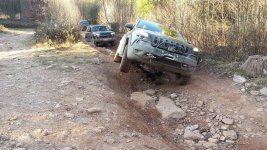
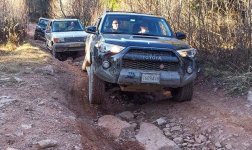
These two pictures dramatize the difference between a Unibody Jeep Cherokee Trailhawk and the Body-on-Frame 4Runner.

I'm still hanging a front tire in the air but nowhere as dramatically out of balance.
 

Attachments

  • Unibody TraiHawk 11-15-2015.jpg
    Unibody TraiHawk 11-15-2015.jpg
    137.8 KB · Views: 3,848
  • BOF 4Runner 11-15-2015.jpg
    BOF 4Runner 11-15-2015.jpg
    93.9 KB · Views: 4,292
Register to hide this ad
Looking at the suspension of the Trailhawk, this is not an apples to apples comparison.

The Trailhawk has independent rear suspension on a unibody compared to the live axle of the 4Runner with body on frame.

If you would to compare a unibody live axle truck (like an xJ) to a body on frame live axle (4runner), that would make an interesting discussion and a fairer comparison.
 
Point taken! No apples-to-apples comparison...don't post.

Truth be told you have called me out on a bit of worthless boasting to show that I did take my grocery-getter off highway.

There is some ego in this hobby and I let it get out.

However, I was influenced by this article less than a year ago where the same comparison was made:
2015 4x4 Of The Year - New-Vehicle Shakedown

In all fairness there were no other unibodies in the group so I had no other "apples" to choose.

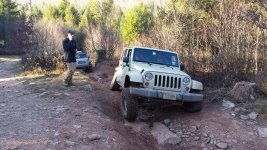
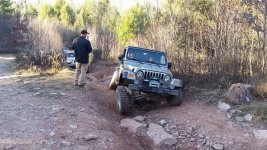
Here are a couple of versions of SAS Wranglers that completely outflexed all of us! Again not "apples"
 

Attachments

  • 12249992_946250588763395_825697893613234568_n.jpg
    12249992_946250588763395_825697893613234568_n.jpg
    136.4 KB · Views: 2,687
  • 11221536_946250512096736_6779137785329010223_n.jpg
    11221536_946250512096736_6779137785329010223_n.jpg
    135.9 KB · Views: 2,693
[MENTION=87036]YotaDan[/MENTION] You are correct. Offroad Consulting does teach offroading classes at Rausch Creek Offroad Park in PA. The 201 level goes through a bit more technical obstacles than the 101 level.

I wanted to get a few lessons under my belt both to familiarize myself with the park and to learn how to wheel.
 
Hmm... I should figure out how to put a program together to teach people.
Offroading classes are a great idea. I used to teach off-road driving skills to emergency service vehicle drivers, mostly for remote area search and rescue purposes. Classes are also good for people who might not have buddies they can wheel with or who just prefer a 'safer', more methodical approach to learning the capabilities of their vehicle.
 
Not really apple to oranges. Here is my old unibody Jeep vs my friends body on frame Xterra. It has more to do with suspension than the body. The biggest difference between the two when offroading is that you can't open doors when flexing

 
Point taken! No apples-to-apples comparison...don't post.

Truth be told you have called me out on a bit of worthless boasting to show that I did take my grocery-getter off highway.

There is some ego in this hobby and I let it get out.

However, I was influenced by this article less than a year ago where the same comparison was made:
2015 4x4 Of The Year - New-Vehicle Shakedown

In all fairness there were no other unibodies in the group so I had no other "apples" to choose.

Here are a couple of versions of SAS Wranglers that completely outflexed all of us! Again not "apples"

It is always nice seeing people going out and learning how to off-road. I will never knock anyone trying to learn.
 
What I find interesting is that between the 3 vehicles shown the 4Runner is the most level while traveling over the terrain. The Cherokee is ridiculously tilted, despite the IRS having full contact in the rear the cab is tilted at least 30+ degrees on the horizontal, while front tire has barely any contact with the ground. The 4Runner and the Wrangler both have relatively flat contact patches in the front and rear, with the 4Runner being the most level of them all.

As was pointed out, the Cherokee's faults are shown clearly; but it's less of a Unibody issue as it is that the Cherokee uses a McPherson Strut in the front unlike the grand Cherokee's & 4Runner's dual wishbone set-up.

The 4Runner in this example shows that while the Wrangler has full contact of all 4 tires, the front IFS & SRA is a good combination that can still do well off-road. While having 1 less wheel on the ground (and without a locker or proper management like ATRAC a potential place for power to be lost) means less traction, the fact the vehicle remains relatively level through that sections means that the vehicle is more likely to make it through that section without much drama (i.e. the vehicle isn't going to suddenly nose dive as bad as the Cherokee probably did). This isn't as big an issue in this particular area, but in twistier sections of trails it could be the difference between the vehicle getting close to tipping angle or being a bit tilted; not to mention sudden "roller coaster" dips and dives through terrain that can promote further tipping potential. Something that isn't obvious in these pictures is that while the Wrangler has the best contact patch; it's on-road manners aren't nearly as refined as the Cherokee or the 4Runner (again, why I mentioned that the IFS/SRA combination is a good compromise in ability.)

Stepping away from that segue in suspension, I will point out that both the frame & cabs of the Wrangler and the 4Runner are not twisting up anywhere near as much as the Cherokee in that area. It's not something that can be seen in the pictures, but because the frame that underpins the body is far more rigid than the cab that floats on the frame; they can flex at different rates in response to stress and gravity. Where as the Cherokee has to endure both gravity and torsional forces of the body twisting with the way the suspension is being pushed. As someone pointed out earlier, you don't want to open the doors when you're in a unibody as you might find they won't close the same later. Not to mention repeated exposure to those stresses will probably result in fractures of the unibody, warping, and/or spot welds popping (at least that's what most of the older JGC guys I know tell me they've had to deal with in their unibody vehicles), not to say you can't fix that by installing an exo-cage or reinforcing the unibody. But at that point you're modding the vehicle way beyond what the Wrangler and 4Runner need to maintain the same reliability in repetitive off-road use.

Awesome pictures by the way! :)

Post Note-

That Xterra looks so low in that picture. But that's a good example where stock length IFS has difficulty; as you can see the Jeep is a bit more level (and appears to be higher up on the rock) than the Xterra is, which goes back to that whole tipping angle thing.

 
What I find interesting is that between the 3 vehicles shown the 4Runner is the most level while traveling over the terrain. The Cherokee is ridiculously tilted, despite the IRS having full contact in the rear the cab is tilted at least 30+ degrees on the horizontal, while front tire has barely any contact with the ground. The 4Runner and the Wrangler both have relatively flat contact patches in the front and rear, with the 4Runner being the most level of them all.

As was pointed out, the Cherokee's faults are shown clearly; but it's less of a Unibody issue as it is that the Cherokee uses a McPherson Strut in the front unlike the grand Cherokee's & 4Runner's dual wishbone set-up.

The 4Runner in this example shows that while the Wrangler has full contact of all 4 tires, the front IFS & SRA is a good combination that can still do well off-road. While having 1 less wheel on the ground (and without a locker or proper management like ATRAC a potential place for power to be lost) means less traction, the fact the vehicle remains relatively level through that sections means that the vehicle is more likely to make it through that section without much drama (i.e. the vehicle isn't going to suddenly nose dive as bad as the Cherokee probably did). This isn't as big an issue in this particular area, but in twistier sections of trails it could be the difference between the vehicle getting close to tipping angle or being a bit tilted; not to mention sudden "roller coaster" dips and dives through terrain that can promote further tipping potential. Something that isn't obvious in these pictures is that while the Wrangler has the best contact patch; it's on-road manners aren't nearly as refined as the Cherokee or the 4Runner (again, why I mentioned that the IFS/SRA combination is a good compromise in ability.)

Stepping away from that segue in suspension, I will point out that both the frame & cabs of the Wrangler and the 4Runner are not twisting up anywhere near as much as the Cherokee in that area. It's not something that can be seen in the pictures, but because the frame that underpins the body is far more rigid than the cab that floats on the frame; they can flex at different rates in response to stress and gravity. Where as the Cherokee has to endure both gravity and torsional forces of the body twisting with the way the suspension is being pushed. As someone pointed out earlier, you don't want to open the doors when you're in a unibody as you might find they won't close the same later. Not to mention repeated exposure to those stresses will probably result in fractures of the unibody, warping, and/or spot welds popping (at least that's what most of the older JGC guys I know tell me they've had to deal with in their unibody vehicles), not to say you can't fix that by installing an exo-cage or reinforcing the unibody. But at that point you're modding the vehicle way beyond what the Wrangler and 4Runner need to maintain the same reliability in repetitive off-road use.

Awesome pictures by the way! :)

Post Note-

That Xterra looks so low in that picture. But that's a good example where stock length IFS has difficulty; as you can see the Jeep is a bit more level (and appears to be higher up on the rock) than the Xterra is, which goes back to that whole tipping angle thing.

When I was fully flexed out like I was on that rock, I couldn't open the rear hatch because of the body flex. There were companies that sold unibody frame stiffeners because of that issue. The X was as far up as it could go on the rock, the front end was fully maxed because he had the torsion bars cranked on it, and I was sway-bar less. That is why I was further up the rock, we were trying to get as far up as we could with all 4 tires on the ground.
 
Point taken! No apples-to-apples comparison...don't post.

Truth be told you have called me out on a bit of worthless boasting to show that I did take my grocery-getter off highway.

There is some ego in this hobby and I let it get out.

However, I was influenced by this article less than a year ago where the same comparison was made:
2015 4x4 Of The Year - New-Vehicle Shakedown

In all fairness there were no other unibodies in the group so I had no other "apples" to choose.

Here are a couple of versions of SAS Wranglers that completely outflexed all of us! Again not "apples"

I just think its great to see people getting their "grocery getters" out wheeling. I have been going to RC for years, and have been wheeling a unibody for all of that time. It has PLENTY of steel added keeping it together and maintaining its rigidity, or it would have been busted up long ago.
Heres my grocery getter (wife driving)...

11541063_10204247436888671_2229458945509484468_n.jpg


I have seen the light though, and also own a 3rd gen Toy that will eventually be built like my Cherokee. For now my Toy has 4.5" of lift, 33's and is capable of some mild wheeling.
 
As was pointed out, the Cherokee's faults are shown clearly; but it's less of a Unibody issue as it is that the Cherokee uses a McPherson Strut in the front unlike the grand Cherokee's & 4Runner's dual wishbone set-up.

the fact the vehicle remains relatively level through that sections means that the vehicle is more likely to make it through that section without much drama (i.e. the vehicle isn't going to suddenly nose dive as bad as the Cherokee probably did). This isn't as big an issue in this particular area, but in twistier sections of trails it could be the difference between the vehicle getting close to tipping angle or being a bit tilted; not to mention sudden "roller coaster" dips and dives through terrain that can promote further tipping potential. Something that isn't obvious in these pictures is that while the Wrangler has the best contact patch; it's on-road manners aren't nearly as refined as the Cherokee or the 4Runner (again, why I mentioned that the IFS/SRA combination is a good compromise in ability.)


Awesome pictures by the way! :)

I did not realize that about the TrailHawk being McPherson Struts (at least in the front) instead of double wish-bone. Looks like double wish-bone has more articulation as a system? Although I would imagine that McPherson Struts could be designed to move more?

I had my swaybars connected so I know that even with the double-wish-bone my front was not going to articulate completely nor even as well as a solid-axle. I agree that the combination of SRA and IFS of the 4Runner is a good compromise as I felt much more comfortable without such wild swings like the TrailHawk was exhibiting.

The same Cherokee TrailHawk driver was in front of me going down a long downward side road along power-lines through the mountain with a cliff sliding down to the right. It dipped nose first really, really fast into a hole in the trail. Next thing I knew I had a clear, unobstructed view of the entire rear third of the under-side of the TrailHawk and the driver, rear wheel about 3 feet up in the air. He seemed fine with that position, but for me (the uninitiated) witnessing that kind of movement from a vehicle...I was worried we were looking at a roll-over in progress and was reaching for the radio to alert the instructor 11 vehicles ahead of us. I got used to it after seeing it happen a few more times.

I feel that the TrailHawk might have better road-manners in terms of a 4x4 Trail Rated vehicle, even more than our beloved 4Runners. Cherokee TrailHawks have other things like powered-rear-liftgates and all sorts of other electronic, comfort and convenience features that most 4Runners don't have. They're just a bit scary in my opinion when going on trails with washouts, twists and holes.

Maybe the way of the future in terms of wheeling with mass production vehicles though. Uni-body for fuel efficiency and 4-wheel independent suspensions for on-road manners still capable of an occasional trail ride.

I did not take the photos but was impressed by them as well and posted them for the examples. Our group instructor took those pictures, clearly at the same spot to show the various vehicle suspensions and how they behaved relative to the terrain.
 
I just think its great to see people getting their "grocery getters" out wheeling. I have been going to RC for years, and have been wheeling a unibody for all of that time. It has PLENTY of steel added keeping it together and maintaining its rigidity, or it would have been busted up long ago.

I wish I lived as close to RC as you do! I'd be there at least once a month until I either broke something on my daily driver or the wife would rescind the hall-pass.:target:

Another place about an hour south of me (Red Cloud) closed indefinitely so RC is the closest, legal place around me.
 

Forum statistics

Threads
278,314
Messages
3,554,097
Members
248,016
Latest member
Advally Service

Trending content

Back
Top