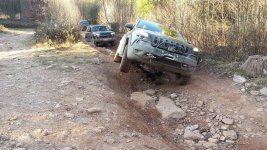
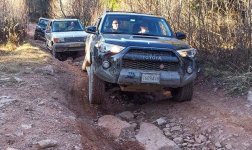
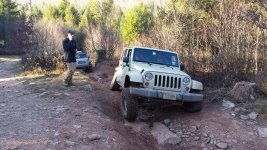
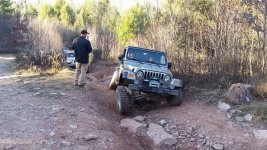
What I find interesting is that between the 3 vehicles shown the 4Runner is the most level while traveling over the terrain. The Cherokee is ridiculously tilted, despite the IRS having full contact in the rear the cab is tilted at least 30+ degrees on the horizontal, while front tire has barely any contact with the ground. The 4Runner and the Wrangler both have relatively flat contact patches in the front and rear, with the 4Runner being the most level of them all.
As was pointed out, the Cherokee's faults are shown clearly; but it's less of a Unibody issue as it is that the Cherokee uses a McPherson Strut in the front unlike the grand Cherokee's & 4Runner's dual wishbone set-up.
The 4Runner in this example shows that while the Wrangler has full contact of all 4 tires, the front IFS & SRA is a good combination that can still do well off-road. While having 1 less wheel on the ground (and without a locker or proper management like ATRAC a potential place for power to be lost) means less traction, the fact the vehicle remains relatively level through that sections means that the vehicle is more likely to make it through that section without much drama (i.e. the vehicle isn't going to suddenly nose dive as bad as the Cherokee probably did). This isn't as big an issue in this particular area, but in twistier sections of trails it could be the difference between the vehicle getting close to tipping angle or being a bit tilted; not to mention sudden "roller coaster" dips and dives through terrain that can promote further tipping potential. Something that isn't obvious in these pictures is that while the Wrangler has the best contact patch; it's on-road manners aren't nearly as refined as the Cherokee or the 4Runner (again, why I mentioned that the IFS/SRA combination is a good compromise in ability.)
Stepping away from that segue in suspension, I will point out that both the frame & cabs of the Wrangler and the 4Runner are not twisting up anywhere near as much as the Cherokee in that area. It's not something that can be seen in the pictures, but because the frame that underpins the body is far more rigid than the cab that floats on the frame; they can flex at different rates in response to stress and gravity. Where as the Cherokee has to endure both gravity and torsional forces of the body twisting with the way the suspension is being pushed. As someone pointed out earlier, you don't want to open the doors when you're in a unibody as you might find they won't close the same later. Not to mention repeated exposure to those stresses will probably result in fractures of the unibody, warping, and/or spot welds popping (at least that's what most of the older JGC guys I know tell me they've had to deal with in their unibody vehicles), not to say you can't fix that by installing an exo-cage or reinforcing the unibody. But at that point you're modding the vehicle way beyond what the Wrangler and 4Runner need to maintain the same reliability in repetitive off-road use.
Awesome pictures by the way!

Post Note-
That Xterra looks so low in that picture. But that's a good example where stock length IFS has difficulty; as you can see the Jeep is a bit more level (and appears to be higher up on the rock) than the Xterra is, which goes back to that whole tipping angle thing.