[Ideas] Patching/Repairing Brake Line

gookies

New member
As you all might know, Toyota put some sort of rubber coating on the brake line, the weak point is at the ends, where it's just bare steel, I don't know why they did that (my guess is to give enough clearance to remove the fitting, but they also could've used a thinner rubber coating to solve that) but that's a very common spot where it ends up failing. I just replaced both of my rear lines and ended up melting away the rubber with a torch on the line I replaced, the brake line looks great underneath. By doing this, you'd be able to patch that small segment at the end, instead of having to replace the entire line.

The problem I have now is I don't want to take a torch to a line that has brake fluid in it since I'd be boiling it (but maybe it doesn't matter too much since I'll be flushing the lines later on and it melts pretty quickly), does anyone happen to know of any solvents that would dissolve this rubber coating? Willing to experiment.
 
Last edited:
Register to hide this ad
As you all might know, Toyota put some sort of rubber coating on the brake line, the weak point is at the ends, where it's just bare steel, I don't know why they did that (my guess is to give enough clearance to remove the fitting, but they also could've used a thinner rubber coating to solve that) but that's a very common spot where it ends up failing. I just replaced both of my rear lines and ended up melting away the rubber with a torch on the line I replaced, the brake line looks great underneath. By doing this, you'd be able to patch that small segment at the end, instead of having to replace the entire line.

The problem I have now is I don't want to take a torch to a line that has brake fluid in it since I'd be boiling it (but maybe it doesn't matter too much since I'll be flushing the lines later on and it melts pretty quickly), does anyone happen to know of any solvents that would dissolve this rubber coating? Willing to experiment.

Not sure about a solvent...but I would try scraping it off and then sanding it with some sandpaper to do the final cleaning.
 
Not sure about a solvent...but I would try scraping it off and then sanding it with some sandpaper to do the final cleaning.

It's bonded to the steel line, I believe it's vulcanized, would not be able to physically scrape it off. Think this is very useful to know for others if they don't want to replace a difficult line, like the ones running near the gas tank (in my case). The rest of the line that's rubber coated is likely to be in great condition.
 
I would never "patch" a fuel or brake line. I have seen compression fittings fail and when they do its big. The only way a brake or fuel line should be fixed is complete replacement or cut out the bad spot, flare it and use a union between the two.
 
I would never "patch" a fuel or brake line. I have seen compression fittings fail and when they do its big. The only way a brake or fuel line should be fixed is complete replacement or cut out the bad spot, flare it and use a union between the two.

That's what I mean by a patch, flaring the lines, not compression fittings. The way the Toyota brake lines are is that they have a rubber coating that stops a few inches before the fitting. The line typically fails at this point, where the steel is showing. In order to flare it, you have to cut out the bad portion and then remove some of the rubber coating before this.
 
Last edited:
Hmm, it's not just a plastic coating you can cut off with a utility knife? It's been awhile since I did the lines on mine so I could be mixing up the coating with another car I worked on.
 
It's bonded to the steel line, I believe it's vulcanized, would not be able to physically scrape it off. Think this is very useful to know for others if they don't want to replace a difficult line, like the ones running near the gas tank (in my case). The rest of the line that's rubber coated is likely to be in great condition.

I still think it could be removed manually, if not by scraping then as mentioned cutting/slicing off as much as possible and then sand the rest off, no way would I try and burn it off.

I just did a web search on what solvent will dissolve rubber and here's the search results, some of them says there are many things that will dissolve rubber, but it also depends on the type of rubber, but the most common was Acetone, but I'll let you read all the rest of the results.

the solvent used to dissolve rubber - Search
 
Last edited:
Hmm, it's not just a plastic coating you can cut off with a utility knife? It's been awhile since I did the lines on mine so I could be mixing up the coating with another car I worked on.

It seems like a pretty tough rubber coating, but maybe I just need to use a sharper utensil and try again.

I still think it could be removed manually, if not by scraping then as mentioned cutting/slicing off as much as possible and then sand the rest off, no way would I try and burn it off.

I just did a web search on what solvent will dissolve rubber and here's the search results, some of them says there are many things that will dissolve rubber, but it also depends on the type of rubber, but the most common was Acetone, but I'll let you read all the rest of the results.

the solvent used to dissolve rubber - Search

Possibly, may give it another attempt with something sharper (just attempted with a random pocket knife I had). Yeah, I probably stumbled upon similar searches as you did, then also saw a comment stating vulcanized rubber is pretty tough and not too many solvents can dissolve it. It did not take long at all to melt though.
 
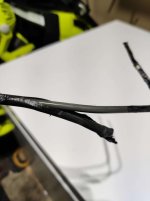
Attempted it again with a sharper blade and that was the problem, after I made an incision, I was able to peel it off. Line looks brand new underneath.
 

Attachments

  • rn_image_picker_lib_temp_f4213880-c7a0-4320-ac9f-8c17561e2394.jpg
    rn_image_picker_lib_temp_f4213880-c7a0-4320-ac9f-8c17561e2394.jpg
    31.1 KB · Views: 608
Buy a 25’ coil of NiCopp brake line and replace the part you took off. It wont corrode and easy to form. That old steel line will be difficult to flare and will rust at every point you nicked the painted surface. Do it once and do it right. That coil of NiCopp is $25. 4Lifetimelines.com
 
Buy a 25’ coil of NiCopp brake line and replace the part you took off. It wont corrode and easy to form. That old steel line will be difficult to flare and will rust at every point you nicked the painted surface. Do it once and do it right. That coil of NiCopp is $25. 4Lifetimelines.com

I did that with both of the rear lines, this line is the one running on the frame rail right near the gas tank, annoying to remove, so will likely patch/splice this one for now. I also have another headache and ended up snapping the front gas tank strap bolt while trying to replace the straps, rear one came out fine though. Nice to know the rubber coating did its job, also, I plan on using some thick shrink tubing that seems similar to this rubber coating they applied to cover the exposed steel.
 
I did that with both of the rear lines, this line is the one running on the frame rail right near the gas tank, annoying to remove, so will likely patch/splice this one for now. I also have another headache and ended up snapping the front gas tank strap bolt while trying to replace the straps, rear one came out fine though. Nice to know the rubber coating did its job, also, I plan on using some thick shrink tubing that seems similar to this rubber coating they applied to cover the exposed steel.

For a better seal than shrink tubing, get some rubber dip for tool handles, probably as close as you will get to the original coating.

Make sure the connections are not leaking before sealing them.

rubber dip for tool handles - Search
 
For a better seal than shrink tubing, get some rubber dip for tool handles, probably as close as you will get to the original coating.

Make sure the connections are not leaking before sealing them.

rubber dip for tool handles - Search

I've used plasti-dip in the past before, you'd need a few coats to have a thick layer, I did find some pretty thick shrink tubing that seems like it would work pretty well.

Wirefy 3/16" Heat Shrink Tubing - 3:1 Ratio - Adhesive Lined - Marine Grade Heat Shrink - Black - 50 Feet Roll: Amazon.com: Industrial & Scientific
 
You can wrap silicone tape around it. Its self sealing/adhering. Why not feed NiCopp tubing along the same path as the old line? You dont have to remove the old one, just cut off the ends for clearance. Then zip tie them together.

Sounds like you will need to drill out the old bolt. Thats never fun

XFasten Silicone Self Fusing Tape 1-Inch x 36-Foot (Red) Silicone Repair Tape: Amazon.com: Industrial & Scientific


It's a very tight spot for the ones running next to the gas tank, if you take a peek, you'll see what I'm referring to. It also clips into a bracket to prevent rubbing on the frame or gas tank, so you do need to remove the old line. I'm slowly draining out the gas tank to pour into my other vehicle to see how much clearance I'll have by dropping it a bit, if there's enough room for me to remove the old line, I'll likely end up replacing both lines and may just buy OEM lines for convenience purposes + the rubber coating did do its job as seen in my picture. Then I may just use the silicone tape to wrap the bare ends on the OEM line.
 

Members online

Forum statistics

Threads
278,309
Messages
3,554,070
Members
248,016
Latest member
Advally Service

Trending content

Back
Top