Is it worth the money to get the K&N air filter?? I have heard mixed opinions. Some say it increased horsepower and gas milage. Others say it actually lost horsepower. And finally, someone at the autoparts store said, he would not put it in because the chance of the filter oil getting in your engine. I just wanted to hear my fellow 4 runner owner's opinions about it.

You are using an out of date browser. It may not display this or other websites correctly.
You should upgrade or use an alternative browser.
You should upgrade or use an alternative browser.
K&N air filter ???????
- Thread starter loudog2
- Start date
Register to hide this ad
Basically it is a over-priced gimick that is widely promoted on the boards.
They make all sorts of wild claims like 20 more HP and etc., in reality it
does nothing and is an inferior filter. This along with the throttle body
spacers have to be one of the all time rip-offs.
Cliff s
They make all sorts of wild claims like 20 more HP and etc., in reality it
does nothing and is an inferior filter. This along with the throttle body
spacers have to be one of the all time rip-offs.
Cliff s

Border411
New member
Cliff s said:Basically it is a over-priced gimick that is widely promoted on the boards.
They make all sorts of wild claims like 20 more HP and etc., in reality it
does nothing and is an inferior filter. This along with the throttle body
spacers have to be one of the all time rip-offs.
Cliff s
Um...Cliff...have you even TRIED the K&N air filter????
I installed mine after 3k miles. For the first 3k I averaged 17MPG going to and from work, and taking a few trips to NY to visit my family.
I then installed the K&N filter and did the same thing, trying to maintain the same speeds and such. I then averaged 19.6MPG, and I am getting 23.5 mpg on the highway doing 75-80MPH! Not to mention my 0-60 time decreased 0.3 seconds. I did this test just by using a GTECH performance computer that I borrowed from a friend. I also made sure it was the same temp out both times I did it.
As an added bonus, it also filters more dirt out of the air, and is reusable. Add up how much a stock air filter is and how many times you would change it. If you change it more than just a few times during the life of the truck (I hope you would) then it has already become cheaper than a crappy paperfilter.

Bobby
New member
I upgraded the intake on my M3 a few years ago and there were a bunch of guys testing the different filters out there. K&N was the worst, letting the most particulates (fine dust) thru the filter into the engine. That's why I would never use one.
The stock filter is very restrictive but since I bought my 4runner, I plan on keeping it a long time so I won't risk killing the engine to get 0.3 sec 0-60 (it's a SUV). The mpg could be attributed to what most others experienced which is that it increases with usage.
Border411 - Glad you're happy with it but don't tell people that it filters more dust when it really doesn't. I don't have the test results but the test was done by Jim Conforti before manufacturing his intake kit to see what would work best.
The stock filter is very restrictive but since I bought my 4runner, I plan on keeping it a long time so I won't risk killing the engine to get 0.3 sec 0-60 (it's a SUV). The mpg could be attributed to what most others experienced which is that it increases with usage.
Border411 - Glad you're happy with it but don't tell people that it filters more dust when it really doesn't. I don't have the test results but the test was done by Jim Conforti before manufacturing his intake kit to see what would work best.
Border411
New member
If it let in MORE dust, wouldnt it void the warranty? I havent heard of any K&N being singled out for causing engine damage by any manufacturer. That is because they conform to ALL requirements set forth by the federal government as well as automotive manufacturers. They DO filter out down to 5.5 micron dust particles (and sometimes even smaller), and they are telling the truth when they say that most automotive engines are harmed by particles in the 10-20 micron range. A few of my friends who where Engineers at RPI (top 10 engineering school in the country) also did air flow and filtration tests in a controlled environment with many different brands of filters, and they found that K&N actually outperfomed the stock airfilters. However, this was based on testing 4 different OEM filters from Ford, GM, Honda, and Chrysler...not Toyota or BMW. The K&N outflowed and outfiltered ALL of these. I havent seen any SPECIFIC test as to the filtration of the stock airfilter in the 4th gen 4runner, so I was wrong in suggesting that it definitely would filter out more particulants from the air. But you cant also say that it wouldnt. I have always used K&N filters, and always will.
On another note, I doubt the increase in performance could be attributed to the "breaking in" of the vehicle as stated above, as a 3mpg gain (as seen by resetting the "average" mileage reading on the dash) was seen IMMEDIATELY after installing it, just like the 0-60 figure. I doubt it broke in within 20 miles of driving with the new filter.
In closing, K&N is a quality product and has worked great for me in all of the cars I have installed it in. I have had no problems, with one vehicle reaching 185k miles when I sold it with a K&N in it since it was new. You decide for yourself. If you dont feel comfortable putting it in, then dont.
On another note, I doubt the increase in performance could be attributed to the "breaking in" of the vehicle as stated above, as a 3mpg gain (as seen by resetting the "average" mileage reading on the dash) was seen IMMEDIATELY after installing it, just like the 0-60 figure. I doubt it broke in within 20 miles of driving with the new filter.
In closing, K&N is a quality product and has worked great for me in all of the cars I have installed it in. I have had no problems, with one vehicle reaching 185k miles when I sold it with a K&N in it since it was new. You decide for yourself. If you dont feel comfortable putting it in, then dont.
Bobby
New member
I don't have the test results but this is the exchange from a few years back....
=========================
Jim Conforti (AKA the Land Shark) did some testing:
This was a scientific test, not one done by filter manufacturer X to show that their filters are better than manufacturer Y. The test results are pretty irrefutable as the test lab tests and designs filters where "screw ups" are absolutely NOT allowable (I can't say any more for security. Think "Glow in the Dark").
A scientific test was done on TEST filters where air was loaded with ACCTD (some standardized "test dust" called AC Coarse Test Dust) and sucked through the TEST filter then through an analysis membrane. From the Quantity of dust injected and the amount that gets through the TEST filter and is then captured on the analysis membrane we can calculate the efficiency of the TEST filter in Question.
BMW Stock Filter, Eff. Area of Media: 8.4 sq ft.
K&N Replacement, Eff. Area of Media: 1.6 sq ft.
The filters are the SAME size. They both fit in the STOCK BMW M3 airbox. The difference is that the STOCK filter has 65 pleats 1.5" deep and the K&N only 29 pleats each 0.75" deep.
Now, remember this ratio: " 5.25:1". It's the ratio of the AREA of STOCK to K&N. It's very important and will come into play later.
The STOCK filter efficiency started at 93.4% at 0 loading and increased to 99.2% efficiency as the loading increased to a max tested of 38.8 gm/sq ft of dust.
The K&N filter efficiency started at 85.2% at 0 loading and increased to 98.1% at the max tested loading of 41.38 gm/sq ft.
Now, I hear you. "Jim, that's only a FEW PERCENT". But is it?
Let's look. If we had 100 grams of dust on a new BMW filter we would let through a total of 6.6 grams of dust in. If we used the new K&N filter we get 14.8 grams of dust. That's 224% (TWO HUNDRED TWENTY FOUR PERCENT!!) more dust ingested initially, stock vs. "free flow" and this ratio is pretty much held. Somewhere between 200-300% more dirt gets "ingested" anywhere across loading equivalence. The more INTERESTING thing is when you look at what happens to the DP or Differential Pressure at a constant airflow as you dirty both filters equally with time.
The test used a rate of 75gr of dust per 20 min. Here's where the AREA difference comes MAJORLY into play. See, even though the BMW filter flows a bit less at the SAME loading, it also LOADS UP 5.25 times SLOWER due to it's LARGER effective area. So what happens is that the K&N initially flows better, but as the dirt continues coming in, the K&N eventually flows WORSE while still letting MORE dirt in.
Now, does any of this additional dirt cause problems? I dunno. I suppose we could have a few people do some independent oil analyses on different motors using both K&Ns and Stock filters. Get enough of them, and you'd have a good statistical basis. For me though, it's simple: More DIRT = BAD.
The additional short-term airflow might make sense on a track car. IMHO, it doesn't for the street.
-- Jim Conforti
K&N Response:
It is incorrect. The difference between 99.2% and 98.1% (his results) is 1.1% not 224% as he states!!! (bmwE34.net: who didn't go to school, Jim was measuring the amount of dust that goes inside the engine). Furthermore, does he realize that 96% meets OEM standards? K&N has been around for over 30 years and we sell over 2,000,000 units a year. If there were any sort of problem, one would think we would know by now and so would everyone else. One Internet "expert's" opinion is not reason for concern and should be taken loosely at best.
That information is 100% untrue. Don't believe all you read on the Net. Most is opinions not based on any sort of factual evidence. Our filters are tested by an outside, independent laboratory. They have been proven to stop at least 99% of particles on a SAE dust test. This test uses particles as low as the 0 - 5 micron range and goes up to 20 microns.
For comparison, a paper filter also stops 99% on the same test and the OEM minimum standard is 96%. Foam is generally the worst media with a typical efficiency rating of 75 - 85%. To get higher ratings, the foam must be more dense and therefore way more restrictive. The "tack" characteristic of a K&N allows for increase filtration without loss of flow as well. The testing procedure used is SAE J-726 using ISO Test Dust.
This test is the standard of the air filter industry. The test procedure consists of flowing air through the filter at a constant rate (airflow rate is determined by the application) while feeding test dust into the air stream at a rate of 1 gram per cubic meter of air.
As the filter loads with dust the pressure drop across the
filter is increased to maintain the prescribed airflow rate. The test is continued until the pressure drop increases 10" H2O above the initial restriction of the clean element (in this case .78" to 10.78" H2O). At this point the test is terminated. The dirty filter element is then weighed. This weight is compared to the clean element weight to determine the total Dust
Capacity. The amount of dust retained by the filter is divided by the total amount of dust fed during the test to determine the Cumulative Efficiency.
The K&N filter achieved the following results:
- Dust Capacity: 305grams
- K&N Cumulative Efficiency: 99.05 %
Holding the filter to the light is useless, pin holes are normal.
That is what makes a K&N filter. There are actually hundreds of microscopic fibers that cross these holes and when treated with oil, capture and hold the very fine particles. On the same hand, they allow the filter to flow more air than paper or foam. The filter is 4 ply cotton gauze unlike some competitors synthetic material filters. The synthetics do not
have the very small fibers that natural cotton does. Also, the oil can be pulled off of a foam filter contaminating electronic sensors. It will absorb into cotton and stay in the media. In fact, Honda and Toyota only recommend K&N filters when using aftermarket high flow filters as K&N is the only brand of filter the oil does NOT come off of. They will not cover a failed sensor if foam filters were used.
We got started over 30 years ago making filters for motorcycles and off road racers. The filters did so well that these guys wanted them for their cars and trucks. We started making filters for these applications and here we are today. If they did not work, we would not still be here and growing every year.
We now make filters for Chrysler/Mopar, Ford Motorsports, Edelbrock, Rotax Engines, and Harley Davidson. We come as original equipment on the 2000 Ford Mustang Cobra-R. We even made filters for the Apache helicopters used in Desert Storm because of maintenance problems with the original paper design. If they work in these conditions they will work for you.
Rick from knfilters.com (Information emailed by Martin)
=====================
=========================
Jim Conforti (AKA the Land Shark) did some testing:
This was a scientific test, not one done by filter manufacturer X to show that their filters are better than manufacturer Y. The test results are pretty irrefutable as the test lab tests and designs filters where "screw ups" are absolutely NOT allowable (I can't say any more for security. Think "Glow in the Dark").
A scientific test was done on TEST filters where air was loaded with ACCTD (some standardized "test dust" called AC Coarse Test Dust) and sucked through the TEST filter then through an analysis membrane. From the Quantity of dust injected and the amount that gets through the TEST filter and is then captured on the analysis membrane we can calculate the efficiency of the TEST filter in Question.
BMW Stock Filter, Eff. Area of Media: 8.4 sq ft.
K&N Replacement, Eff. Area of Media: 1.6 sq ft.
The filters are the SAME size. They both fit in the STOCK BMW M3 airbox. The difference is that the STOCK filter has 65 pleats 1.5" deep and the K&N only 29 pleats each 0.75" deep.
Now, remember this ratio: " 5.25:1". It's the ratio of the AREA of STOCK to K&N. It's very important and will come into play later.
The STOCK filter efficiency started at 93.4% at 0 loading and increased to 99.2% efficiency as the loading increased to a max tested of 38.8 gm/sq ft of dust.
The K&N filter efficiency started at 85.2% at 0 loading and increased to 98.1% at the max tested loading of 41.38 gm/sq ft.
Now, I hear you. "Jim, that's only a FEW PERCENT". But is it?
Let's look. If we had 100 grams of dust on a new BMW filter we would let through a total of 6.6 grams of dust in. If we used the new K&N filter we get 14.8 grams of dust. That's 224% (TWO HUNDRED TWENTY FOUR PERCENT!!) more dust ingested initially, stock vs. "free flow" and this ratio is pretty much held. Somewhere between 200-300% more dirt gets "ingested" anywhere across loading equivalence. The more INTERESTING thing is when you look at what happens to the DP or Differential Pressure at a constant airflow as you dirty both filters equally with time.
The test used a rate of 75gr of dust per 20 min. Here's where the AREA difference comes MAJORLY into play. See, even though the BMW filter flows a bit less at the SAME loading, it also LOADS UP 5.25 times SLOWER due to it's LARGER effective area. So what happens is that the K&N initially flows better, but as the dirt continues coming in, the K&N eventually flows WORSE while still letting MORE dirt in.
Now, does any of this additional dirt cause problems? I dunno. I suppose we could have a few people do some independent oil analyses on different motors using both K&Ns and Stock filters. Get enough of them, and you'd have a good statistical basis. For me though, it's simple: More DIRT = BAD.
The additional short-term airflow might make sense on a track car. IMHO, it doesn't for the street.
-- Jim Conforti
K&N Response:
It is incorrect. The difference between 99.2% and 98.1% (his results) is 1.1% not 224% as he states!!! (bmwE34.net: who didn't go to school, Jim was measuring the amount of dust that goes inside the engine). Furthermore, does he realize that 96% meets OEM standards? K&N has been around for over 30 years and we sell over 2,000,000 units a year. If there were any sort of problem, one would think we would know by now and so would everyone else. One Internet "expert's" opinion is not reason for concern and should be taken loosely at best.
That information is 100% untrue. Don't believe all you read on the Net. Most is opinions not based on any sort of factual evidence. Our filters are tested by an outside, independent laboratory. They have been proven to stop at least 99% of particles on a SAE dust test. This test uses particles as low as the 0 - 5 micron range and goes up to 20 microns.
For comparison, a paper filter also stops 99% on the same test and the OEM minimum standard is 96%. Foam is generally the worst media with a typical efficiency rating of 75 - 85%. To get higher ratings, the foam must be more dense and therefore way more restrictive. The "tack" characteristic of a K&N allows for increase filtration without loss of flow as well. The testing procedure used is SAE J-726 using ISO Test Dust.
This test is the standard of the air filter industry. The test procedure consists of flowing air through the filter at a constant rate (airflow rate is determined by the application) while feeding test dust into the air stream at a rate of 1 gram per cubic meter of air.
As the filter loads with dust the pressure drop across the
filter is increased to maintain the prescribed airflow rate. The test is continued until the pressure drop increases 10" H2O above the initial restriction of the clean element (in this case .78" to 10.78" H2O). At this point the test is terminated. The dirty filter element is then weighed. This weight is compared to the clean element weight to determine the total Dust
Capacity. The amount of dust retained by the filter is divided by the total amount of dust fed during the test to determine the Cumulative Efficiency.
The K&N filter achieved the following results:
- Dust Capacity: 305grams
- K&N Cumulative Efficiency: 99.05 %
Holding the filter to the light is useless, pin holes are normal.
That is what makes a K&N filter. There are actually hundreds of microscopic fibers that cross these holes and when treated with oil, capture and hold the very fine particles. On the same hand, they allow the filter to flow more air than paper or foam. The filter is 4 ply cotton gauze unlike some competitors synthetic material filters. The synthetics do not
have the very small fibers that natural cotton does. Also, the oil can be pulled off of a foam filter contaminating electronic sensors. It will absorb into cotton and stay in the media. In fact, Honda and Toyota only recommend K&N filters when using aftermarket high flow filters as K&N is the only brand of filter the oil does NOT come off of. They will not cover a failed sensor if foam filters were used.
We got started over 30 years ago making filters for motorcycles and off road racers. The filters did so well that these guys wanted them for their cars and trucks. We started making filters for these applications and here we are today. If they did not work, we would not still be here and growing every year.
We now make filters for Chrysler/Mopar, Ford Motorsports, Edelbrock, Rotax Engines, and Harley Davidson. We come as original equipment on the 2000 Ford Mustang Cobra-R. We even made filters for the Apache helicopters used in Desert Storm because of maintenance problems with the original paper design. If they work in these conditions they will work for you.
Rick from knfilters.com (Information emailed by Martin)
=====================


It always amazes me how the snake oil purveyor's pop out of the woodwork on the forums.
I will tell a little story which will make my point. About 25 years ago there was a guy named
Franz who did alot of promoting of his revolutionary oil filter, well what was it. It seems as
though a standard roll of toilet paper will fit into the replacement Fram oil filter can. He
repainted these and sold them for $49.95, without the toilet paper. It cost him about $6.00
for the filter can. All the magazines at the time raved how this was so great. I owned a motor
shop then and the motors came rolling in, the toilet paper plugged all the oil galleys and
ruined many motors. Of course Franz disappeared and left everyone holding the bag.
This legend lives on, as it wasn't a couple of months ago I saw the same filter advertised for trucks.
Snake oil has been around forever and so are all the wild claims. One article I read claimed that the
K&N gave 30 more HP and 15 more MPG. I real truth is the oil filled filter was abandonded by auto
manufactuers about 1950. All that happens is the dirt sticks to the oil and clogs the filter. But then
again with enough hype you can sell anything. Since the air intake system is part of the emissions
system it is questionable whether tampering with it is legal(California approval is only good in CA.).
I would not be surprised if the auto manufacturers would deny a warranty claim if they found one installed
and I don't think K&N will give you a new motor.
Cliff s
I will tell a little story which will make my point. About 25 years ago there was a guy named
Franz who did alot of promoting of his revolutionary oil filter, well what was it. It seems as
though a standard roll of toilet paper will fit into the replacement Fram oil filter can. He
repainted these and sold them for $49.95, without the toilet paper. It cost him about $6.00
for the filter can. All the magazines at the time raved how this was so great. I owned a motor
shop then and the motors came rolling in, the toilet paper plugged all the oil galleys and
ruined many motors. Of course Franz disappeared and left everyone holding the bag.
This legend lives on, as it wasn't a couple of months ago I saw the same filter advertised for trucks.
Snake oil has been around forever and so are all the wild claims. One article I read claimed that the
K&N gave 30 more HP and 15 more MPG. I real truth is the oil filled filter was abandonded by auto
manufactuers about 1950. All that happens is the dirt sticks to the oil and clogs the filter. But then
again with enough hype you can sell anything. Since the air intake system is part of the emissions
system it is questionable whether tampering with it is legal(California approval is only good in CA.).
I would not be surprised if the auto manufacturers would deny a warranty claim if they found one installed
and I don't think K&N will give you a new motor.
Cliff s
thank you Bobby. Someone else told me that the biggest problem with those filters is the people who buy them. A lot of times the filters are either under or over oiled. Over oiled would be bad for a turbo or a super charger, and the engine if too much was on it. And under oiled would collect less dirt. This maked a little sense. But I guess people can use what they want for their vehicle. I think I am just going to stay with the stock filter. All the cleaning and oiling sounds a little agravating. That is just my opinion. I am not saying anything bad to the people who use them.
Thank you all for the insight. I just didn't know if the extra $35 was worth it over the stock toyota filter.
Thank you all for the insight. I just didn't know if the extra $35 was worth it over the stock toyota filter.
Cliff, K&N has been around for a LONG time. Your oil filter analogy is invalid. If there is something seriously wrong with these filters, word would have been out a long time ago and you would NOT have major players suggesting their use.
Regarding the "scientific" test above, in order for any test to be "scientific", it MUST be reproducible by others. The test methodolgy should be published so that others can attempt to reproduce the results. If the test lab is unwilling to do this, they're not really practicing "science".
Having said all that, I personally would not get a K&N or any other after-market oil filter unless I saw REAL scientific results. Personal impressions are meaningless. Personal data regarding more perceived power, more mpg, better 0-60 times are next to meaningless.
Until it's proven, it's not.
Regarding the "scientific" test above, in order for any test to be "scientific", it MUST be reproducible by others. The test methodolgy should be published so that others can attempt to reproduce the results. If the test lab is unwilling to do this, they're not really practicing "science".
Having said all that, I personally would not get a K&N or any other after-market oil filter unless I saw REAL scientific results. Personal impressions are meaningless. Personal data regarding more perceived power, more mpg, better 0-60 times are next to meaningless.
Until it's proven, it's not.
Bobby
New member
I'm not putting down Border411's choice. I'm just playing devil's advocate. I did some research when I changed the stock air box/filter in my M3 to an ITG foam filter JimC intake kit. More than likely the particulates that the K&N filter allows won't damage the engine enough that you'll need a new engine but why take the chance?
I did a lot of mods on my M3 that I wouldn't recommend to others but those are the choices I made to increase handling and power. Of course any mod will have some consequences so do some homework before you proceed.
I did a lot of mods on my M3 that I wouldn't recommend to others but those are the choices I made to increase handling and power. Of course any mod will have some consequences so do some homework before you proceed.
Response
Frankly, both camps of folks who have posted are wrong. Check out Gadget's site for info on filters and his 4Runner :
http://www.gadgetonline.com/airinduction.htm#Modified Air Box:
Hi-flow air filters do in fact help an engine breath easier (much like a cold air intake or just opening up a stock air box.) Increased airflow can give a modest increase in horsepower, and if the stock breather on an engine is very restrictive, it can also help a little with fuel economy.
On the other hand, gains are very very small (for horsepower, too small to pick up without a dyno). And of the drop-in filter manufacturers, K&N is actually the worst (their filter medium is cotton). K&N does let in slightly more grit than a stock filter (which is made of paper). However, there are hi-flow foam filters that do a better job of filtering dust than either K&N or stock.
Both Amsoil and now TRD offer drop-in high-flow air filters (well, TRD does for Tacomas and previous generation 4Runners for sure). If you want a higher air flow filter, and want to keep the stock airbox, I'd go with TRD.
The only serious problem with the oils from the filters is that if you over-apply it, you can foul the MAF sensor in your airbox (it can be cleaned with acetone and a q-tip).
Frankly, both camps of folks who have posted are wrong. Check out Gadget's site for info on filters and his 4Runner :
http://www.gadgetonline.com/airinduction.htm#Modified Air Box:
Hi-flow air filters do in fact help an engine breath easier (much like a cold air intake or just opening up a stock air box.) Increased airflow can give a modest increase in horsepower, and if the stock breather on an engine is very restrictive, it can also help a little with fuel economy.
On the other hand, gains are very very small (for horsepower, too small to pick up without a dyno). And of the drop-in filter manufacturers, K&N is actually the worst (their filter medium is cotton). K&N does let in slightly more grit than a stock filter (which is made of paper). However, there are hi-flow foam filters that do a better job of filtering dust than either K&N or stock.
Both Amsoil and now TRD offer drop-in high-flow air filters (well, TRD does for Tacomas and previous generation 4Runners for sure). If you want a higher air flow filter, and want to keep the stock airbox, I'd go with TRD.
The only serious problem with the oils from the filters is that if you over-apply it, you can foul the MAF sensor in your airbox (it can be cleaned with acetone and a q-tip).
Last edited:
Border411
New member
Yet more good reading. I believe that everyone has the right to there own opinion, so I dont take any offense to any disagreeing with me. I will say this...if TRD came out with a high flow filter, I would quickly replce the K&N with that. However, it is like the smaller engine in every 4runner always seems to be slighted when it comes to TRD parts. Along with that, AMSOIL doesnt make one either.
There is a basic truth with aftermarket parts. The auto manufacturer has to put his money
where his mouth is, in other words he has to stand behind his product and fix it under his warranty.
The aftermarket folks don't have to do anything. The only way they have to prove their claims is in a court
of law. The FTC has taken on many of them and obtained injuctions against their wild claims.
When I built racing motors I had a steady stream of the hucksters call on the shop making wild claims.
We did analyze much of the snake oil and you would be surprised what is in it. One product which is still sold
and has been around for many years is nothing more than deoderized kerosene, which they sell for $4.00 a
quart. One major oil brand foamed just like a chocolate milkshake. I could go on and on.
We did many dyno runs to check the products. This was for our own use and not for public consumption.
We did not publish these results because of the costs involved with the testing(there ain't no free lunch).
I have since retired and it always pains me to see hard earned money wasted on junk. There are excellent products
on the market and most of them are on the dealers parts shelves. The auto manufacturers have spent billions(yes,
with a B) of dollars on research to improve their products, they warranty them and stand behind them.
Another almost fraud is the so called CARB certification, well it is only good in the state of California and nowhere
else. This was put in to pacify SEMA. The phrase "50 state legal" means nothing.
Yes, I sold speed parts at the shop, but I made the customers sign on the invoice that these were to be used
for "OFF ROAD only". I pointed this out to them when they came back crying that they got a ticket or were rejected by
the DEQ.
Every vehicle owner is responsible for for his own vehicle and it complying to the various laws.
Cliff s
where his mouth is, in other words he has to stand behind his product and fix it under his warranty.
The aftermarket folks don't have to do anything. The only way they have to prove their claims is in a court
of law. The FTC has taken on many of them and obtained injuctions against their wild claims.
When I built racing motors I had a steady stream of the hucksters call on the shop making wild claims.
We did analyze much of the snake oil and you would be surprised what is in it. One product which is still sold
and has been around for many years is nothing more than deoderized kerosene, which they sell for $4.00 a
quart. One major oil brand foamed just like a chocolate milkshake. I could go on and on.
We did many dyno runs to check the products. This was for our own use and not for public consumption.
We did not publish these results because of the costs involved with the testing(there ain't no free lunch).
I have since retired and it always pains me to see hard earned money wasted on junk. There are excellent products
on the market and most of them are on the dealers parts shelves. The auto manufacturers have spent billions(yes,
with a B) of dollars on research to improve their products, they warranty them and stand behind them.
Another almost fraud is the so called CARB certification, well it is only good in the state of California and nowhere
else. This was put in to pacify SEMA. The phrase "50 state legal" means nothing.
Yes, I sold speed parts at the shop, but I made the customers sign on the invoice that these were to be used
for "OFF ROAD only". I pointed this out to them when they came back crying that they got a ticket or were rejected by
the DEQ.
Every vehicle owner is responsible for for his own vehicle and it complying to the various laws.
Cliff s
http://www.gadgetonline.com/airinduction.htm does a good job of refuting the claims for the K&N filter.
97RUNNERltd
New member
Would you pick the TRD filter over the AMSoil filter?

navyaircrew
New member
4th gen air fliter
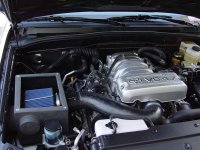
Hey guys, i just wanted to put a plug in for VOLANT Cold Air intakes.... I have been running the proto-type cold air intake on my truck and it has increased my fuel mileage and horsepower... i don't know how much horsepower.... i am also running a magnaflow muffler and i cut off the quiet baffler on the end of the exhaust system..... Volant is making the final molds now and should ship mine to me in one week... Hector was working with me... any resaler that sells volant can get these kits.... it is really superior to K&N by far... the entire air filter is inside an box... so, water crossings, mud baths... don't get this filter all dirty... just my 2 cents...
Hey guys, i just wanted to put a plug in for VOLANT Cold Air intakes.... I have been running the proto-type cold air intake on my truck and it has increased my fuel mileage and horsepower... i don't know how much horsepower.... i am also running a magnaflow muffler and i cut off the quiet baffler on the end of the exhaust system..... Volant is making the final molds now and should ship mine to me in one week... Hector was working with me... any resaler that sells volant can get these kits.... it is really superior to K&N by far... the entire air filter is inside an box... so, water crossings, mud baths... don't get this filter all dirty... just my 2 cents...
Attachments

TranceKrayz
New member
finally!! how does it sound with the exhaust? not too loud i hope. you've got the setup i want. oh yea....will it work on a V6???
