
KDSS Long term reliability?

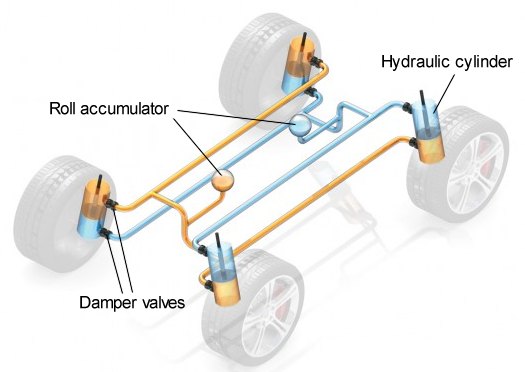
A fluid pressure equilibrium in both chambers (up and down) will result in the cylinder wanting to extend and therefore applying a force to the sway bar. Same front and rear. The reason for this is that the cylinder is a single ended cylinder rather than a double ended one. By that I mean that it only extends the shaft in one direction. The result of that is that the internal area where hydraulic force is applied is greater on the top side of the cylinder than it is on the bottom side of the cylinder. The difference in area where force is applied is equal to the cross section area of the shaft. KDSS cylinders have relatively large shaft diameter compared to overall internal cylinder diameter.

So - as a result of having more area with applied force on one side - if the pressures in the system are balanced, the cylinder will try to extend. This is the same reason that all gas charged shock absorbers always seek to extend. If your shocks had a 20mm diameter shaft and 400psi - they'd push with about the same force as KDSS when balanced in pressure top/bottom.

If it were a free cylinder with nothing stopping it - it would extend until the force on both sides balance (but the pressures would not be balanced). In this case the cylinders extend until the additional force trying to extend them is balanced by the force resisting extension. That force is gravity pushing down on vehicle body and the sway bar force up against the cylinder. So the result is that it pushes the body up with a force of about 200-300lbs. And it creates a lean in the same way that a spring with 200lb of force would do on that side.

What is happening when you compress one cylinder all the way closed (rear by jacking), and presumably keep the front somewhat compressed, is that you're effectively increasing the oil volume in the lower chamber and decreasing the volume of the upper chamber as a net effect. Then you balance the pressure. When it settles back after closing the chambers, the upper chamber ends up with a lower pressure (because you've moved some of the oil from the upper chamber to the lower chamber). Then the system can reach an equilibrium of force that applies less "push" on each cylinder to cause the lean.

The reason it probably goes back to a lean after a short time is that the system likely bleeds pressure between chambers anyway. Either around one of the cylinder pistons, or possibly by not having the shutter valves tight enough. Either way - over time at the pressures run in the KDSS system (often exceeding 1,000psi), it will likely return to its original state of lean.

The best long term fix is with springs to offset the force of KDSS. IN a perfect world, Toyota would use double ended hydraulic cylinders and the balance would always remain neutral. That's what McLaren does with its KDSS sysetm. - Not sure if you know, but Mclaren uses KDSS in its supercars, but it uses a double ended ram with neutral force on all 4 corners.
Tenneco_Kinetic_1.jpg


Toyota also uses an even more complex system in the LX570
1468652


(I think earlier I said single acting - it's double acting, but single ended)

Wow this is great information, thanks for that Jetboy! No I wasn't aware it was used by Maclaren and the LX system was that complex, I'd say their repair bills would trump ours.

My understanding of the calibration was way off but its all coming together now, again thanks for explaining in layman's terms. I guess Toyota just shrug their shoulders and say 'it works doesn't it'. Much like when they say 20mm lean is within spec.

I actually installed a 6mm strut top spacer on my Prado two days ago and so far am very happy with the result. Lean has reduced from 20mm to about 3mm in the front. The 6mm plate fits perfectly on the stock strut with just enough thread left to do the nuts up properly. One day the wife will let me buy some 2" lifted suspension and I'll be able to sort it out with finer height adjustment, but for now it will do the job.
 
KDSS Removal?

hey all.

new to the forum. and, resurrecting this thread 3 years after the last post.

I have a deposit on a '13 Trail Edition (149k miles) - looking through the pictures from the dealer tonight, I noticed a small light on the dash: "KDSS".

Now, I'm waiting to hear back from the dealer if that light is on all the time.

(Dealer is based in OH, I'm in NC. So, there's quite a bit of time / $$ that'll be invested to get out there. Trying to weigh my options...)

My question:
IF there is an issue with KDSS, if that light is actually on, my understanding is if Toyota is to fix it, it'll be $2-$3k.

Both for now and the future, if the KDSS does go out, is there some way to simply remove it entirely?

My gut is no.
That the complexity means removal isn't really an option...
And, that removal is expensive as $**t.

Thanks all,

J
 
Last edited:
hey all.

new to the forum. and, resurrecting this thread 3 years after the last post.

I have a deposit on a '13 Trail Edition (149k miles) - looking through the pictures from the dealer tonight, I noticed a small light on the dash: "KDSS".

Now, I'm waiting to hear back from the dealer if that light is on all the time.

(Dealer is based in OH, I'm in NC. So, there's quite a bit of time / $$ that'll be invested to get out there. Trying to weigh my options...)

My question:
IF there is an issue with KDSS, if that light is actually on, my understanding is if Toyota is to fix it, it'll be $2-$3k.

Both for now and the future, if the KDSS does go out, is there some way to simply remove it entirely?

My gut is no.
That the complexity means removal isn't really an option...
And, that removal is expensive as $**t.

Thanks all,

J
Don't but a 10 year old car from the rust belt, KDSS is probably the least of its problems.
 
I am looking to buy a new 4Runner. I just read this whole thread. I still have no idea whether to get KDSS ...

It'll just be a daily and an occasional camping and hunting rig. I hate stuff that breaks. But most of the 4Runners in the trims I like seem to have it (TRD offroad and TRD offroad premium). Is it worth it to try that hard to find one that doesn't have it?
 
I am looking to buy a new 4Runner. I just read this whole thread. I still have no idea whether to get KDSS ...

It'll just be a daily and an occasional camping and hunting rig. I hate stuff that breaks. But most of the 4Runners in the trims I like seem to have it (TRD offroad and TRD offroad premium). Is it worth it to try that hard to find one that doesn't have it?

It's all a matter of opinion. Test drive 4Runners with and without KDSS, and decide. I personally wanted KDSS, and haven't regretted it.
 
It's all a matter of opinion. Test drive 4Runners with and without KDSS, and decide. I personally wanted KDSS, and haven't regretted it.

If it breaks, can you just turn it off and effectively have a stock 4Runner without KDSS?
 
ok. i dont see it as a make or break type thing in terms of whether we buy. would prefer without but not going to be a major factor. thanks!

That's good, helps with options. I specifically got it and love how KDSS handles and its advantages off road. Been fine so far.
 
The ORD I’m looking at has KDSS and I’m hoping it will last a very long time as well. I’m skeptical of these fancy systems in vehicles.
 
Same experience as [MENTION=50569]FlyNavy[/MENTION] on my (sold this week) 2010 OG TE w/ KDSS. Solid system & was a must have on the 2023 TRD ORP I just bought.
 
The ORD I’m looking at has KDSS and I’m hoping it will last a very long time as well. I’m skeptical of these fancy systems in vehicles.

It's definitely not fancy. No more or less reliable than most suspension systems nowadays. But it IS an additional item that adds the possibility, no matter how small.
 
Last edited:
My 2018 TRD OR developed a seep on the rear hydraulic ram at about 40k miles. I've continued to drive it. I'm not willing to pay the $2k or so the dealer wants to replace it, so at some point I plan to remove it.
 
My 2018 TRD OR developed a seep on the rear hydraulic ram at about 40k miles. I've continued to drive it. I'm not willing to pay the $2k or so the dealer wants to replace it, so at some point I plan to remove it.

Same here but mine failed under warranty still. 2018 Offroad
 
80k miles and I absolutely beat the crap out of it with a kdss +2 long travel setup and it works perfect. I feel like it’s going to last longer if you can keep valves open in the kdss system here and there.

a9b5a5ad34042b6f5f0238401dcf80fd.jpg


Sent from my iPhone using Tapatalk
 
My 2018 TRD OR developed a seep on the rear hydraulic ram at about 40k miles. I've continued to drive it. I'm not willing to pay the $2k or so the dealer wants to replace it, so at some point I plan to remove it.

If you remove it will you run with no sway bars or do you know of a conventional SB substitute?
 
My current plan is to replace the hydraulic ram with a fixed link that is constructed from the passenger side fixed link, i.e. cutting it in half and making it the same length as the hydraulic ram. While I would lose the travel provided by the hydraulic ram, I am thinking the result would be no worse than when the rams prevent travel. Anyway, if it works it will keep the same sway bar design and eliminate the need for a hack job that also results in way more sway. Someone elsewhere has speculated that this idea will result in a teeth chattering ride, and he may be right , but then again this is a sway bar drop link, not a shock absorber. Either way, I guess I'm going to find out. One last thing: I will try to not remove the rams completely, if possible, until I see how the rigid links work. The machine shop is taking its time, so I don't have the links yet. I will eventually post an update...
 
My current plan is to replace the hydraulic ram with a fixed link that is constructed from the passenger side fixed link, i.e. cutting it in half and making it the same length as the hydraulic ram. While I would lose the travel provided by the hydraulic ram, I am thinking the result would be no worse than when the rams prevent travel. Anyway, if it works it will keep the same sway bar design and eliminate the need for a hack job that also results in way more sway. Someone elsewhere has speculated that this idea will result in a teeth chattering ride, and he may be right , but then again this is a sway bar drop link, not a shock absorber. Either way, I guess I'm going to find out. One last thing: I will try to not remove the rams completely, if possible, until I see how the rigid links work. The machine shop is taking its time, so I don't have the links yet. I will eventually post an update...

I applaud your efforts! I also remember reading about how KDSS doesn't become fixed until a minimum lateral G load and/or steering rate is achieved, So presumably, straight ahead traveling acts like having no SB. Comfort could possibly be degraded while hitting deferential road imperfections (left side vs right side) when using fixed end links since the SB is so thick/stiff. Then there's the reservoir component contribution which I don't currently understand. It has a purpose but it's impact on ride harshness is not clear to me. Maybe it acts like a buffer when KDSS is in fixed mode?
 
Thanks for your feedback. I mostly drive on road, so I theorize (hope) that I shouldn't notice too much difference there. I do not rock crawl, so I'm not worried about reduced travel. As for dirt/sand/gravel who knows?
 

Members online

Forum statistics

Threads
278,307
Messages
3,554,050
Members
248,016
Latest member
Advally Service

Trending content

Back
Top