
woodkakado?
New member
A fluid pressure equilibrium in both chambers (up and down) will result in the cylinder wanting to extend and therefore applying a force to the sway bar. Same front and rear. The reason for this is that the cylinder is a single ended cylinder rather than a double ended one. By that I mean that it only extends the shaft in one direction. The result of that is that the internal area where hydraulic force is applied is greater on the top side of the cylinder than it is on the bottom side of the cylinder. The difference in area where force is applied is equal to the cross section area of the shaft. KDSS cylinders have relatively large shaft diameter compared to overall internal cylinder diameter.
So - as a result of having more area with applied force on one side - if the pressures in the system are balanced, the cylinder will try to extend. This is the same reason that all gas charged shock absorbers always seek to extend. If your shocks had a 20mm diameter shaft and 400psi - they'd push with about the same force as KDSS when balanced in pressure top/bottom.
If it were a free cylinder with nothing stopping it - it would extend until the force on both sides balance (but the pressures would not be balanced). In this case the cylinders extend until the additional force trying to extend them is balanced by the force resisting extension. That force is gravity pushing down on vehicle body and the sway bar force up against the cylinder. So the result is that it pushes the body up with a force of about 200-300lbs. And it creates a lean in the same way that a spring with 200lb of force would do on that side.
What is happening when you compress one cylinder all the way closed (rear by jacking), and presumably keep the front somewhat compressed, is that you're effectively increasing the oil volume in the lower chamber and decreasing the volume of the upper chamber as a net effect. Then you balance the pressure. When it settles back after closing the chambers, the upper chamber ends up with a lower pressure (because you've moved some of the oil from the upper chamber to the lower chamber). Then the system can reach an equilibrium of force that applies less "push" on each cylinder to cause the lean.
The reason it probably goes back to a lean after a short time is that the system likely bleeds pressure between chambers anyway. Either around one of the cylinder pistons, or possibly by not having the shutter valves tight enough. Either way - over time at the pressures run in the KDSS system (often exceeding 1,000psi), it will likely return to its original state of lean.
The best long term fix is with springs to offset the force of KDSS. IN a perfect world, Toyota would use double ended hydraulic cylinders and the balance would always remain neutral. That's what McLaren does with its KDSS sysetm. - Not sure if you know, but Mclaren uses KDSS in its supercars, but it uses a double ended ram with neutral force on all 4 corners.
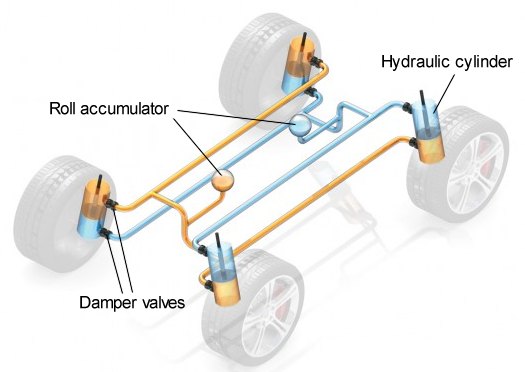
Toyota also uses an even more complex system in the LX570

(I think earlier I said single acting - it's double acting, but single ended)
Wow this is great information, thanks for that Jetboy! No I wasn't aware it was used by Maclaren and the LX system was that complex, I'd say their repair bills would trump ours.
My understanding of the calibration was way off but its all coming together now, again thanks for explaining in layman's terms. I guess Toyota just shrug their shoulders and say 'it works doesn't it'. Much like when they say 20mm lean is within spec.
I actually installed a 6mm strut top spacer on my Prado two days ago and so far am very happy with the result. Lean has reduced from 20mm to about 3mm in the front. The 6mm plate fits perfectly on the stock strut with just enough thread left to do the nuts up properly. One day the wife will let me buy some 2" lifted suspension and I'll be able to sort it out with finer height adjustment, but for now it will do the job.


