KDSS Long term reliability?

I don’t believe kdss has anything to do with nose dive or bouncy ride. Observations such as yours makes me question just what the hell kdss really does do.

And yet it has a lot to do with it.

Because of the way hydraulics work in this system, the sway bar will be pushing against the fluid, which will always make a difference, as there will always be pressure in the system.

whether or not the actuators are allowing fluid to pass through the system or not, there will always be pressure on the sway bar. The only thing the actuators do is increase and decrease the pressure that the sway bar acts against. When the actuators close, it increased the pressure, when open they decrease the pressure.

A thicker sway bar will have an effect on overall ride feel, not just body roll as someone else said. A thicker sway bar has more mass, and the additional mass will affect how the shocks feel, and how they transmit surface changes to the driver. If it didn't there would be no point in sway bars.

If you slam on the brakes, you will get a dose of nosedive. However, under normal stop and go traffic, the nosedive in a non-KDSS is still noticeable, where as in both of my KDSS equipped 4Runners, it's not nearly as noticable, to the point I don't even see it.
 
Last edited:
Not exactly more mass guaranteed from a larger sway. Minimal compared to other components, and small sways are often heavy/solid, and larger sways are just as heavy, but hollow. Just sayin.
 
Not exactly more mass guaranteed from a larger sway. Minimal compared to other components, and small sways are often heavy/solid, and larger sways are just as heavy, but hollow. Just sayin.

Larger diameter steel sway bar will weigh more than a smaller diameter steel sway bar. increased size=more material=more mass.

But with KDSS, you also have to factor in the resistance of the hydraulic system.
 
And yet it has a lot to do with it.

Because of the way hydraulics work in this system, the sway bar will be pushing against the fluid, which will always make a difference, as there will always be pressure in the system.

whether or not the actuators are allowing fluid to pass through the system or not, there will always be pressure on the sway bar. The only thing the actuators do is increase and decrease the pressure that the sway bar acts against. When the actuators close, it increased the pressure, when open they decrease the pressure.

A thicker sway bar will have an effect on overall ride feel, not just body roll as someone else said. A thicker sway bar has more mass, and the additional mass will affect how the shocks feel, and how they transmit surface changes to the driver. If it didn't there would be no point in sway bars.

If you slam on the brakes, you will get a dose of nosedive. However, under normal stop and go traffic, the nosedive in a non-KDSS is still noticeable, where as in both of my KDSS equipped 4Runners, it's not nearly as noticable, to the point I don't even see it.

That’s all news to me. For 45 years I was always under the impression that sway bars only worked to reduce side to side movement. I fail to see how it would have any impact on fore and aft movement. Of course, I am a little behind the times because I’ll take a turbocharged 6 over a V8 any day of the week.
 
That’s all news to me. For 45 years I was always under the impression that sway bars only worked to reduce side to side movement. I fail to see how it would have any impact on fore and aft movement. Of course, I am a little behind the times because I’ll take a turbocharged 6 over a V8 any day of the week.

Most swaybars have no impact on nose dive. I'm not sure where he is coming up with this theory about sway bars.. it is clearly not based in physics or a traditional swaybar design or tuning. While coming into a corner.. yes, but not what is being talked about here.

A sway bar allows the suspension to cycle free of obstruction as long as both wheels are moving in unison (hitting the brakes on flat ground...) It does come into play as soon as you start dealing with dynamic loads corners/uneven bumps... The swaybar and spring rates need to match up because of this.

KDSS is however connected and shaped differently than most sway bars. It seems to have some type resistance to compression and droop as it is not on a free floating link with the suspension. Just look at it. It does not take an expert to see that it's not working like a regular swaybar. Even if you locked the frame link into position.. it's different. Almost like a bad swaybar design, but the floating piston sort of makes up for it. The front and rear of it are also very different where most swaybars are pretty much the same front to rear with just different thickness and leverage.

On two totally stock trucks with factory suspension.. it seems the KDSS is acting to increase spring rates at least upfront.. even when going in a straight line on an even surface. Yet, some claim it still has bad nose dive.. so I don't know for sure. As soon as you throw on an different set of coil overs.. everything is different anyway.
 
Last edited:
Most swaybars have no impact on nose dive. I'm not sure where he is coming up with this theory about sway bars.. it is clearly not based in physics or a traditional swaybar design or tuning. While coming into a corner.. yes, but not what is being talked about here.

A sway bar allows the suspension to cycle free of obstruction as long as both wheels are moving in unison (hitting the brakes on flat ground...) It does come into play as soon as you start dealing with dynamic loads corners/uneven bumps... The swaybar and spring rates need to match up because of this.

KDSS is however connected and shaped differently than most sway bars. It seems to have some type resistance to compression and droop as it is not on a free floating link with the suspension. Just look at it. It does not take an expert to see that it's not working like a regular swaybar. Even if you locked the frame link into position.. it's different. Almost like a bad swaybar design, but the floating piston sort of makes up for it. The front and rear of it are also very different where most swaybars are pretty much the same front to rear with just different thickness and leverage.

On two totally stock trucks with factory suspension.. it seems the KDSS is acting to increase spring rates at least upfront.. even when going in a straight line on an even surface. Yet, some claim it still has bad nose dive.. so I don't know for sure. As soon as you throw on an different set of coil overs.. everything is different anyway.

stock ours had a bunch of nose dive. with 6112's it still has bunch of nose dive.:girl:
 
stock ours had a bunch of nose dive. with 6112's it still has bunch of nose dive.:girl:

Well, there is one view on it... It really is amazing how different peoples perceptions are. I keep forgetting that. :confused:

BTW, change the springs and it will stop nose diving....but you may get other negative characteristics with it. It's always a set of compromises....
 
Last edited:
When people ask me what KDSS is, after they had a near death experience in my vehicle b/c I took a turn too fast....i say its some voodoo magic. I don't quite understand it, but it works.

At the same time, I curse KDSS when I'm driving on washboard roads.
 
And yet it has a lot to do with it.

Because of the way hydraulics work in this system, the sway bar will be pushing against the fluid, which will always make a difference, as there will always be pressure in the system.

whether or not the actuators are allowing fluid to pass through the system or not, there will always be pressure on the sway bar. The only thing the actuators do is increase and decrease the pressure that the sway bar acts against. When the actuators close, it increased the pressure, when open they decrease the pressure.

A thicker sway bar will have an effect on overall ride feel, not just body roll as someone else said. A thicker sway bar has more mass, and the additional mass will affect how the shocks feel, and how they transmit surface changes to the driver. If it didn't there would be no point in sway bars.

If you slam on the brakes, you will get a dose of nosedive. However, under normal stop and go traffic, the nosedive in a non-KDSS is still noticeable, where as in both of my KDSS equipped 4Runners, it's not nearly as noticable, to the point I don't even see it.
KDSS will only have an influence on nosedive to one corner, for example when turning at speed or maneuvering when braking. The KDSS cylinders are only on one side of the sway bar.

You are describing a system more similar to XREAS

Sent from my SM-G930V using Tapatalk
 
IMHO: this thread obviously got “sideways” from its original tile… I think it is mainly because most of us are not able to change personal perspective or point of views even when others have a valid point… but that is a fact of life and applies to most of things not just “KDSS”….

That thread reminds me of many heated and mostly pointless discussion on 4th gen sections about V6 vs. V8 models… each engine had their advantages and disadvantages, but on the end of the day, they were just different as most of V6 vs. V8 engines… but people would forget those inherited design difference and jump right into personal opinions, subjective feelings, needs/wants and what is better … followed by insults at each other…
I believe that is what happening here, as suspension with KDSS and without is just that: different-which makes it “better” or “worse” depending on personal needs…
And since this is still somewhat free country, anyone can choose to have KDSS or not- but it should not be followed by insults or attempts to change what other people need from their personal vehicle choice…

I personally chose to have KDSS because I like the feel of it on the road (a LOT more stable and controllable ride vs. non KDSS)… I also know, there is no other dynamic suspension exist that would suites MY needs better on the road… additional “off-road KDSS” benefits is just a BIG plus... again for my needs: over-landing family trips and off-roading during hunting season … I totally understand why KDSS is not the right choice for others…

I have not read through all 22 pages here, so maybe I have missed some data points, but considering that this thread has started on the beginning of 2013, bearing in mind that 4runners with KDSS now being around 10 years mark and that KDSS was and still used in my other Toyota\Lexus vehicles - one thing is evident to me: 4Runner KDSS is definitely reliable… at least relatively (as everything is) to all other major and complex components of 4runner (or any other semi modern vehicle).

Cheers!
 
Last edited:
KDSS will only have an influence on nosedive to one corner, for example when turning at speed or maneuvering when braking. The KDSS cylinders are only on one side of the sway bar.

You are describing a system more similar to XREAS

Sent from my SM-G930V using Tapatalk

Just one comment about the cylinder only being on one side. I'm not sure how much that matters.

Even though there are different motion ratios from side to side.. Since the piston is free floating the energy of the bar can be absorbed into the piston vs transferred to the other wheel regardless of what side it is on... But there does seem to be a different motion ratio depending on what side the energy is being generated from. I don't know if that really matters if the system is just letting the fluid move in and out of the accumulators in almost a free flow/open mode`.

Once again. I think we are back to it's not really that well understood.

At a basic level.. it's pretty obvious what is going on.. but I think there are some subtle things that have additional impact to the behavior. I know I keep realizing additional factors that could be at play as time goes on.
 
Just one comment about the cylinder only being on one side. I'm not sure how much that matters.

Even though there are different motion ratios from side to side.. Since the piston is free floating the energy of the bar can be absorbed into the piston vs transferred to the other wheel regardless of what side it is on... But there does seem to be a different motion ratio depending on what side the energy is being generated from. I don't know if that really matters if the system is just letting the fluid move in and out of the accumulators in almost a free flow/open mode`.

Once again. I think we are back to it's not really that well understood.

At a basic level.. it's pretty obvious what is going on.. but I think there are some subtle things that have additional impact to the behavior. I know I keep realizing additional factors that could be at play as time goes on.
They have to be on the same side

Sent from my SM-G930V using Tapatalk
 
Well, there is one view on it... It really is amazing how different peoples perceptions are. I keep forgetting that. :confused:

BTW, change the springs and it will stop nose diving....but you may get other negative characteristics with it. It's always a set of compromises....


its an improvement. overall ride quality is perfect for a daily driver. heavier springs and aggressive valving will take away more nose dive but like you said, its a give and take deal. My titan was setup super stiff for on the street but off road it was blast..
 
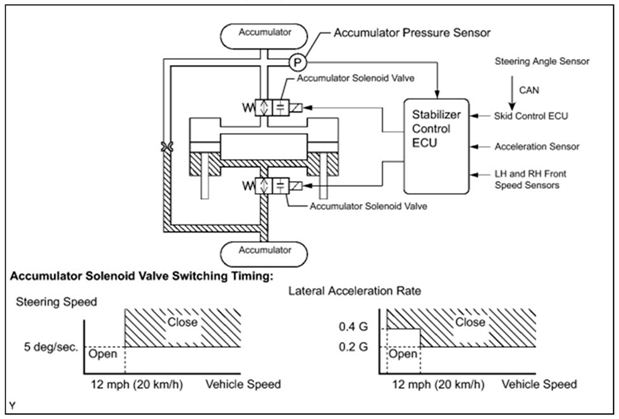
Same action open or closed where the load is uniform on one side. If the valves were open at high speed, the cornering would be the same. The LC200 for example is always active. I don't know why they close the valves on the 4Runner other than to reduce wear somewhat or they think the system will overheat from fluid flow in the moguls at too much speed. There may be some additional effect in terms of removing the air springs from the system by closing the valves.

I need to see the inside valving in the accumulator assembly to really know. It may actually be possible that the only thing that's happening when closed is to eliminate the accumulator air spring effect and firm up the action, but not actually close flow between the cylinders. After learning more about how the LX570 system works that's what it does. It selectively eliminates various air chambers to adjust spring rates.

I have no idea how to actually test this other than video moguls at variable speeds.

Edit: I'm stupid. I didn't realize it until I looked at this diagram just now after learning more about the LX570. I don't think KDSS ever becomes inactive. It just firms up the motion by removing the air springs provided by the accumulators. I think visually looking at the outside of the valve manifold that the function of closing is to block the accumulator only. Not to stop fluid between the upper or lower chambers of the two pistons. Not sure why I had never recognized this, but it does not lock out the cylinders above 12mph. Not at all. It simply makes them a very firm direct hydraulic relationship rather than a softer one that adds some dampening by using accumulators. I'm embarrassed about how badly I missed something obvious.
167132d1268351767-does-the-gx-tilt-kdss3.jpg

Hey everyone, I hope you don't mind me reopening this can of worms thread haha.
I'm an Aussy with a 2016 Prado Kakadu that has KDSS. I had been trying to find out more information about the system just out of interest for about a month before I googled 'KDSS schematic' and came across the image above which was exactly what I was looking for at the time. I now have more questions.

The diagram was very helpful because at the time I was having a discussion with someone who believes KDSS is 'deactivated' under a certain speed. As Jetboy points out, the accumultors and associated solenoids are in parallel not series (I'm a sparky not sure if this is the right terminology) so the fluid transfer in the lines is never actually cut off. And lets not forget some of the explanation diagrams and videos don't even include the accumulators in the picture. Anyway I'm kinda just restating the obvious at the moment. My question is, what the hell do those valves do that we have to undo 3 turns before fiddling or performing the calibration?
If the fluid transfer is never blocked then wouldn't we still be able to manipulate the position of the pistons without undoing anything?
Can someone just cut one of the assemblies in half already so we can find out whats going on once and for all :rofl:
This could all boil down to my lack of understanding about hydraulic systems, my view of the operation may be too simplistic. Happy to hear other theories!
 
Hey everyone, I hope you don't mind me reopening this can of worms thread haha.
I'm an Aussy with a 2016 Prado Kakadu that has KDSS. I had been trying to find out more information about the system just out of interest for about a month before I googled 'KDSS schematic' and came across the image above which was exactly what I was looking for at the time. I now have more questions.

The diagram was very helpful because at the time I was having a discussion with someone who believes KDSS is 'deactivated' under a certain speed. As Jetboy points out, the accumultors and associated solenoids are in parallel not series (I'm a sparky not sure if this is the right terminology) so the fluid transfer in the lines is never actually cut off. And lets not forget some of the explanation diagrams and videos don't even include the accumulators in the picture. Anyway I'm kinda just restating the obvious at the moment. My question is, what the hell do those valves do that we have to undo 3 turns before fiddling or performing the calibration?
If the fluid transfer is never blocked then wouldn't we still be able to manipulate the position of the pistons without undoing anything?
Can someone just cut one of the assemblies in half already so we can find out whats going on once and for all :rofl:
This could all boil down to my lack of understanding about hydraulic systems, my view of the operation may be too simplistic. Happy to hear other theories!

When you undo the valves - what's happening is that you're allowing fluid to flow between the lower and upper chambers. Presumably that effectively resets the zero point where both cylinders are sitting effectively neutral. If you lift the front more than the rear this is probably more important to do than if you lift both ends the same.

When the manual balancing valves are closed there is no path for fluid to flow between the upper and lower chambers. If those valves are open - that would be the scenario where it is truly similar to a disconnected sway bar.

And some clarity on the LC200 that i think I've read and learned since that post. The LC200 is not always "open". The LC200 actually acts very similar to the 150 platform, but does so mechanically. The LC200 valve manifold uses floating ball type valves that close mechanically when fluid transfer exceeds a certain flow rate. The ball will be pushed into a conical seat and block fluid flow. So it's also going to open at lower speeds to include the accumulator and close them off at higher cycle speeds. Just like the electronic valves in the 150 series.

I assume you're talking the basic KDSS version in the LC200. Not the AHC that we in the USA get in the Lexus LX570. It's a very complex version of a combination of KDSS and XREAS type system that operates via the shock absorbers not the sway bars.
 
When you undo the valves - what's happening is that you're allowing fluid to flow between the lower and upper chambers. Presumably that effectively resets the zero point where both cylinders are sitting effectively neutral. If you lift the front more than the rear this is probably more important to do than if you lift both ends the same.

When the manual balancing valves are closed there is no path for fluid to flow between the upper and lower chambers. If those valves are open - that would be the scenario where it is truly similar to a disconnected sway bar.

And some clarity on the LC200 that i think I've read and learned since that post. The LC200 is not always "open". The LC200 actually acts very similar to the 150 platform, but does so mechanically. The LC200 valve manifold uses floating ball type valves that close mechanically when fluid transfer exceeds a certain flow rate. The ball will be pushed into a conical seat and block fluid flow. So it's also going to open at lower speeds to include the accumulator and close them off at higher cycle speeds. Just like the electronic valves in the 150 series.

I assume you're talking the basic KDSS version in the LC200. Not the AHC that we in the USA get in the Lexus LX570. It's a very complex version of a combination of KDSS and XREAS type system that operates via the shock absorbers not the sway bars.

Thanks mate, that makes sense. Out of interest where did you find the diagram?
Yeah I'm talking about the basic system, the one in our Prados looks identical to yours from the pics I've seen.
I have fiddled around with those valves a few times trying to correct my lean. How common is the lean in completely stock 4 runners (mine leaned from completely stock)?
 
Actually now that I think about it, that doesn't make sense WRT the 'calibration' procedure.

So the procedure I followed on mine was; undo valves 3 turns, jack rear left wheel up (a lot!), then close the valves whilst wheel is still jacked up. This corrected my lean. My thinking was that the action of jacking up the rear left wheel was to compress the rear actuator which in effect extends the front actuator that then applies more pressure on the front right side via the sway bar and effectively lifting that leaning side.

If undoing the valves allows fluid to flow between the top and bottom chamber of an individual actuator (how I interpreted what you said) then that would cancel the relationship between front and rear and wouldn't help to correct the lean?
 
Actually now that I think about it, that doesn't make sense WRT the 'calibration' procedure.

So the procedure I followed on mine was; undo valves 3 turns, jack rear left wheel up (a lot!), then close the valves whilst wheel is still jacked up. This corrected my lean. My thinking was that the action of jacking up the rear left wheel was to compress the rear actuator which in effect extends the front actuator that then applies more pressure on the front right side via the sway bar and effectively lifting that leaning side.

If undoing the valves allows fluid to flow between the top and bottom chamber of an individual actuator (how I interpreted what you said) then that would cancel the relationship between front and rear and wouldn't help to correct the lean?


The fluid path is always open between the top chamber of both cylinders and also between the two lower chambers. The reason for the lean is that the chambers are both pressurized to around 400psi. And the upper chamber has a different mechanical advantage as compared to the lower chamber. This is inherent in a single acting hydraulic cylinder. So the result is that there will naturally be a downward force on both cylinders. That creates the lean. In an old thread on here somewhere I calculated it. IIRC it's roughly equivalent to around 300 lbs of lifting force on the left hand side.

To balance that, you need a slightly longer spring on the right hand side both front and rear. The 4Runner in the USA models with kdss come with different front springs on each side. I think the rears are the same. Mine did not have a measurable lean with the OEM springs. I now have aftermarket suspension with adjustable height, so I level it out that way.

I don't fully understand the re-balancing procedure or why it would help. If the upper and lower chamber should have equal internal pressures as per the manual - then the force will not be balanced and it'll have a lean. If you balance the force on each cylinder, it will not have equal pressure. I assume that the lifting of the rear tire during the re-balance procedure is used to achieve a higher final pressure in the lower chamber after the valves are closed. I don't know why that would be the result.

You could probably also put a jack directly under the KDSS cylinder both front and rear. Lift them up a bit on both (compressing the cylinders). Then open the valves. Then close them. And you'd get a better result.

The other solution as mentioned is different height springs, threaded adjustable coilovers, or shims.
 
The fluid path is always open between the top chamber of both cylinders and also between the two lower chambers. The reason for the lean is that the chambers are both pressurized to around 400psi. And the upper chamber has a different mechanical advantage as compared to the lower chamber. This is inherent in a single acting hydraulic cylinder. So the result is that there will naturally be a downward force on both cylinders. That creates the lean. In an old thread on here somewhere I calculated it. IIRC it's roughly equivalent to around 300 lbs of lifting force on the left hand side.

To balance that, you need a slightly longer spring on the right hand side both front and rear. The 4Runner in the USA models with kdss come with different front springs on each side. I think the rears are the same. Mine did not have a measurable lean with the OEM springs. I now have aftermarket suspension with adjustable height, so I level it out that way.

I don't fully understand the re-balancing procedure or why it would help. If the upper and lower chamber should have equal internal pressures as per the manual - then the force will not be balanced and it'll have a lean. If you balance the force on each cylinder, it will not have equal pressure. I assume that the lifting of the rear tire during the re-balance procedure is used to achieve a higher final pressure in the lower chamber after the valves are closed. I don't know why that would be the result.

You could probably also put a jack directly under the KDSS cylinder both front and rear. Lift them up a bit on both (compressing the cylinders). Then open the valves. Then close them. And you'd get a better result.

The other solution as mentioned is different height springs, threaded adjustable coilovers, or shims.

Yeah that's exactly the same as the Prado, front springs are two different lengths from factory. Rear springs are airbags so we can't really do much for leveling the rear on ours.

We really need a whiteboard for this haha. It sounds like my understanding of the calibration procedure is a bit off. No one really explains why it works they just tell you to do it! When you say there is a natural downward force on both cylinders does this mean a downward force that acts on the whole assembly to compress the cylinder or an internal force that would extend it?

What I found when attempting the calibration for the third time on mine was I had to fully compress the rear cylinder then close off the valves. This brought the car dead level front and rear (measured in the workshop). Compressing the rear cylinder had a significant affect on the front. I then parked my car up overnight on my pebbly driveway and woke up to a 20mm lean again. So the system must have just returned to its equilibrium?

As I said before I thought that by fully compressing the rear cylinder this was transferring the pressure to the front cylinder, extending it and applying downward pressure to the front LCAs, but going by your explanation this would occur only when the valves are closed. If opening the valves basically isolates the front half of the system from the rear then I'm left wondering why are we told to compress the rear to fix the lean in the front?
 
Yeah that's exactly the same as the Prado, front springs are two different lengths from factory. Rear springs are airbags so we can't really do much for leveling the rear on ours.

We really need a whiteboard for this haha. It sounds like my understanding of the calibration procedure is a bit off. No one really explains why it works they just tell you to do it! When you say there is a natural downward force on both cylinders does this mean a downward force that acts on the whole assembly to compress the cylinder or an internal force that would extend it?

What I found when attempting the calibration for the third time on mine was I had to fully compress the rear cylinder then close off the valves. This brought the car dead level front and rear (measured in the workshop). Compressing the rear cylinder had a significant affect on the front. I then parked my car up overnight on my pebbly driveway and woke up to a 20mm lean again. So the system must have just returned to its equilibrium?

As I said before I thought that by fully compressing the rear cylinder this was transferring the pressure to the front cylinder, extending it and applying downward pressure to the front LCAs, but going by your explanation this would occur only when the valves are closed. If opening the valves basically isolates the front half of the system from the rear then I'm left wondering why are we told to compress the rear to fix the lean in the front?

A fluid pressure equilibrium in both chambers (up and down) will result in the cylinder wanting to extend and therefore applying a force to the sway bar. Same front and rear. The reason for this is that the cylinder is a single ended cylinder rather than a double ended one. By that I mean that it only extends the shaft in one direction. The result of that is that the internal area where hydraulic force is applied is greater on the top side of the cylinder than it is on the bottom side of the cylinder. The difference in area where force is applied is equal to the cross section area of the shaft. KDSS cylinders have relatively large shaft diameter compared to overall internal cylinder diameter.

So - as a result of having more area with applied force on one side - if the pressures in the system are balanced, the cylinder will try to extend. This is the same reason that all gas charged shock absorbers always seek to extend. If your shocks had a 20mm diameter shaft and 400psi - they'd push with about the same force as KDSS when balanced in pressure top/bottom.

If it were a free cylinder with nothing stopping it - it would extend until the force on both sides balance (but the pressures would not be balanced). In this case the cylinders extend until the additional force trying to extend them is balanced by the force resisting extension. That force is gravity pushing down on vehicle body and the sway bar force up against the cylinder. So the result is that it pushes the body up with a force of about 200-300lbs. And it creates a lean in the same way that a spring with 200lb of force would do on that side.

What is happening when you compress one cylinder all the way closed (rear by jacking), and presumably keep the front somewhat compressed, is that you're effectively increasing the oil volume in the lower chamber and decreasing the volume of the upper chamber as a net effect. Then you balance the pressure. When it settles back after closing the chambers, the upper chamber ends up with a lower pressure (because you've moved some of the oil from the upper chamber to the lower chamber). Then the system can reach an equilibrium of force that applies less "push" on each cylinder to cause the lean.

The reason it probably goes back to a lean after a short time is that the system likely bleeds pressure between chambers anyway. Either around one of the cylinder pistons, or possibly by not having the shutter valves tight enough. Either way - over time at the pressures run in the KDSS system (often exceeding 1,000psi), it will likely return to its original state of lean.

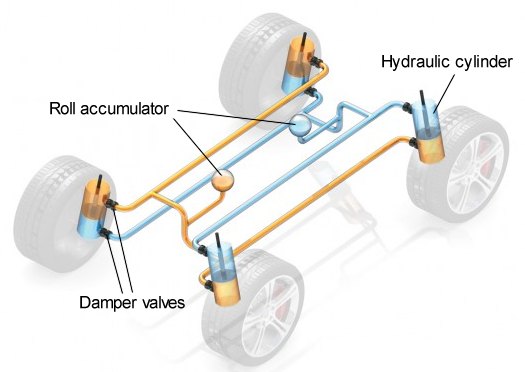
The best long term fix is with springs to offset the force of KDSS. IN a perfect world, Toyota would use double ended hydraulic cylinders and the balance would always remain neutral. That's what McLaren does with its KDSS sysetm. - Not sure if you know, but Mclaren uses KDSS in its supercars, but it uses a double ended ram with neutral force on all 4 corners.

Tenneco_Kinetic_1.jpg


Toyota also uses an even more complex system in the LX570
1468652


(I think earlier I said single acting - it's double acting, but single ended)

 

Members online

Forum statistics

Threads
278,307
Messages
3,554,050
Members
248,016
Latest member
Advally Service

Trending content

Back
Top