KDSS or PRO?

20180901_130523-jpg.84545


Could you imagine a red 4Runner arriving at the dealer with blue bumpers? No, because that would be ridiculous and the undoing of Toyota's fastidious image of building things correctly. Jeep gets a pass because, well, Jeep guys are willing to put up with a lot of bullshít to be seen as "Jeep guys" including watching their trackbars shearing off at the frame.

I'll bet that the one-off colors for the 4Runner Pro had to be hard fought with the bean-counters over in Tahara. I am guessing that there is more flexibility in San Antonio because there is less automation, and more people on site to accommodate line errors.
No, you really don't get it, do you?

The photo of the Jeep with the multi colored panels is merely Jeep's attempt to imitate Volkwagen's Golf Harlequin edition :lmao::lmao:

Back in the 90's, I bought a GMC Yukon. On one side it said "1500", on the other side it said "Yukon" - Chevy Tahoes were labeled with the 1500 on the side.
 
FWIW Toyota does not build vehicles in production series. On the same factory line a red prado will follow a white 4runner then a blue gx460. Adding a paint color is not really a complicated task on a Toyota production line like it might be on many others. However, it still requires paint and every color has a cost. There's no reason they couldn't sell in every gx/prado/4runner color though. Paint is s minor detail. The trd pro doesn't share a frame with a kdss model (kdss has a different frame, pro is shared with all other 4x4 models ).

Yes this is actually common for a lot of production lines. I visited Stuttgart a few years ago and did the Porsche factory tour where 718 Caymans and GT3RS 911s rolled off the same conveyor. Porsche has a fantastically larger catalogue of options and packages in their vehicle product mix, but they also can easily alleviate these added complications by charging more. Seriously, go look at prices for custom paint or interior packages- the Weissach package famously costs $18,000 on the GT3RS to replace some body panels and components with carbon fiber- to be just 40 pounds lighter.

Toyota does not have, nor would it want to have, this kind of demand for variation in its product lines. Porsche sport car numbers pale in comparison to the juggernaut of plain, boring Toyota passenger car sales. But even in low volume, specialty vehicles; Toyota famously has very little product mix. The Land Cruiser, with about 3000 examples sold in the states every year, still only has ONE option available to customers (TV screens for rear passengers). Toyota pioneered the very bones of lean manufacturing, and enjoy the largest profit margins of any major automaker by far. A large part of this profit margin comes from tightly controlling their product mix to keep production lines moving efficiently. The Pro 4Runner having some one-off colors is an example of Toyota "letting their hair down" and really getting WILD with product mix.

When you say "adding a different paint isn't that difficult", you're not really grasping the scope of how small changes induce a ripple effect in the entire production line. Especially a line as established as the Tahara 4x4 plant, and the 4Runner being as ancient in its life cycle as it is.

If Toyota could easily integrate things like Fox shocks into production for the Pro at the Tahara plant, don't you think they would have? After all, why completely take the factory suspension apart at the docks to swap in the Fox suspension? Or ship the truck with a bare roof, only to add that hideous new roof rack when it rolls off the boat? Luckily they've been able to offset these costs by charging people ridiculous amounts for what is essentially an Off Road premium 4Runner with some black badges.

Remember the precursor to the Pro Tacoma, the Baja edition? A TRD specialty team did the same thing and swapped in special Bilstein shocks and slapped some vinyl graphics on a plain old Tacoma Off Road. It too was during the last few years of the second generation truck heading into the sunset. I suspect that the new lines for the 3rd Gen Tacoma have the Pros integrated directly into the line, because they had planning and allocation for it from the start.

Or I could be full of shit. I come from a manufacturing background but these are just my assumptions. I can't say for sure.
 
Yes this is actually common for a lot of production lines. I visited Stuttgart a few years ago and did the Porsche factory tour where 718 Caymans and GT3RS 911s rolled off the same conveyor. Porsche has a fantastically larger catalogue of options and packages in their vehicle product mix, but they also can easily alleviate these added complications by charging more. Seriously, go look at prices for custom paint or interior packages- the Weissach package famously costs $18,000 on the GT3RS to replace some body panels and components with carbon fiber- to be just 40 pounds lighter.

Toyota does not have, nor would it want to have, this kind of demand for variation in its product lines. Porsche sport car numbers pale in comparison to the juggernaut of plain, boring Toyota passenger car sales. But even in low volume, specialty vehicles; Toyota famously has very little product mix. The Land Cruiser, with about 3000 examples sold in the states every year, still only has ONE option available to customers (TV screens for rear passengers). Toyota pioneered the very bones of lean manufacturing, and enjoy the largest profit margins of any major automaker by far. A large part of this profit margin comes from tightly controlling their product mix to keep production lines moving efficiently. The Pro 4Runner having some one-off colors is an example of Toyota "letting their hair down" and really getting WILD with product mix.

When you say "adding a different paint isn't that difficult", you're not really grasping the scope of how small changes induce a ripple effect in the entire production line. Especially a line as established as the Tahara 4x4 plant, and the 4Runner being as ancient in its life cycle as it is.

If Toyota could easily integrate things like Fox shocks into production for the Pro at the Tahara plant, don't you think they would have? After all, why completely take the factory suspension apart at the docks to swap in the Fox suspension? Or ship the truck with a bare roof, only to add that hideous new roof rack when it rolls off the boat? Luckily they've been able to offset these costs by charging people ridiculous amounts for what is essentially an Off Road premium 4Runner with some black badges.

Remember the precursor to the Pro Tacoma, the Baja edition? A TRD specialty team did the same thing and swapped in special Bilstein shocks and slapped some vinyl graphics on a plain old Tacoma Off Road. It too was during the last few years of the second generation truck heading into the sunset. I suspect that the new lines for the 3rd Gen Tacoma have the Pros integrated directly into the line, because they had planning and allocation for it from the start.

Or I could be full of shit. I come from a manufacturing background but these are just my assumptions. I can't say for sure.
Well, you may be full of shit, but you're most likely correct here.

One of the reasons that the Japanese auto industry could sell cars cheaper initially than the US was that there were few options. You might have a couple of trim levels but very few options. It has only been in the last 20 years or so that individual options were added and even now there are many bundled options to reduce costs.
 
I was deciding on adding KDSS and after a lot of searching i found little to no issues reported. Mostly speculation and assumptions that because dealers just replace the whole thing its an expensive add on that will break. When if fact this tells me dealers have so little issues with it they just replace the whole thing to avoid the extra work. Even the one tread i found the dealer tried to incorporate the cost of a tool they needed to fix the one KDSS failure i found. This also tells me its so rare they don't even have the right tools at the dealer.

So i just picked up my 2019 R4 with KDSS. Its Well worth it if you not going to super mod it.

At slower speeds (like 12mph) KDSS will likely show off more of what it can do articulation wise. At Higher speeds like 30+ it will show its better handling capabilities.

KDSS is a passive system, constantly active. When one wheel goes up enough, and the other goes down enough as determined by the hydraulic sensors, the system simply "disengages/releases pressure" (allows fluid to flow freely) to the sway bar. When on flat more consistent roads at higher speeds it will engage/add pressure (restrict flow) to the sway bar helping stabilize it in the turn. Its simple and quite effective.

This is a good video of how and when it works: https://www.youtube.com/watch?v=NLF6n3nMwww&feature=youtube_gdata_player


Height limitations in regards to lifts and long term
maintenance/failure. Read up on the system long term and its failures. Before the bandwagon jumps in and starts talking crap, yes I have owned a vehicle with it in a 200 series, we now have a new 200 (LX570) with AHC which we prefer.

Is it better on the road than a model without KDSS, well duh, but it isn't mind blowing like some here will have you believe. Your money best spent would undoubtedly be a SR5 with a quality lift and an aftermarket rear locker.

If you have links to failures i would love to see them.

And i agree, its not mind blowing. But its certainly much better to have it than not if you are not modding your 4R. Its also very noticeable compared side by side.


I'm also looking for an ORP with KDSS and they're nowhere to be found in northern New England. Do dealers actually stock any 4R's with KDSS, or do they have to be special-ordered, and what's the usual wait time on delivery?

I live in the NE and found 2 (bought one of them) so they are around, but will be hard to find soon since the 2020's will be out and 2019's wont be made anymore.
 
Last edited:
KDSS is a passive system, constantly active. When one wheel goes up enough, and the other goes down enough as determined by the hydraulic sensors, the system simply "disengages/releases pressure" (allows fluid to flow freely) to the sway bar. When on flat more consistent roads at higher speeds it will engage/add pressure (restrict flow) to the sway bar helping stabilize it in the turn. Its simple and quite effective.

that's not how KDSS works
 
Watch the video. That's exactly how it works. Though i may not have worded it as well as what a video can show.


https://www.youtube.com/watch?v=NLF6n3nMwww&feature=youtube_gdata_player

i don't think it's a wording problem, you seem to have a misunderstanding of the concept

"KDSS is a passive system, constantly active." - true

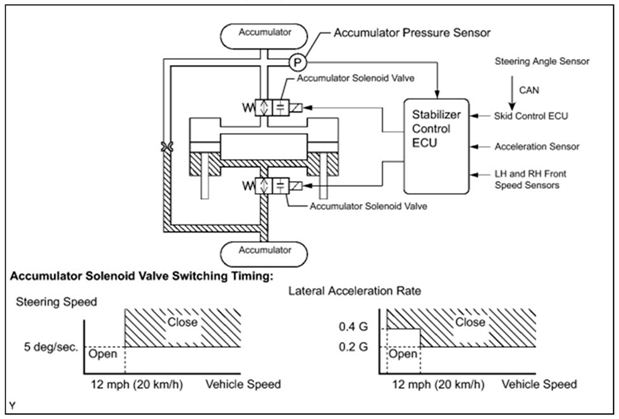
"When one wheel goes up enough, and the other goes down enough as determined by the hydraulic sensors, the system simply "disengages/releases pressure" (allows fluid to flow freely) to the sway bar." - No, its a closed system with accumulators that can be closed off, so fluid is always flowing as sway bars are moving just when the accumulator is open it's not as direct because it can compress into the accumulator. when the accumulator is closed off it's a very direct transfer of forces because hydraulic fluid is essentially incompressible.

"When on flat more consistent roads at higher speeds it will engage/add pressure (restrict flow) to the sway bar helping stabilize it in the turn. Its simple and quite effective." - it's passive, there is no pump i.e. there is no adding pressure

this is the easiest diagram
167132d1268351767-does-the-gx-tilt-kdss3.jpg
 
Last edited:
i don't think it's a wording problem, you seem to have a misunderstanding of the concept

"KDSS is a passive system, constantly active." - true

"When one wheel goes up enough, and the other goes down enough as determined by the hydraulic sensors, the system simply "disengages/releases pressure" (allows fluid to flow freely) to the sway bar." - No, its a closed system with an accumulator that can be closed off, so fluid is always flowing as sway bars are moving just when the accumulator is open it's not as direct because it can compress into the accumulator. when the accumulator is closed off it's a very direct transfer of forces because hydraulic fluid is essentially incompressible.

"When on flat more consistent roads at higher speeds it will engage/add pressure (restrict flow) to the sway bar helping stabilize it in the turn. Its simple and quite effective." - it's passive, there is no pump i.e. there is no adding pressure

I don't really see a difference. I never said it was not a closed system or that there is a pump doing this?

But clearly my explanation has no relevance to the way it truly is working in technical terms.

Thank you for explaining in detailed terms. This help a lot.
 
I was deciding on adding KDSS and after a lot of searching i found little to no issues reported. Mostly speculation and assumptions that because dealers just replace the whole thing its an expensive add on that will break. When if fact this tells me dealers have so little issues with it they just replace the whole thing to avoid the extra work. Even the one tread i found the dealer tried to incorporate the cost of a tool they needed to fix the one KDSS failure i found. This also tells me its so rare they don't even have the right tools at the dealer.

So i just picked up my 2019 R4 with KDSS. Its Well worth it if you not going to super mod it.

At slower speeds (like 12mph) KDSS will likely show off more of what it can do articulation wise. At Higher speeds like 30+ it will show its better handling capabilities.

KDSS is a passive system, constantly active. When one wheel goes up enough, and the other goes down enough as determined by the hydraulic sensors, the system simply "disengages/releases pressure" (allows fluid to flow freely) to the sway bar. When on flat more consistent roads at higher speeds it will engage/add pressure (restrict flow) to the sway bar helping stabilize it in the turn. Its simple and quite effective.

This is a good video of how and when it works: https://www.youtube.com/watch?v=NLF6n3nMwww&feature=youtube_gdata_player


If you have links to failures i would love to see them.

And i agree, its not mind blowing. But its certainly much better to have it than not if you are not modding your 4R. Its also very noticeable compared side by side.


I live in the NE and found 2 (bought one of them) so they are around, but will be hard to find soon since the 2020's will be out and 2019's wont be made anymore.

This video is a little easier to understand and shows the actual parts.
https://www.youtube.com/watch?v=deH4HNqiyMg
 
Yes this is actually common for a lot of production lines. I visited Stuttgart a few years ago and did the Porsche factory tour where 718 Caymans and GT3RS 911s rolled off the same conveyor. Porsche has a fantastically larger catalogue of options and packages in their vehicle product mix, but they also can easily alleviate these added complications by charging more. Seriously, go look at prices for custom paint or interior packages- the Weissach package famously costs $18,000 on the GT3RS to replace some body panels and components with carbon fiber- to be just 40 pounds lighter.

Toyota does not have, nor would it want to have, this kind of demand for variation in its product lines. Porsche sport car numbers pale in comparison to the juggernaut of plain, boring Toyota passenger car sales. But even in low volume, specialty vehicles; Toyota famously has very little product mix. The Land Cruiser, with about 3000 examples sold in the states every year, still only has ONE option available to customers (TV screens for rear passengers). Toyota pioneered the very bones of lean manufacturing, and enjoy the largest profit margins of any major automaker by far. A large part of this profit margin comes from tightly controlling their product mix to keep production lines moving efficiently. The Pro 4Runner having some one-off colors is an example of Toyota "letting their hair down" and really getting WILD with product mix.

When you say "adding a different paint isn't that difficult", you're not really grasping the scope of how small changes induce a ripple effect in the entire production line. Especially a line as established as the Tahara 4x4 plant, and the 4Runner being as ancient in its life cycle as it is.

If Toyota could easily integrate things like Fox shocks into production for the Pro at the Tahara plant, don't you think they would have? After all, why completely take the factory suspension apart at the docks to swap in the Fox suspension? Or ship the truck with a bare roof, only to add that hideous new roof rack when it rolls off the boat? Luckily they've been able to offset these costs by charging people ridiculous amounts for what is essentially an Off Road premium 4Runner with some black badges.

Remember the precursor to the Pro Tacoma, the Baja edition? A TRD specialty team did the same thing and swapped in special Bilstein shocks and slapped some vinyl graphics on a plain old Tacoma Off Road. It too was during the last few years of the second generation truck heading into the sunset. I suspect that the new lines for the 3rd Gen Tacoma have the Pros integrated directly into the line, because they had planning and allocation for it from the start.

Or I could be full of shit. I come from a manufacturing background but these are just my assumptions. I can't say for sure.

A Toyota assembly line is quite a bit more advanced than anything in Volkswagen auto group's. Toyota assembly line can change stamping dies between different models in about 1 minute. The second fastest factory outside of Toyotas is a Volkswagen factory in Germany that can do it in about 8 hours. My brother-in-law I worked on the consulting team that was hired to reduce the time from 3 minutes to 1 minute.

Toyota extremely dedicated to efficient production and minimal stock. So they build effectively to order and not in production runs of similar vehicles. I do think the easily could integrate them at the factory. I haven't been to tahara, but I have been to a couple facilities in Japan and the Texas plant. The 150 built in any order in the same production line has about 6 different frames. There are at least a dozen suspension configurations already on that line and probably 15 paint colors. My guess is trd pro suspension has a tariff issue or something of the sort keeping it off the factory floor. It's very basic compared to kdss vs xreas vs air/magnetic versions that are all already on the same line.So it doesn't make a lot of sense to do later unless there's something non-production going on. Swapping coilovers at the port is super inefficient and out of character.


They change paint colors every year. Unless they're already maxed on the amount of colors the tooling can run, it should be pretty easy.
 
Last edited:

Members online

Forum statistics

Threads
278,309
Messages
3,554,066
Members
248,016
Latest member
Advally Service

Trending content

Back
Top