KDSS question

vicar

Member
This is probably discussed somewhere but here goes....

I know KDSS is supposed to decrease body roll on road. But is it possible for KDSS to actually increase body roll at low speeds?

I have a 19 TRD ORP with KDSS. I liked it when I test drove it (mostly on the interstate) - it seemed firmer and more controlled than the non-KDSS 4runners I have driven. But now that I own the car I’m experiencing it under different conditions. I’ve got a couple places in my work commute where I have to take a left turn at very low speeds, one of them coming off a bit of a hill. On both turns I notice very excessive body roll. I know various sensors, including speed sensors, are involved in engaging KDSS. Is it possible the system is just giving extra articulation in those instances since I’m going slow? The body roll is far greater than other trucks and SUVs I’ve driven on this same route. Since I’m new to KDSS I wanted to see if anyone else had similar experiences making low speed on-road turns. Is it something I need to get used or something I should check into?

I’m on the stock Bridgestone tires, which I realize are pretty squishy. But I do have them at 35 psi. I look forward to replacing these tires with better ones eventually...

Thanks.
 
Register to hide this ad
I guess I'm not fully understanding your question...
Usually a "turn at very low speeds" and "very excessive body roll" would be mutually exclusive. I have the exact same setup as you (2019 ORP w/KDSS) and haven't experienced any abnormal body roll on the street.
 
KDSS is automatically engaged at any speed above 12 mph. Seems like you'd have to really work at it to take a corner sharply enough to induce body roll at a speed of less than 12 mph.
 
I know KDSS is supposed to decrease body roll on road. But is it possible for KDSS to actually increase body roll at low speeds?

Yes. KDSS rigs will have more body roll at low speeds relative to non-KDSS, but the rig will be going less than 12mph, so I don't see how it would be excessive unless maybe you are really top heavy or cranking a very tight turn at a weird angle.
 
What you're experiencing is what 4Runners without sway bars feel like. At very low speeds, KDSS is disengaged (very similar to not having sway bars), so you basically have a very tall vehicle making a turn without say bars. The KDSS isn't making your truck sway more, it just isn't doing anything to help it sway less. Make sense? So you have nothing to worry about, it is "normal" for our 4Runners that are equipped with KDSS and since you have to be going very slowly for this to happen, it should never be an issue.
 
"is it possible for KDSS to actually increase body roll at low speeds?"

Yes. Not possible, but actually engineered that way. You basically have have no sway bars below 12 mph.
 
"is it possible for KDSS to actually increase body roll at low speeds?"

Yes. Not possible, but actually engineered that way. You basically have have no sway bars below 12 mph.

Umm... no. It is not engineered to increase body roll. It is engineered to allow more flex in the suspension so it is not increasing body roll, it is just allowing for it. But again, that does not mean it is engineered to increase body roll, it doesn't do anything to actively increase body roll.
 
"is it possible for KDSS to actually increase body roll at low speeds?"

Yes. Not possible, but actually engineered that way. You basically have have no sway bars below 12 mph.

What makes you say that? All KDSS does is allow more wheel articulation in situations where the wheels are at different levels, which essentially means when opposite corners are at different heights. It does this by using the hydraulics to allow the sway bar to drop a few inches. The sway bars are always working when on a flat surface.
 
Here is how I interpret it.

The difference in a KDSS sway bar and a regular sway bar is that one end link / swing arm is replaced with a piston, on opposite sides front and rear. The hydraulics that drive the pistons is not pumped, but pushed from the piston that is being forced in at the opposite corner, through a balancing valve (accumulator) with electronics, to the piston that is extending.

The sway bar does not disconnect, it just has further travel and dampening, and one endlink /swing arm is still present on each.

Also, where is the engagement speed reference coming from? I have never seen that written, but i really havent looked either. My understanding of the system is that it engages when a wheel drops and force changes allowing the fluid to push to the extended cylinder. When you are driving on normal flat roads, the drops don't occur and pressures / forces are mostly equal.

When i replaced my shocks, I had to unbolt the sway bars and raise and lower the pistons. It's really a pretty simple system aside from the electronics in the accumulator / valve.
 
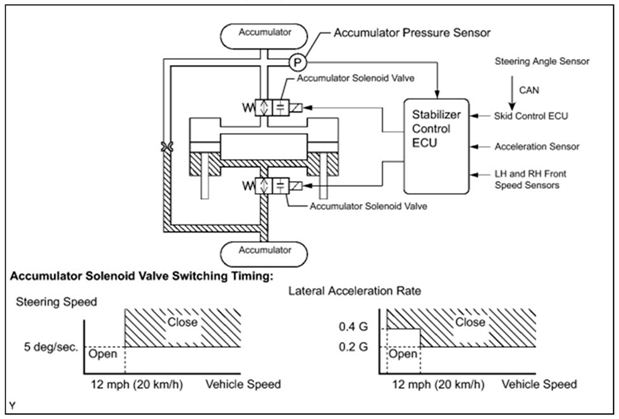
The KDSS computer also looks at steering angle and lateral acceleration, not just speed, so no the KDSS isn't increasing body roll
 
Lots of bad info in this thread :(

This is as simple as I can make it: The KDSS sway bar has two hydraulic pistons (one front and one back) attached to the frame rail. These pistons become the 4th connecting point when charged/firm. When traveling at lower speeds/off road, the pistons un-charge/loosen, basically turning the sway bar into an unconnected flopping bar. This lets the suspension fully-travel (droop/compress) without causing opposite-side force via sway-bar.

So, yes, when traveling at lower speeds, the pistons effectively stop the sway bars from doing their anti-sway job. At speeds below ~12 mph, this will make the driver perceive MORE body roll. It is engineered this way. This is why the model is called the "Trail or TRD OffRoad" model. Toyota assumes you want more articulation when you travel off road at low speeds.


Understanding Sway Bar Technology - Tire Review Magazine

Anti-roll bar - Wikipedia
 
Lots of bad info in this thread :(

Then goes ahead and basically repeats what people have posted in the thread. You are basically restating what I and others have said. No idea why some people insist they are experts and others aren't. You've adding nothing that wasn't already said here, why do you have a need to act like your information is so much more valid than others?
 
The primary error in a lot of what I've read in comments above is that the sway bars do not ever become disconnected or act as though they're disconnected. There are two independent hydraulic circuits between the two cylinders - one front one rear. Each circuit has a gas charged small expansion chamber called an accumulator. Each circuit also has a valve that opens or closes the expansion chamber from the rest of the circuit. The fluid transfer between the cylinders is 1:1 in either circuit. The result is that in "closed" position there is no dampening and it's a very rigid connection front/rear, but the two cylinders can and do still move - they do so with a very rigid master/slave function.

When the valves are in the "open" position the two circuits are dampened by the accumulators. So the master/slave movement is not fully rigid. It is not fully free either. And that's the main point I'm trying to correct. They act as a softer master/slave, not really like a disconnected sway bar. And they only have a limited range of travel. Combined with the accumulator having a gas compression spring rate (highly progressive) the result is that they have relatively soft feel near the neutral position in the travel range of the cylinders and become progressively more rigid near the ends of the piston travel, and then very rigid beyond the max travel of the cylinders. There is also a significant force applied to the body to retain it's position balanced between the front and rear axle angles. So there's a body stabilization function occurring along with a forced articulation function (the two are really the opposing reactions of the same forces).

The accumulators start with IRC 500psi charge. They're not really disconnected or fully connected. It's somewhere in between. I've often been curious how the ride quality would be with a sway bar spring rate similar to an SR5 but mounted in the KDSS system. I think that could offer a feel much closer to a true disconnected sway bar.

The 12mph is taken from this diagram I believe. I'm not sure if it's totally correct though. My reading of the diagram is that over 12mph it will close the valves if the steering rate of change exceeds the limit (you turn the wheel fast) or if the lateral acceleration exceeds a certain amount - you go around a corner fast. I'm not sure if they otherwise remain open or not - for example going 40mph in a straight section of road.

I am also unaware of anyone having played with the gas pressure to see how it might work with 100psi for example.

167132d1268351767-does-the-gx-tilt-kdss3.jpg
 
Last edited:
This is probably discussed somewhere but here goes....

I know KDSS is supposed to decrease body roll on road. But is it possible for KDSS to actually increase body roll at low speeds?

I have a 19 TRD ORP with KDSS. I liked it when I test drove it (mostly on the interstate) - it seemed firmer and more controlled than the non-KDSS 4runners I have driven. But now that I own the car I’m experiencing it under different conditions. I’ve got a couple places in my work commute where I have to take a left turn at very low speeds, one of them coming off a bit of a hill. On both turns I notice very excessive body roll. I know various sensors, including speed sensors, are involved in engaging KDSS. Is it possible the system is just giving extra articulation in those instances since I’m going slow? The body roll is far greater than other trucks and SUVs I’ve driven on this same route. Since I’m new to KDSS I wanted to see if anyone else had similar experiences making low speed on-road turns. Is it something I need to get used or something I should check into?

I’m on the stock Bridgestone tires, which I realize are pretty squishy. But I do have them at 35 psi. I look forward to replacing these tires with better ones eventually...

Thanks.

So, to add a nice bow on this whole thread: YES, you can perceive your KDSS equipped 4Runner to have more body-roll at low speed. Since the anti-sway bars are not doing their job, you can feel more body-roll because there likely is more body-roll.

:cheers:
 
Last edited:

Members online

Forum statistics

Threads
278,304
Messages
3,554,041
Members
248,016
Latest member
Advally Service

Trending content

Back
Top