TrailGear high steer install
I was intending to use a low-crossover setup by modifying my factory arms, but when TrailGear's high steer went on sale for $299 that made it a no-brainer. I already had the IFS box I'd kept from my last truck, so I picked up the high steer setup from Low Range a couple weeks ago and decided to use Front Range Offroad's frame brace.
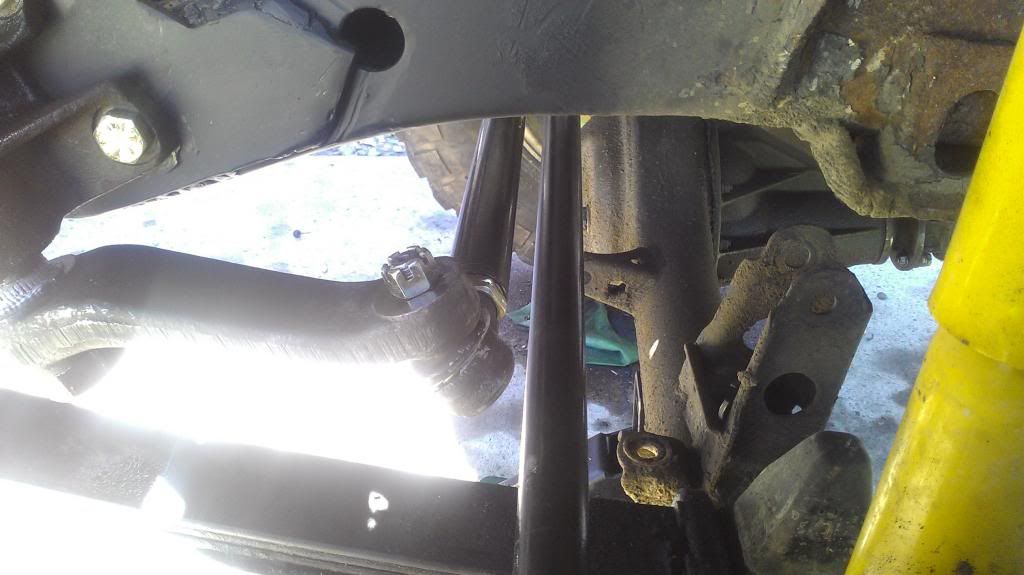
First thing was to get all the old junk off - the push/pull steering box, the stock steering arms, the stock steering links, and the dogbone track bar all have to be removed, the dogbone bracket on the frame has to be cut off, and the frame has to be ground smooth and cleaned up for welding. All of this is much easier if you pull the radiator first. Now put the new steering arms on and have a buddy hold the IFS box in place while you mock up the tie rod and drag link and check clearances - what you're looking for is room for the drag link to clear the tie rod when you stuff the drivers side. You want them moving past eachother, not binding, so you'll want the steering box as far forward on the frame as you can get it. If you're confused now, you'll see what I'm talking about when you get everything mocked up. I left about a half-inch between the steering box and the core support, and I
think my drag link will clear the tie rod, but it's close. If you're feeling spiffy, you can cut a hole in the core support for the steering box, but I wasn't that motivated. Maybe I should have been. The other thing to pay attention to is the height of the steering box - I put mine in a little too low, and now I can't get my 32mm socket over the pitman arm bolt. I have to tighten it with a pipe wrench now, so that kinda sucks.
Once you've got your steering box position roughed up, it's time to plate the frame. I'm not an experienced fabricator so I decided to use Front Range Offroad's frame brace. I lined the frame plates up and clamped them in, then held the steering box in place one more time to make sure I had everything right, then I marked out the holes and started drilling.
One note here - you cannot have enough drill bits, nor can they be sharp enough. Your final hole size, at least for the Front Range kit, is going to be 3/4", but start small and step up through at least four or five pilot bits to get there. I piloted the first hole at 3/8", then 1/2", then 3/4", and I burned up a couple bits and it took
forever. I used two more pilot stages on the other three holes and they went much faster. Either way, I recommend having a Drill Doctor or you're going to learn to sharpen a bit with a flap wheel, because I dulled the larger bits several times.
Once you're drilled, clamp those frame plates back on there and put the box back on to triplecheck your fit. If it's good, get out the welder. (I won't go into details on this part because I'm a shit welder and have no business giving anybody advice. This is your steering we're talking about - if you don't know for sure that your welding skills are up to securely gluing 1/4in plate to your frame, get help from somebody who's a better welder.)
After you're welded up, it's just a matter of putting everything back together. Steering hoses was the only real snag I ran into. The fittings are all the same size, but there's a weird loopy hardline assembly between the pump and stock steering box, and I had a hard time finding room for it with the new steering box in place. So I hacked it out of the middle of that line, and planned on using a little bit of rubber line to splice the two ends together. That didn't last long enough to bleed the air out of the new box, so I had to run down to the hydraulic hose place. $30 later and they'd found a couple press-on screw fittings to splice my line together, and I'm rolling.
Getting busy:
Getting fit:
Shiny!
Boogers.
Brace is installed:
And the box is bolted up:
Just barely enough clearance:
The weird loopy tube I cut out of the middle of the high pressure line:
My failed splice attempt:
The right way to do it:
Fits perfectly:
All done. Where'd that tie rod go???
It's definitely a different steering setup. Everything feels much looser at the wheel - there's no slop, but it's much easier to turn and feedback from the road is enhanced, so that'll take some getting used to I guess. I'm going wheeling in the morning and we'll see what happens - I still have the stock front driveshaft on there, and it's entirely possible that I'll pull it apart every time I flex out now. The driveline place quoted me $200 to build a shaft with a longer slip, but I'm going to look around for a better deal, and in the meantime I guess I'll carry a pair of 14mm wrenches just in case.






 op2:
op2:


