Known problems with 3.4l?

The highest mileage i've seen for 5VZ-FE is on a 97 Tacoma (Member on TacomaWorld) -- 489,000 miles before head gasket failure.


I am FULLY unaware of a head gasket recall on any third gen. It's also not in the Buyers Guide, and [MENTION=57546]4-Ripcord[/MENTION] didn't miss anything in that guide that I can think of.


Are you maybe talking about the 3.0 on the 2nd gen?


The local dealer still services a Tacoma that has over a million miles.
 
Change your oil to prevent sludge. A carbon cleaning is beneficial on them if you don't do highway driving often. Mine has low miles but it pings on regular fuel due to carbon buildup caused by nearly 15 years of mostly city driving. I don't use cheap gas either, but I would imagine the issue would be worse if I did. I plan on getting a MotorVac treatment done. Think of it as Seafoam on steroids.

Make sure you change your transmission fluid so that it is up to par with your 5VZ!
 
Great engine, pretty bulletproof and legendary. Stay on top of coolant changes, some say a new radiator/lines every 150-200K, timing belt/water pump/tensioners every 90-100K. Valve cover gaskets leak but that happens in any engine and the replacement is worth it. I Seafoam the fuel every oil change and switched my 2002 LTD to high-mileage full synthetic. Not a single leak. Just replaced the fan belts and the new ones still squeak, makes me see red every time I start her, but if that's my only problem in a 14 y/o car then I'm golden. Good luck, take your time and find the right T4R for you.
 
Apparently engine sludge doesn't bother these motors. My truck is heavily sludged (thanks previous owner!) and yet it runs great! Doesn't over-heat, plenty of power and acceleration. Pulls hard up the mountain grades while fully loaded, and I'm averaging about 18 mpg mix and 21 on the highway. She'll hit 390,000 miles later this week and 400,000 in a few months.


Here's a pic from the fill port during the my last oil change. Sludge city! I switched from conventional to synthetic blend. We'll see if it slowly starts to clean things out.


Either way, I'm not too worried about sludge at this point. My engine seems to run just fine with it.
 
There was a head gasket recall that affected at least the '96 3.4. I bought one new and took it in for the recall a year or so later. Only other recall I was notified about was replacing the rear springs.
 
Jhfleet, you are correct on that. Not all 96 engines were affected in the recall as I did talk to corporate Toyota one time and my 96 VIN number was not in the range for head gasket. I also had the spring recall on mine. As far as seafoam never used it yet. Does anyone have any proof it removes carbon deposits and if so how often used and method (gas tank or pcv) Heard both sides on the motorvac stuff. Are these high mileage motors on regular oil or synthetics. I use full synthetic on all my stuff, better protection in the cold weather IMO. Radiator is a 100k deal too much at stake here.
 
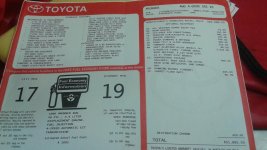
I know for a fact that a head gasket recall went in effect for 1996, not sure about 1997 or 1998. I recently bought a 1 owner 96 4runner with a seized 3.4 with 179k miles for $200. Not the engines fault the po neglected a bad oil leak. The owner gave me all the original sales papers and maintenance records from day 1 and included is a dealer receipt for new head gaskets due to a recall shortly after he bought it new. Check out the original window sticker for my 96, and this was 20 years ago!
 

Attachments

  • 96 4RUNNER 003.jpg
    96 4RUNNER 003.jpg
    137.2 KB · Views: 12,114
we have 2 runners with the 3.4. Both on occasion need 02 sensors...Also Around 170k miles both needed new coils and a couple of injectors. Really just easy tasks. Both trucks also have had the coolant temp sensors replaced around the same time. My wife's 96 at 240k needed a new radiator this fall...thats really it. Driveline wise Ive replaced both of our driveshafts around 180k miles also...Mine 4x4 was out of balance and cv joints worn....hers 2wd had a terrible vibration..also was out of balance,

Usual Maintenance.
 
Apparently engine sludge doesn't bother these motors. My truck is heavily sludged (thanks previous owner!) and yet it runs great! Doesn't over-heat, plenty of power and acceleration. Pulls hard up the mountain grades while fully loaded, and I'm averaging about 18 mpg mix and 21 on the highway. She'll hit 390,000 miles later this week and 400,000 in a few months.

Here's a pic from the fill port during the my last oil change. Sludge city! I switched from conventional to synthetic blend. We'll see if it slowly starts to clean things out.

Either way, I'm not too worried about sludge at this point. My engine seems to run just fine with it.

That's just the baffle on the valve cover. Not a reliable indicator. Your engine is probably clean.
 
Jhfleet, you are correct on that. Not all 96 engines were affected in the recall as I did talk to corporate Toyota one time and my 96 VIN number was not in the range for head gasket. I also had the spring recall on mine. As far as seafoam never used it yet. Does anyone have any proof it removes carbon deposits and if so how often used and method (gas tank or pcv) Heard both sides on the motorvac stuff. Are these high mileage motors on regular oil or synthetics. I use full synthetic on all my stuff, better protection in the cold weather IMO. Radiator is a 100k deal too much at stake here.

https://www.youtube.com/watch?v=u6UeJXkzDW8
 
One of the best!

This thread says it all: http://www.toyota-4runner.org/3rd-gen-t4rs/82033-3rd-gen-4runner-buyers-guide.html

As a long term owner I've unfortunately, personally experienced a rod failure at 237K km (due, I believe, to lack of maintenance from before I owned it), and I then performed a JDM swap in my driveway. The only other issue I experienced with this truck was a rear axle seal failure.

All the years I've been a member, I've read of a few other rods failures, some head gasket failures, 2 of which on disassembly, were identified to be head failures---- a valve stem and a crack, if I remember right. Recently, I've read of a few flex plate failures--- which aren't really engine related.....
Considering how many thousands of these engines exist in 4R's, Tacoma's, T100's, Hiace's etc, and how few failures we hear of, it's truly amazing! The bottom line is, there really isn't one specific root failure with this engine.
 
That's just the baffle on the valve cover. Not a reliable indicator. Your engine is probably clean.

You may well be correct, however, the truck had been neglected for 18 years and never once went back to the dealer for anything. Records I have from the PO indicate that oil changes were infrequent at best and non-existent most of the time. 10k or more was not uncommon between oil changes. When changes were done, the cheapest oil and filters were used.

At approx 360k when I got the truck, it still had original PCV, wrong plugs and crappy flea-market looking wires that looked as if they were installed during the Bush administration. Shit man, I found dead maggot husks under the back seat! Cleanliness and maintenance were the last priority for this truck. If the passenger LBJ hadn't failed catastrophically — the previous owner would probably still be rolling around on 4 bald mismatched tires with date codes ranging between 9 years and 11 years old.

While I suppose the Oil Fairy could have been secretly working on keeping the engine shinny inside, I've seen no outward indication of anything other than neglect, so I assume the worst based on what I know and what I've seen.

Still love this damn truck though.
 
I worked on these at the dealer when they were under warranty.. I've owned at least 8 since then, and worked on hundreds. This is still about the best engine I've ever come across. A select few crack heads. Headgaskets going away are rare. I'd venture to bet that majority of blown headgaskets are due to improper surface cleaning practices during the X01 campaign to replace headgaskets at the dealer due to the factory having installed them on the wrong sides. Factory sealed engines that have never been overheated seem to never blow the headgaskets. The later 3.4s used an MLS headgasket, which I always switch to if I'm resurfacing both the block and the heads, but they don't play nice with used deck surfaces...the earlier composite head gaskets are more forgiving to surface imperfections but are nowhere near as robust.

If the engines have been well taken care of, I'd bet 95% or better will run to well over 350K miles without more than timing belts. At about the 200-220K mile mark, I start seeing oil leaks...oil pan, VC gaskets. I just yanked a 245K mile engine and the rear main seal was dry...which was a pleasant surprise.

Don't try and outsmart the Toyota engineers...use a name brand conventional 5W-30 oil, regardless of mileage, change it at 4000-5000 mile intervals and they'll about go forever. Synthetic may make you feel better but won't improve longevity and will just cost you more money. Use the oil these engines were designed for. Use good Wix or OE oil filters.

These are relatively low output engines for a 4 cam 3.4L, so it's real tough to hurt 'em. Because of this simple fact, people lose their minds when something major goes wrong well after 200, 300, or even 400K miles. Most other engines would have been replaced once or twice by that point. Toyota has conditioned their owners to expect nothing less. When I went to work for GM dealers, I was shocked to see customers not surprised to spend $1000-$2000 fixing their 4 or 5 year old car...they'd clearly never owned a Toyota. I haven't spend that much on maintaining my 96 4runner between 2008 and now, and it just clicked over 245K. I replaced the engine with a good used because it blew a headgasket...head had been off once in about 2000 for the X01 campaign and again a bit over a year ago for a cracked head...I was skeptical about the condition of the deck so opted for a complete engine due to time restraints.

 
That's just the baffle on the valve cover. Not a reliable indicator. Your engine is probably clean.

This. That baffle gets oil on it that doesn't cycle well, so it cruds up over time.

Mine looks exactly the same, but is clean as a whistle beneath.
 
I know for a fact that a head gasket recall went in effect for 1996, not sure about 1997 or 1998. I recently bought a 1 owner 96 4runner with a seized 3.4 with 179k miles for $200. Not the engines fault the po neglected a bad oil leak. The owner gave me all the original sales papers and maintenance records from day 1 and included is a dealer receipt for new head gaskets due to a recall shortly after he bought it new. Check out the original window sticker for my 96, and this was 20 years ago!

Love the annual fuel cost on that window sticker.....
 
1 PROBLEM I've had.

Love the annual fuel cost on that window sticker.....


I have a 99 4runner with 350000 miles on the original engine and the only problem I'm having is when I get up to 70mph is that the CEL comes on and its a miss in cylinder 5 and 2. It only happens at highway speeds and once I get below 70 it stops and the light won't stay on. Not sure if anyone else has had this problem if so please any info to fix the problem would be great.

Also I already replaced the TPS, coils plugs wires, injectors, and the fuel pump.
 
I have a 99 4runner with 350000 miles on the original engine and the only problem I'm having is when I get up to 70mph is that the CEL comes on and its a miss in cylinder 5 and 2. It only happens at highway speeds and once I get below 70 it stops and the light won't stay on. Not sure if anyone else has had this problem if so please any info to fix the problem would be great.


Also I already replaced the TPS, coils plugs wires, injectors, and the fuel pump.


Have you ever done a valve adjustment? It may be time. Aren't 5 and 2 on the same coil?


Sent from my iPhone using Tapatalk
 
Have you ever done a valve adjustment? It may be time. Aren't 5 and 2 on the same coil?


Sent from my iPhone using Tapatalk

Yes. Pairs are always separated by 3. 1-4, 2-5, 3-6. So I would start by swapping coil on #5 with one of the others and see what happens. If the miss follows the coil, swap out the coil.

64398d1337227175-need-help-spark-plug_wires-zcruiser.jpg
 
You can check for the Strawberry Milkshake by disconnecting the transmission cooler line on the bottom of the radiator (there are two, use the low pressure one on the driver side), have an assistant start the vehicle and take a sample. These engines are also known to leak oil from the valve covers; an involved job, but not impossible. Also, go with DENSO plugs with two prongs/double platinum (something about the way the spark is delivered or something like that, I forget why). Other than that; they are powerful, easy to fix, parts are plentiful and reasonably priced
 

Members online

Forum statistics

Threads
278,307
Messages
3,554,056
Members
248,016
Latest member
Advally Service

Trending content

Back
Top