Have Frame Will Travel
Proof that radical departures from proven concepts aren’t part of Toyota’s Land Cruiser ethos.
It should be noted that executive chief engineer Hideki Watanabe briefly considered shifting the Land Cruiser to a monocoque structure, but buyers wanted a full-function 4WD vehicle capable of tackling tough off-road trails, as well as towing heavy loads. Though possible to accomplish with a monocoque body shell, it would require reinforcements nearly identical in overall mass to the weight of a separate frame, and eliminate the chance to suppress road noise and vibration via the body mounts. In addition, a frame acts as a last line of defense between the surface and the underbody in tough off-road situations. Therefore, Watanabe chose to stick with proven body-on-frame construction. Accordingly, the Land Cruiser’s frame has fully boxed sections throughout, and the fifth and sixth (of eight) cross members are hydroformed with the thickness of cross member walls increased where they penetrate the side rails. Torsional and bending rigidity are up 40% and 20%, respectively, versus the outgoing model.
To keep things under control and protected, a double A-arm front suspension with coil-over dampers replaces the previous version’s torsion bar system. This places the spring/damper units inside the confines of the upper and lower arms, and wheel travel increases from 7.9-in. to 9.05-in. As before, the solid axle rear suspension has four links, coil springs, and a Panhard rod. However, rear travel has increased to 9.45-in. with a total vertical articulation of 27.6-in. With some segment competitors ditching solid axles in favor of an independent rear suspension, a design that allows the third row of seats to fold flat into the floor, the retention of a solid rear axle is something of a mystery—to everyone, that is, but Toshihiko Kanai, assistant chief engineer, Product Planning Div., Toyota Motor Corp. “Longevity under harsh conditions is very important to our customers,” he says, “so a live axle was the only solution.” To increase load space without having to resort to a removable rear seat, Toyota engineers split the third row down the middle so each half can fold up against an inner body side.
A new double A-arm front suspension, automatically decoupling anti-roll bars, and revised 4-link rear suspension give the Land Cruiser greater wheel articulation and better on-road ride and handling.
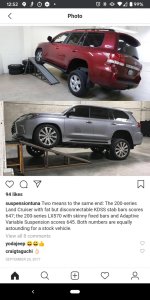
This same spirit is seen in the compromise between on-road ride and handling, and off-road capability. Toyota’s Kinetic Dynamic Suspension System (KDSS) decouples the larger anti-roll bars on rough terrain via hydraulic cylinders located on the same side of the vehicle and placed between the anti-roll bars and lower suspension mounts. An upper and lower flow path for the hydraulic fluid runs between them. On smooth roads, the pistons in the cylinders move in unison, pushing the hydraulic fluid toward the center of the vehicle. This keeps the links locked and the anti-roll bars fully engaged. In off-road situations, the front and rear wheels often move in opposite directions along their vertical axis, opening both flow paths. This lets the cylinders move the fluid fore and aft, and decouples the outer anti-roll bar link to increase suspension travel. An electrically triggered disconnect may be used on the Lexus version (LX570) of the Land Cruiser, but Kanai defends the mechanical system by saying, “Given this vehicle’s market and driving environments, we needed a system with the highest reliability possible that could be serviced easily in primitive settings, if necessary.”
Power for the 2008 Land Cruiser comes from the same 5.7-liter 3UR-FE V8 found in the Tundra pickup (381 hp @ 5,600 and 401 lb-ft @ 3,600), mated to its AB60F six-speed automatic transmission. The new full-time, electrically shifted JF2A transfer case uses a six-pinion planetary reduction gear, silent chain drive, houses a Torsen limited-slip differential, and splits torque in normal driving 41% front/59% rear. When the front wheels start to slip, this is shifted to a maximum ratio of 30% front/70% rear. If the rear wheels are the first to slip, the slip is adjusted to a maximum of 50% front/50% rear. Both the front and rear differentials are open designs with 8.7-in. and 9.5-in. ring gears, respectively. The front differential carrier and intermediate tube are made of aluminum—a double-row bearing is used for the front bearing—and both differentials use low viscosity oil.
Though approximately half of the 200 Series Land Cruiser’s five-year development program was devoted to testing in tough conditions on challenging terrain, it also included time to develop less prosaic items. These include power front windows with variable speed control that decelerate when nearing their full up or down position, a standard four-zone automatic climate control system with 28 total outlets and seven fan speeds, dash under-covers to keep interior noise levels low, and a large center console with an available cooler box to keep sandwiches and drinks cold. It’s about what you’d expect from an SUV as likely to be seen in the Outback—or the Middle East, its largest market—as at an Outback Steakhouse.