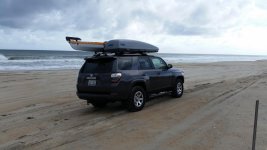
Limited going to Cape Lookout tire pressure?

Mult1Beast

New member
Me and some friends are headed to Cape Lookout NC for the weekend. I have a 2011 Limited with 265/70/17 Ko2s on TRD pro wheels. Just wondering what tire pressure I should deflate the tires to. Also, if anyone has been there before and has any tip or tips for beach driving in general it would be much appreciated!

Thanks
 
Register to hide this ad
15-20psi, hopefully someone in your group has a recovery strap. Do yourself a favor and find your recovery points prior to leaving on your trip. Stay out of the soft stuff.
 
Me and some friends are headed to Cape Lookout NC for the weekend. I have a 2011 Limited with 265/70/17 Ko2s on TRD pro wheels. Just wondering what tire pressure I should deflate the tires to. Also, if anyone has been there before and has any tip or tips for beach driving in general it would be much appreciated!

Thanks

I air down to 20psi. The ferry service there has air available which is great. I'd recommend going and checking out the lighthouse of course. If you haven't camped on the beach before, make sure your camp site is above high tide, I'd try and tuck in between a few dunes to get out of the wind. DON'T GO ON THE DUNES! Make sure you have a winch or a strap between the group of you to pull each other out if necessary.

At least once during your weekend there on a clear night just turn out all of your lights at the campsite (including your fire) and just look up. It's dark enough to see the milky way with the naked eye.

I'd say this is probably my favorite campsite I've been to.
 
Tips

Bring a shovel
Bring a strap and shackles
Air down (if its really soft, like parts there are, i air down to 18)
If you get stuck don't keep spinning your wheels, you will just bury yourself deeper.
Know where your towing point is (I think on the limited you have to remove part of the bumper to use?)
Be smooth on the throttle and brakes, if you get going too fast gently left foot brake a little to slow (if you left foot brake a lot while on throttle the vehicle will cut your throttle because old people keep driving into buildings)
Pay attention to the tide and if it is coming in or going out
Salt water is bad, stay out of the water
Check yourself for ticks after walking through any grasses
 
Tips

Bring a shovel
Bring a strap and shackles
Air down (if its really soft, like parts there are, i air down to 18)
If you get stuck don't keep spinning your wheels, you will just bury yourself deeper.
Know where your towing point is (I think on the limited you have to remove part of the bumper to use?)
Be smooth on the throttle and brakes, if you get going too fast gently left foot brake a little to slow (if you left foot brake a lot while on throttle the vehicle will cut your throttle because old people keep driving into buildings)
Pay attention to the tide and if it is coming in or going out
Salt water is bad, stay out of the water
Check yourself for ticks after walking through any grasses

All of this.
 
pro tip

bring recovery boards (TRED, MAxxtraxx, etc)
Those are always my first choice rather than getting pulled out by someone else. matter of fact, that's all i have had to use when i go to Pismo Beach.
 
I took my 2016 TEP to Hatteras Island at the end of last summer. 18psi seemed about perfect in the sand.
 

Attachments

  • 20160830_143910.jpg
    20160830_143910.jpg
    136.7 KB · Views: 762
That's pretty firm for Hatteras. Ocracoke, the next island south, can be substantially softer. Looking forward to getting out there this summer.
 
Sand dunes are my favorite, no pinstripes, no rocks.


I run 15 in soft sand, but no fast turns. Don't want to have the tire come off the wheel.


At 15 I can start and stop most anywhere. Follow the previous suggestions about not digging in, easy on the power but keep the tires moving.


If you have another vehicle with you, don't avoid the dunes, enjoy them.


It's not at all a matter of whether the 4Runner is capable of driving on them. It's an ecological matter. Below is just a small blurb about why you shouldn't and that'll be the last I mention of it.


Sand dunes need to be protected so they can continue to protect coastal communities from coastal erosion and flooding and so the natural character of the coast is preserved for future generations.

Dunes are formed when dry sand is blown up the beach and trapped by native sand binding plants. The plants then grow through the trapped sand increasing the height of the dune and becoming a natural barrier between the land and the sea. The greater the width of the dunes, the greater the reservoir of sand available to provide protection from storm waves.

Any activity that damages these important sand binding plants can stop the dunes from rebuilding and can lead to increased erosion.

Driving over sand dune plants can destroy them and lower their growth rates by breaking off stems, crushing seedlings and damaging underground roots.

Vehicles also compact the sand and soils which changes the conditions needed for sand binding grasses to grow.

The loss of plant cover, as well as the physical changes to the sands and soils, makes dunes more vulnerable to wind erosion and 'blow-outs' - where the dune gives way and sand is blown inland. Driving on dunes can also change the profile or shape of the dunes, creating wind funnels and making the dunes more vulnerable to erosion during storm events.


OP, please don't be that guy.

 
It's not at all a matter of whether the 4Runner is capable of driving on them. It's an ecological matter. Below is just a small blurb about why you shouldn't and that'll be the last I mention of it.


Sand dunes need to be protected so they can continue to protect coastal communities from coastal erosion and flooding and so the natural character of the coast is preserved for future generations.

Dunes are formed when dry sand is blown up the beach and trapped by native sand binding plants. The plants then grow through the trapped sand increasing the height of the dune and becoming a natural barrier between the land and the sea. The greater the width of the dunes, the greater the reservoir of sand available to provide protection from storm waves.

Any activity that damages these important sand binding plants can stop the dunes from rebuilding and can lead to increased erosion.

Driving over sand dune plants can destroy them and lower their growth rates by breaking off stems, crushing seedlings and damaging underground roots.

Vehicles also compact the sand and soils which changes the conditions needed for sand binding grasses to grow.

The loss of plant cover, as well as the physical changes to the sands and soils, makes dunes more vulnerable to wind erosion and 'blow-outs' - where the dune gives way and sand is blown inland. Driving on dunes can also change the profile or shape of the dunes, creating wind funnels and making the dunes more vulnerable to erosion during storm events.


OP, please don't be that guy.

Will absolutely not be that guy. They are very strict about not driving on the dunes there and for good reason. I would love to tackle some dunes but in a desert type setting, not on the coast.
 
I'm trying to grow a dune to move the CAMA line back enough that our lot is rebuildable if something happened to the house. Dunes are our friends, be nice to the dunes. People on the wrong coast don't understand.

I did environmental assessments and surveying in the outer banks which involved sand driving in overweight suburbans or explorers on crappy tires and never had an issue just lowering the air pressure a bit.

Recovery boards are great but I wouldn't spend the money just for a trip to cape lookout, there are enough people there to get a pull if you need. If you get stuck just drop your air pressure more, dig a bit, and you can even use floor mats to help float up out of your hole. If that still doesn't work just hook up your strap and be ready, someone will help you out

Sent from my SM-G930V using Tapatalk
 
Lol OP you had better watch out... these guys are going to offer advice normally used by the Dakkar race trucks instead of advice for driving on a beach where thousands of crossovers drive all the time!
 
Lol OP you had better watch out... these guys are going to offer advice normally used by the Dakkar race trucks instead of advice for driving on a beach where thousands of crossovers drive all the time!

No kidding. You should probably get lift, sliders, 285s, full skids and front and rear bumpers. Then a hi lift jack, winch, multiple straps, and shovel; all mounted to your full length Gobi rack, of course.
 
F....all sand is different, air down according. If you find yourself digging in drop a few more psi. This isn't rocket science but it is simple enough to figure out.
 
That's pretty firm for Hatteras. Ocracoke, the next island south, can be substantially softer. Looking forward to getting out there this summer.

its never down by the water that's the issue, the rams are the soft part. If you make it through the ramp you shouldn't have any other problems

And watch out for jeep JK's, they can't drive on sand in 4Hi without the transmission boiling over and catching the jeep on fire. Which i guess is another tip, keep an eye on your vehicle temps. I've never had a problem in mine and am not aware of any 5th gen 4runners that have issues, but vehicles catching fire on the beach is a common thing. It's usually jeeps though.
 
Last edited:
I'm planning on going to Cape Lookout next month. Is a day and night enough to look around and enjoy the island or should I camp two nights? We're also going to stay in Wilmington a couple of nights. I'm trying to figure out how to divide up the days.
 
I have been driving in the sand of Bodie, Hatteras and Ocracoke Islands since about 1949. Several decades ago I learned this from some Western dessert rats.

The optimum footprint for sand.

It is not a one size fits all so you will have to experiment a little to find what fits your setup. Your vehicle should roll (float) rather easily over the sand and not require a lot of extra power (torque). And remember street pressure is not necessarily exactly what is on the door placard. The placard is nominal for a nominal load (usually indicated on the placard). Both street and sand pressures are load dependent (including passengers, gas, etc) and may vary front to back, depending on how you are loaded.

Here is a place to start on airing down. Works for radials; don’t know about others.

Load your vehicle, including passengers, like you will have it in the sand. On level pavement with the tires at street recommended pressure, measure the height from the pavement to bottom of the rim. Remember recommended street pressure on the door placard is nominal so more or less load means more or less pressure. And the height can vary front to back, depending on load, so measure both.

Then drop the pressure until the height is ¾ of the street pressure measurement. This will give a nice flat footprint that will roll (float) easier over the sand rather than pushing down into the sand as hard tires tend to do. Lowering the pressure more generally does not gain you much and it can concave the center of the tread in toward the rim and thus you are riding more on the edges and that can also tend to dig you in.

With the flat footprint you can also drive on pavement without fear of excessive tire wear because you are not riding just on the edges. Now that said you want to keep speed down on pavement because the extra flex in the sidewall can generate excessive heat and that is where damage can occur.

I have used this for decades, staying aired down for weeks at a time, and have seen no noticeable degradation in tire wear. Just keep my speed at about 45 mph max, particularly in hot weather and don’t do long trips. But never hesitate to do a 60 mile round trip up and down Bodie, Hatteras and Ocracoke Islands.

For my 5th gen 4Runner this works to about 20 +/- 2 psi, give or take on load.
 
I went to south core island via the Davis Ferry about 2-3 weeks ago and stayed for 5 days over spring break. We had a great time. Couple of things to keep in mind:

The weather over there is pretty volatile right now, especially the wind. I brought some 2'-3' long pieces of rebar driven at an angle for tent stakes.....cheap and effective. The first night we were there the wind was blowing 40 mph

We drove all over the island aired down to 20 lbs. Worked out great. 4 Hi and about 20 mph and you are in business.

Prepare for 2 days of cleaning sand and salt when you get back.....:thumb:
 

Members online

Forum statistics

Threads
278,316
Messages
3,554,121
Members
248,016
Latest member
Advally Service

Trending content

Back
Top