Losing coolant regularly, but not leaking?

as i've said, check the bottom of the radiator. slow leaks of this kind don't get to the ground when parked. it gets splashed when driving. as you drive, the engine heats up and builds pressure which then causes the radiator fluid to come out and fall on the road, not on your driveway.

so what do i do now? i mean i don't see any leaks on the ground or any check engine light on. what to do now?
 
I just went to take a look at the radiator facing outwards. I didn't see any crust of white/orange stuff like you described. it looks pretty free of any white crust. Can it be under the pulley system? but i dont think i see anything there as well.
 
The radiator usually leaks on the drivers side as mentioned, but you need to remove the plastic clips holding down the cover which is over the radiator and AC condenser, as they are sandwiched together under that cover.

In between the two (radiator vs AC Condenser), you will easily see the pink crust growing if its leaking.
 
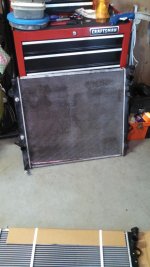
this exact thing happened to me, this is what my bad radiator looked like when i pulled it to replace it.

bottom left side is drivers side
 

Attachments

  • IMG_20140713_121509_282.jpg
    IMG_20140713_121509_282.jpg
    136 KB · Views: 5,964
how much is it to replace the radiator?

i did it for the cost of the radiator. its super simple, if you can change your oil you can replace your radiator. ill post a full set of directions if you need it, but it really is not hard. you can buy oem for lots of money, or buy aftermarket like i did.

this is the one i used
http://www.amazon.com/TYC-2580-Alum...1-2282-116-1-0&sr=1-3&ymm=2004:toyota:4runner

works beautifully, no real need to buy oem when this is the same exact thing
 
so i looked again under the skid plate. I did see some pint crust inside the skid plate around the pulley system but nothing on the radiator. where is the coolant leaking? i dont see anything on the radiator itself... it's a little mystery
 
You might need to remove the fan shroud in order to see the leak. Mine was leaking on both sides at bottom corners... After I replaced the radiator, my cooling issues and fluid disappearance did not happen for a couple of months but It re-appeared and the head gasket was the culprit this time...
In terms of hg replacement cost there are variables pending things like how much machining needed, what needs to be replaced etc... Expect to pay 1500+
Anything less, i would bet the heads are not sent to machine shop and some parts are reused (head bolts?!?)... I believe its rated as a 20hr job! Probably 3K+ at dealer
 
Ethan,

if you can please add the directions in case i need. it will be beneficial to all of us owners of the 4Runner. I still don't know what can be the problem.
 
Usually a misfire code will appear. Also when you first start the car it will run rough. Overheating and rad fluid loss are also signs. It appears to be common on the 4lt V6 due to a poor quality hg manufacturer. Typically the misfire happens on cyl #6 and sometimes on #2

forgot to mention rad fluid *loss
 
Last edited:
Its super easy to take radiator off. 4x12mm bolts hold it in place. The bottom ones you access thru the rad support/frame and need an extension to reach em. 2x10mm bolts hold the fan shroud. 2 Rad hoses and 2 transmission cooler lines (driver side)need to be disconnected
 
so this is basically the short and sweet version

1. drain fluid from the radiator, the drain is underneath on the drivers side
2. in the engine compartment, remove the overflow reservoir, 3 bolt hold it on. be careful as fluid will still be in it.
3. unbolt the shroud from around the radiator, there are 3 bolts on each side.
4. if you have a v6, remove the transmission lines from the drivers side of the radiator. if you keep them straight up and down, you won't have to worry about losing fluid.
5. tranny fluid won't leak from the transmission side if you're careful removing it.
6. remove the hoses attached to the radiator, keep them upright and you won't lose fluid.
7. unbolt the 4 bolts and washers that hold the radiator on, it is much easier to do with two people.
8. lift straight out and drain excess fluid.
9. installation of the new radiator is the reverse process.
10. Refill new radiator with coolant after it is all installed
11. make sure to check tranny fluid level and your coolant level after bringing the vehicle up to temperature.
 
Does anyone know if Toyota Corporate will cover the repair cost of the water pump? Since I have been using the Toyota Pink coolant since i bought the truck. I just purchased an OEM water pump and serp belt on ebay and was wondering if Toyota Corporate can reimburse me for the parts.
 
I'm just throwing in suggestion but could it be water pump seal leaking? I from V8 owners club but I had really similar bizarre experience. Coolant was disappearing but I could not find a leak, anywhere. It was bone dry under truck for months on end. I know V6 doesn't have timing belt but when I did TB service I replaced water pump which had slight gasket leak and coolant was evaporating I guess in a little cavity between water pump and engine block. I replaced water pump and gasket and mysterious leak was gone!
 
Does anyone if i can use old coolant, like 15 years ago? is it safe to use?

Not sure if its still good after 15 years, but its probably not the correct coolant since we barely introduce SLLC (Super Long Life Coolant) aka "Toyota Pink" less than 15 years ago.
 
similar issue but I do not think it is the HG

I have a similar issue. Rad overflow tank is constantly empty, no matter what. I have zero indicators of leaking anywhere, skid plate, hoses, etc.

It seems like everyone is quick to jump to head gasket issues, so I'm keeping my fingers crossed.

04 v6 limited 4x4

I just started towing a 19ft trailer for the first time - so I'd like to upgrade radiator, install trans cooler, and upgrade exhaust.

Cylinder compression test good - all @ roughly 120-125PSI. The lowest is within the acceptable % of the highest cylinder.

I also did compression on my radiator - which after 7 minutes drops from 16 to about 12-13psi. HOWEVER I started the car with the gauge still in place of the cap and the needle was solid - not bouncing at all. Which my neighbor said would indicate HG issues. ( I've seen videos online where the person said you must rev the engine to see any pressure change. I was alone so I could not do this and be looking at the gauge simultaneously - not sure if that was a wasted test. let me know.)

I'm a bit lost. I also tried to use soapy water to see if the rented pressure tester was creating a seal on my rad filler neck - didn't see anything, but I might have to do it again with more water. It was kind of difficult to get the soap upwards into the recessed part of the adapter piece.

Where to go from here?

No weird smells. no smokey exhaust. no white crud on underside of rad cap. or engine oil cap, or any cap for that matter.

 

Members online

Forum statistics

Threads
278,309
Messages
3,554,075
Members
248,016
Latest member
Advally Service

Trending content

Back
Top