Low(er) TE Cargo Weight Limit

dsfra

Member
Does anyone know what prompted Toyota to specify such a low weight limit for the TE?

Page 286 of the owner's manual states:

Total Load Capacity

Without rear differential lock system: 1165 lbs.
With rear differential lock system (Trail): 835 lbs.

I'm not particularly going to second guess this, but am wondering what exactly it is that is causing such a low(er) limit for the TE. Is the diff housing different on the TE vs. the SR-5 and LE? Or same diff housing, same springs, same wheel bearings, but something about being a locker that reduces the limit for some reason?

I'm trying to coordinate the logistics for a trip to Utah involving the wife and 3 relatives/friends, and to everyone's surprise and disbelief, once the 5 of us are in the vehicle we will only have enough extra capacity to load 30 lbs. of cargo - to support 5 people for 3 weeks. And no, we're not THAT fat. Then throw on a couple of hundred lbs. of trailer tongue weight, and we're really screwed.
 
Last edited:
Register to hide this ad
It makes little sense when they wrote this right below it...

Luggage compartment load capacity:
970 lb. (445 kg) With 5 occupants
670 lb. (309 kg) With 7 occupants
 
Weight

I think I would put on a set of Air Lift bags and put most of the luggage in the camper. I know that does not increase the capacity but maybe it's close enough to be OK.
 
Does anyone know what prompted Toyota to specify such a low weight limit for the TE?

Page 286 of the owner's manual states:

Total Load Capacity

Without rear differential lock system: 1165 lbs.
With rear differential lock system (Trail): 835 lbs.

I'm not particularly going to second guess this, but am wondering what exactly it is that is causing such a low(er) limit for the TE. Is the diff housing different on the TE vs. the SR-5 and LE? Or same diff housing, same springs, same wheel bearings, but something about being a locker that reduces the limit for some reason?

I'm trying to coordinate the logistics for a trip to Utah involving the wife and 3 relatives/friends, and to everyone's surprise and disbelief, once the 5 of us are loaded into the vehicle we will have enough extra capacity to load exactly 30 lbs. of cargo to support 5 people for 3 weeks. And no, we're not THAT fat. Then throw on a couple of hundred lbs. of trailer tongue weight, and we're really screwed.


While going over the GVWR is nothing to be taken lightly, for this example I think I'd verify there was at least 44psi in your LT tires and enjoy your trip.

Your TE weights 4750 per Toyota's website. The GVWR of your vehicle is 6300 lbs. This leaves you with 1550 lbs of payload (people, luggage, tongue weight). If you, your wife, friends, gear, and tongue weight weigh more than 1550 lbs then you need to start thinking of alternatives.

This weight will be dispersed over the front and rear axle (most on the rear obviously), but for your scenario I would load up and enjoy your trip to UTAH without worrying - if indeed the trailer is not that heavy.

Remember that adding stiffer springs, air bags, etc does nothing to increase your GVWR. They can definitely help in controlling excess weight, but I wouldn't ever assume going over the GVWR is a good idea.
 
Last edited:
Just talked to someone at Toyota's 800 number. She had to go talk to a "senior tech" about this matter, and after a few false starts (talking in circles about the 5,000 lb towing capacity and telling me that the "senior tech" confirmed that the curb weight is 4,750 and the GVWR is 6,300) their consensus was that the load capacities in the owner's manual (835 lbs for lockers and 1,165 lbs for non-lockers) are what we should be paying attention to, and the business about GVWR and curb weight (and the 1,550 lb difference between them) on the Toyota web site maybe doesn't matter so much since it really maybe isn't really all that, uh, applicable to, uh, specific questions, maybe, uh... The uncertainty was palpable, and not altogether unexpected. They referred me to the cute little drawing on page 282 with the little people standing on the big huge scale. And no one had any idea what the "970 lbs with 5 occupants" or "670 lbs with 7 occupants" business was trying to say.

Who knows what Toyota did with the missing 1,550 - 835 = 715 lbs? Apparently RAV4's can carry 825 lbs, only 10 less that our TE's. So much for our truck-based body-on-frame tough-guy SUV's.

So the question remains: Anyone know why the locker and non-locker have different capacity ratings? Toyota apparently doesn't.
 
Last edited:
Just talked to someone at Toyota's 800 number. She had to go talk to a "senior tech" about this matter, and after a few false starts (talking in circles about the 5,000 lb towing capacity and telling me that the "senior tech" confirmed that the curb weight is 4,750 and the GVWR is 6,300) their consensus was that the load capacities in the owner's manual (835 lbs for lockers and 1,165 lbs for non-lockers) are what we should be paying attention to, and the business about GVWR and curb weight (and the 1,550 lb difference between them) on the Toyota web site maybe doesn't matter so much since it really maybe isn't really all that, uh, applicable to specific questions, maybe, uh... The uncertainty was palpable, and not altogether unexpected. They referred me to the cute little drawing on page 282 with the little people standing on the big huge scale. And no one had any idea what the "970 lbs with 5 occupants" or "670 lbs with 7 occupants" business was trying to say.

Who knows what Toyota did with the missing 1,550 - 835 = 715 lbs? Apparently RAV4's can carry 825 lbs, only 10 less that our TE's. So much for our truck-based body-on-frame tough-guy SUV's.

So the question remains: Anyone know why the locker and non-locker have different capacity ratings? Toyota apparently doesn't.

E-locker differential is smaller than standard diff and therefore it is weaker. Which is why the load rating of the truck is lower.

It is a known issue with late-model trucks, tacomas/4runners.

The 5 vs 7 person loads are Toyota trying to help people that can't do math, those numbers are assuming each person weigh 150lbs. More people, less allowable cargo/trailer load.
 
Last edited:
OK - that 'splains it. Thanks for the info. Why am I always the last to know?

Just for the sake of completeness, could someone post up pics of a SR-5 door jamb weight sticker? I would be interested to see what it says for the front and rear axle weights.

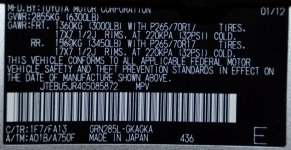
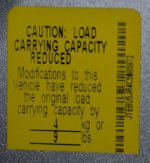
I uploaded my TE sticker, plus an interesting little extra yellow sticker that reduces my weight by 9 lbs. Maybe a KDSS thing of some sort? Pretty finely tuned if they're pinning it down to 9 lb increments.

Toyota giveth and then Toyota taketh away: "Here's a nice locking rear end for you to use, but don't use it too much or you'll break it". Maybe should have foregone the TE and KDSS, saved a few bucks, gotten an SR-5, and been able to carry 5 adults plus gear without having to worry about exceeding the weight limit.

And dare I ask how on the sticker we have 3,000 front + 3,450 rear = 6,300 vehicle?
 

Attachments

  • weight.sticker.big.jpg
    weight.sticker.big.jpg
    87 KB · Views: 2,290
  • weight.sticker.small.jpg
    weight.sticker.small.jpg
    30.3 KB · Views: 2,123
Last edited:
OK - that 'splains it. Thanks for the info. Why am I always the last to know?

Just for the sake of completeness, could someone post up pics of a SR-5 door jamb weight sticker? I would be interested to see what it says for the front and rear axle weights.

I uploaded my TE sticker, plus an interesting little extra yellow sticker that reduces my weight by 9 lbs. Maybe a KDSS thing of some sort? Pretty finely tuned if they're pinning it down to 9 lb increments.

Toyota giveth and then Toyota taketh away: "Here's a nice locking rear end for you to use, but don't use it too much". Maybe should have foregone the TE and KDSS, saved a few bucks, gotten an SR-5, and been able to carry 5 adults plus gear without exceeding the weight limit.

And dare I ask how 3,000 front + 3,450 rear = 6,300 vehicle?

Gvwr = gross vehicle weight rating, maximum total vehicle weight allowed ( add up bare vehicle (curb weight) + cargo + passengers + trailer tongue weight, don't exceed this number)
Gawr = gross axle weight rating, don't exceed this weight at each axle, ie truck has to be evenly loaded to safely achieve full gvwr. The gawr rating also takes into account individual tire load ratings, that is why it calls out tire size and pressure.

The yellow tag is based on port-of-entry or dealer installed accessories or other post-factory conditions. That is why it is a seemingly precise number and a sticker.

I just took a look at my sr5 tag, same numbers as above, except my sticker says 15 lb reduction.
 
Last edited:
If you haul a trailer regularly, it would be good to find out the 4runners gcvwr which takes into account your total trailer weight, not just tongue weight.

Gcvwr is both your truck and trailer weighed together.

To be legal and safe, you should be below both the gvwr and gcvwr when traveling.
 
E-locker differential is smaller than standard diff and therefore it is weaker. Which is why the load rating of the truck is lower.

It is a known issue with late-model trucks, tacomas/4runners..

Where did you read that or who told you that?
As far as I know all 5th Gens have the new updated rear diffs with the 8.2" ring and pinion....8.2 2010+ REAR, FJ CRUISER, 4RU : JTs Parts & Accessories, Justdifferentials.com
The TE axle housing and carrier are different(has cut outs) to accommodate the e-locker is all.

No idea on the different capacity ratings though. TE's with KDSS do weigh more because of all the KDSS components and E-locker but I doubt that much.
 
If you haul a trailer regularly, it would be good to find out the 4runners gcvwr which takes into account your total trailer weight, not just tongue weight.

Gcvwr is both your truck and trailer weighed together.

To be legal and safe, you should be below both the gvwr and gcvwr when traveling.

Thanks for the input. You seem to be a wealth of information, so let me nag you for some further details...

When you say the locker diff is "smaller", are you talking about the housing, the spring mounts, the actual gears, the wheel bearings, or what? My main concern at this point is worrying about beating the snot out of the diff and paying the price either with a failure in the middle of nowhere, or a premature visit to the diff store. We don't plan to do any real rock crawling per se, but plan to spend lots of time on some fairly rough dirt roads. E.g, on our upcoming Utah trip, we're planning to drop the trailer and do the White Rim Trail, Burr Trail, Cathedral Valley Loop, the Notom Road, parts of the Flint Trail, the Hole-in-the-Rock Road, and some short drives around Moab - something around 500 off-pavement miles in total - some of it with 2 aboard and some with 5 aboard. I'm mostly worried about washboarded roads since they can really beat up the suspension when the driver's patience runs out and the speed goes up - as it always seems to eventually do.

It was apparent when talking to Toyota that the people I was speaking with didn't particularly know what a differential was, had no idea what a locking diff was, and had no concept of GVWR, so I suspect that I would get nowhere asking about GCVWR. I was planning to just make sure that the 'Frunner was under its GVWR and that the trailer was well below the 5,000 lb limit and call it good.

A question about the weight stickers: If my TE and your SR-5 stickers have the same numbers on them, then why would the owner's manual say that there's a 330 lb weight capacity difference? I'm missing something.

Edit: Just saw the intervening posts while typing the above (and surfing around a little). Thanks for all the input guys.
 
Last edited:
Where did you read that or who told you that?
As far as I know all 5th Gens have the new updated rear diffs with the 8.2" ring and pinion....8.2 2010+ REAR, FJ CRUISER, 4RU : JTs Parts & Accessories, Justdifferentials.com
The TE axle housing and carrier are different(has cut outs) to accommodate the e-locker is all.

No idea on the different capacity ratings though. TE's with KDSS do weigh more because of all the KDSS components and E-locker but I doubt that much.

Looks like I was mistaken. I did not know Toyota changed the diffs in 2010. The pre-2010 diffs were 8" for elocker vs the 8.4" non elocker. A few desert racers changed out the Tacoma diffs for non elocker diffs to get the extra strength, then put an after market locker in.

The rating may have to do with the strength concerns of locked vs unlocked on a trail. That does not seem likely though.

I apologize for my misinformation.
 
Thanks for the input. You seem to be a wealth of information, so let me nag you for some further details...

When you say the locker diff is "smaller", are you talking about the housing, the spring mounts, the actual gears, the wheel bearings, or what? My main concern at this point is worrying about beating the snot out of the diff and paying the price either with a failure in the middle of nowhere, or a premature visit to the diff store. We don't plan to do any real rock crawling per se, but plan to spend lots of time on some fairly rough dirt roads. E.g, on our upcoming Utah trip, we're planning to drop the trailer and do the White Rim Trail, Burr Trail, Cathedral Valley Loop, the Notom Road, parts of the Flint Trail, the Hole-in-the-Rock Road, and some short drives around Moab - something around 500 off-pavement miles in total - some of it with 2 aboard and some with 5 aboard. I'm mostly worried about washboarded roads since they can really beat up the suspension when the driver's patience runs out and the speed goes up - as it always seems to eventually do.

It was apparent when talking to Toyota that the people I was speaking with didn't particularly know what a differential was, had no idea what a locking diff was, and had no concept of GVWR, so I suspect that I would get nowhere asking about GCVWR. I was planning to just make sure that the 'Frunner was under its GVWR and that the trailer was well below the 5,000 lb limit and call it good.

A question about the weight stickers: If my TE and your SR-5 stickers have the same numbers on them, then why would the owner's manual say that there's a 330 lb weight capacity difference? I'm missing something.

Edit: Just saw the intervening posts while typing the above (and surfing around a little). Thanks for all the input guys.

Regardless of size of diff, the Toyota axles are reliable units, you should not have any problems.

When running open fire roads you will not need to have the axle locked and loose gravel is not going to be a major stress condition for the axle.

The most likely place to break an axle shaft or differential is in steep or difficult rock crawling trails where your truck may be bound up and you are in 4lo with rear locker engaged, you give it too much gas and bam.

If you are doing more difficult trails in Moab, just be aware of the high friction of the rock when you are wheeling and disengage the locker if you are in a tight turn on solid rock, etc. be sure to disengage before the turn.

If you are running stock size tires there is less of a chance of axle breakage as well.

There have been a lot of guys on this forum that have wheeled Moab trails, Colorado trails, and ca desert trails without any axle issues, so I would not worry too much about axle breakage. It also depends on the type of person you are, some people can break a steel ball in a rubber room.

In the long run, if you are towing in the summer and heavily using the truck you can change your diff fluids more often and search the owners manual to see if toyota recommends using a heavier weight oil. That can help with long term reliability as well.

Have you considered a transmission cooler as well?
 
It makes little sense when they wrote this right below it...

Luggage compartment load capacity:
970 lb. (445 kg) With 5 occupants
670 lb. (309 kg) With 7 occupants

That makes sense, 970lb cargo capacity + the weight of passengers. 7 occupants is more weight, so less cargo capacity.
 
While going over the GVWR is nothing to be taken lightly, for this example I think I'd verify there was at least 44psi in your LT tires and enjoy your trip.

Your TE weights 4750 per Toyota's website. The GVWR of your vehicle is 6300 lbs. This leaves you with 1550 lbs of payload (people, luggage, tongue weight). If you, your wife, friends, gear, and tongue weight weigh more than 1550 lbs then you need to start thinking of alternatives.

This weight will be dispersed over the front and rear axle (most on the rear obviously), but for your scenario I would load up and enjoy your trip to UTAH without worrying - if indeed the trailer is not that heavy.

Remember that adding stiffer springs, air bags, etc does nothing to increase your GVWR. They can definitely help in controlling excess weight, but I wouldn't ever assume going over the GVWR is a good idea.

@OP:
Read the above quoted post and pay attention to it as it is the closest thing to truth with no assumptions. The manual has to assume many things when publishing things like "number of people." I weigh 250 so I am a person+ according to the manual lol.

You have 1550 lbs to use. 200 is max tongue weight so 1350 for ALL cargo including people and stuff on the outside. Why you ask? Many things are taken into account when calculating max payload such as:
-Brakes
-Tires
-Bearings
-Suspension components
-Frame
-Strength of sheet metal
-Gears and components
-Clutches
-And the list goes on.

The only real difference between the SR5 and the TE is the locker. Not the housing or anything else so that leads me to think the actual locker itself is the culprit in the reduction of payload. It could be that during calculations or testing the safety factor was reduced because a given load on a given slope with given acceleration was determined to be a little less with the locker engaged. Remember there are safety factors that have to be designed in during the initial design. I do not know if they are 3:1 or 4:1 or even 10:1 but trust me, there are.

Case in point (or something to think about):
The stock OEM furnished tire is the crap Bridgestone. It has a certain coefficient of adhesion on a given surface such as concrete. An aftermarket tire such as a Duratrac will offer a larger coefficient of adhesion so that means more torque could be applied before the wheels started to spin. Now add slope and payload and those two numbers ( torque required to spin with stock tire vs aftermarket tires) will be different. You could get into a condition where in order to stay within the original design parameters and safety factor the max payload could decrease more even without the locker!

The engineers have been given parameters they work with in order to come up with such things as max payload capacity. When something changes such as a different suspension like ICON or a different brake rotor or different tires or regearing anything else that changes the whole equation! They cannot possibly know everything that operators will change so they test and publish safe numbers well within the actual limits in a stock configuration. All you have to do is look at a few threads of these trucks going off road and you will know you will be fine on easy trails. Remember some of these guys are running 1K in armor including bumpers and winch and rack and THEN they load it up with gear AND pull a trailer! Have fun out there.
 
@OP:
Read the above quoted post and pay attention to it as it is the closest thing to truth with no assumptions. The manual has to assume many things when publishing things like "number of people." I weigh 250 so I am a person+ according to the manual lol.

You have 1550 lbs to use. 200 is max tongue weight so 1350 for ALL cargo including people and stuff on the outside. Why you ask? Many things are taken into account when calculating max payload such as:
-Brakes
-Tires
-Bearings
-Suspension components
-Frame
-Strength of sheet metal
-Gears and components
-Clutches
-And the list goes on.

The only real difference between the SR5 and the TE is the locker. Not the housing or anything else so that leads me to think the actual locker itself is the culprit in the reduction of payload. It could be that during calculations or testing the safety factor was reduced because a given load on a given slope with given acceleration was determined to be a little less with the locker engaged. Remember there are safety factors that have to be designed in during the initial design. I do not know if they are 3:1 or 4:1 or even 10:1 but trust me, there are.

Case in point (or something to think about):
The stock OEM furnished tire is the crap Bridgestone. It has a certain coefficient of adhesion on a given surface such as concrete. An aftermarket tire such as a Duratrac will offer a larger coefficient of adhesion so that means more torque could be applied before the wheels started to spin. Now add slope and payload and those two numbers ( torque required to spin with stock tire vs aftermarket tires) will be different. You could get into a condition where in order to stay within the original design parameters and safety factor the max payload could decrease more even without the locker!

The engineers have been given parameters they work with in order to come up with such things as max payload capacity. When something changes such as a different suspension like ICON or a different brake rotor or different tires or regearing anything else that changes the whole equation! They cannot possibly know everything that operators will change so they test and publish safe numbers well within the actual limits in a stock configuration. All you have to do is look at a few threads of these trucks going off road and you will know you will be fine on easy trails. Remember some of these guys are running 1K in armor including bumpers and winch and rack and THEN they load it up with gear AND pull a trailer! Have fun out there.

So you are saying that we should easily be able to overload our truck by at least 1.5x toyota's numbers due to the over conservative engineer's calcs? Just kidding :D:jk:

To add more numbers:

The manual I am looking at has the following:

GCVWR: 11300lb (4WD)
Max tongue weight: 500 lbs
Max trailer GW that requires sway control: 2000 lbs
Max trailer GW: 5000 lbs

The manual does not differentiate between trail vs SR5, but between 3rd row seats and non-3rd row seats.

Total load capacity:
3rd Row: 1155 lbs
Non-3rd Row: 825 lbs
 
So you are saying that we should easily be able to overload our truck by at least 1.5x toyota's numbers due to the over conservative engineer's calcs? Just kidding :D:jk:

I have tested off highway vehicles to their real limits and trust me, the ragged edge is a scary place to be lol.
 

Members online

No members online now.

Forum statistics

Threads
278,309
Messages
3,554,071
Members
248,016
Latest member
Advally Service

Trending content

Back
Top