Low Oil Pressure: Pump? Bearings? Is 22psi at 1800rpm OK?

3.4L_V6_2000

New member
Starting last year, I went through 4 alternators, 2 batteries, and a starter in ten months.

Date Mileage Shop Task
4/23/2013 112984 Firestone Battery Replacement
3/20/2014 121658 Firestone Replace Alternator & Replace Battery
8/7/2014 125732 Firestone Replace Alternator
10/9/2014 127950 Firestone Replace Alternator
1/12/2015 129894 Firestone Replace Starter, Change Oil, Add Leak Detection Dye to oil
1/21/2015 130151 Firestone Replace Battery & Replace Alternator
1/23/2015 130151 **Low Oil Pressure Light-->Timing Thrown

Then, while driving my 4Runner to an electrical specialist in Houston immediately after picking it up from Firestone after the last battery and alternator replacement on 1/21, my low oil pressure light came on. I should have stopped then, but I was trying to make it to the electrical shop before they closed. I didn't pull over until the timing belt was thrown, the engine made some serious noise, and the check engine light came on. (I got towed the rest of the way).

The electrical specialist first had to reset the timing which meant replacing the timing belt, the timing pulley, and a malfunctioning timing pulley tensioner. (The Cams were way off when the tow truck dropped it off). Then, they replaced the oil sending unit which caused the low oil pressure dashboard light to go away. With the engine back up and running quiet, they found nothing wrong with the electrical system except some corrosion in the junction box next to the battery. They cleaned the corrosion and noticed that the "voltage to the battery increased to 14.4 volts."

Like deja vu, I was only a couple of miles down the road when the brand new sending unit was giving the low oil pressure light again.

Since, I have done following:
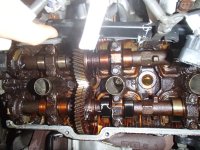
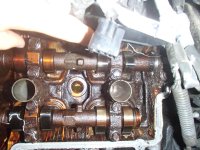
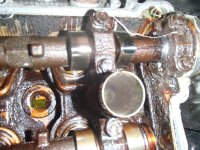
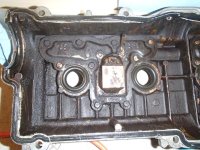
-taken off the passenger side valve cover and taken pics
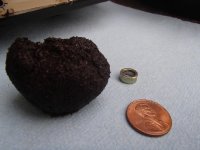
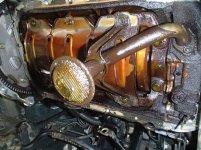
-dropped the oil pan and taken pics. (**In the oil pan I found a little bit of fine metal shavings and a small metal ring--maybe a valve spring seat or a valve lifter.**)
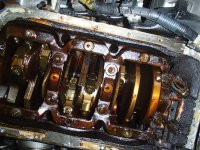
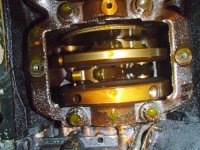
-dropped the pickup (oil strainer) and the baffle plate and taken pics of the crankshaft
-changed the oil, put SeaFoam in the oil, put SeaFoam in the gas, and ran SeaFoam through the intake
-Removed the oil sending unit and installed a mechanical analog oil pressure gage
-I have run a number of extended tests including driving it on the highway with the oil pressure gage
-Last, I have replaced the sending unit and drove it without getting the low oil pressure light.

The Haynes Repair manual states oil pressure ranges for only two rpm values: idle and 3000 rpm. At idle the oil pressure should be "at least 4.3 psi." At 3000 rpm, the oil pressure should be between 36 and 75 psi. While I was out driving with the mechanical oil pressure gage, I noticed that when the engine is hot and has been running, the pressure will drop to around 2psi at idle and will be around 36-38 psi for the second to two that I force the engine to up to 3000 rpm. When I drive at 60mph and 1800 rpm, the engine will maintain 21-22psi for 30 minutes.

I would like to know...
1. Is 22psi at 1800 rpm OK? What should the pressure range be for 1800 rpm?
2. How do I determine the root cause of the low oil pressure? Is there a way to tell if it is the bearings and not the pump?
3. Is the oil pressure in any way affected by any electrical component or is it simply a function of the crank's rpm, the amount and the viscosity of the oil, the play between the bearings, and the cleanliness of the oil passages?
 
Register to hide this ad
According to the FSM the minimum pressure as the Hayes states is 4.3 psi. If you are only at 2psi hot, then look for a replacement motor. Nothing short of a low end rebuild with the one you have will get the pressure back up. A main bearing may be on its way out.

Is this 4runner new to you or are you the original owner?
 
Thanks LittleCaesar. She's got 131,000 miles. I got it used in 2004 when it had 56,000 miles on it. How can you tell that it is a main bearing and not the pump?
 
Thanks LittleCaesar. She's got 131,000 miles. I got it used in 2004 when it had 56,000 miles on it. How can you tell that it is a main bearing and not the pump?

If the clearances in the bearings are large, it will allow greater flow and thus, reduce overall pressure. The same could be said for the rod bearings.
How did the crankshaft look? You didn't happen to pull any of the bearing caps and inspect the journals for scoring or anything, did you?
Thrown timing belt is interesting, was the cause for that ever determined?
Are the pictures you took of the crankshaft worth posting here?
 
I forgot to ask if there is/was any knocking in the lower or bottom part of the engine?

The oil pump doesn't produce or create pressure, it creates the flow for the oil and the resistance to that flow comes from the oil orifices as well as the clearance between the bearings and crank journals. You have flow, just not enough pressure. Plus I have never heard of a 5vz pump failing, but there is a first for everything.

This may help:
Signs of a Worn Out Engine Bearing - CarsDirect

I would say if you don't want to rebuild the engine (I would not) then find a low mileage used one. To keep the engine going while you look for another, possibly switch to a thicker grade oil as well as look into adding a quart of Lucas oil treatment. But neither is a long term fix.
 
Thrown timing belt is interesting, was the cause for that ever determined?

The timing belt was thrown when I was driving to the electrical shop with the low oil pressure light on (thinking it was electrical). They discovered that the tensioner was no good. That is all I can say.

How did the crankshaft look? You didn't happen to pull any of the bearing caps and inspect the journals for scoring or anything, did you?... Are the pictures you took of the crankshaft worth posting here?

I didn't disassemble the crankshaft. I simply dropped the pan and the baffle plate and took pictures looking up at it. I was just trying to assess if sludge was a definite problem. Trying to upload a couple of pictures of the crank. If they are helpful I can add more.
 

Attachments

  • P5170242.jpg
    P5170242.jpg
    146.4 KB · Views: 2,188
  • P5170232.jpg
    P5170232.jpg
    141.8 KB · Views: 1,533
I forgot to ask if there is/was any knocking in the lower or bottom part of the engine?

I don't hear any knocking or rattling. It sounds quiet to me. That is why I wonder if it is the pump. It would be a lot of work, but I think I'm going to take the pump off and check the clearances with a feeler gage. How else could I determine whether it was the pump or a bearing(s)?

What do you think this little silver ring is? I found it in the oil pan covered in dirty oil. That rock is not a rock it is just all of the solids that were in the pan; its condensed and globbed because I strained the dirty oil. The penny is just for size reference.
 

Attachments

  • P5170216.jpg
    P5170216.jpg
    119.3 KB · Views: 1,470
The more pics the better, though I am just making a guess(s) here. I'd love to see what underneath the valve cover looked like.

To me, from the three pics, it looks like the oil sometime in the past has had thermal breakdown, thus rendering it useless for lubrication protection. You shouldn't be able to pull that solid mess from the bottom of any oil pan unless the oil has been left in the crankcase for too long of a time period, plus all that

In one pic on the head of the two bolts look to have green coolant on them. Is that just due to having to remove hoses to get the oil pan off?

I wonder how many times the oil was changed by the previous owner? I had a girlfriend once who owned a Honda Civic since driving it off the lot new. By 41,000 miles she was still on the factory fill. I drained the oil, to find that only about 3/4 of a quart drained out.

The ring? Possible a spring retainer for the valve? No clue.
 
The more pics the better, though I am just making a guess(s) here. I'd love to see what underneath the valve cover looked like.

To me, from the three pics, it looks like the oil sometime in the past has had thermal breakdown, thus rendering it useless for lubrication protection. You shouldn't be able to pull that solid mess from the bottom of any oil pan unless the oil has been left in the crankcase for too long of a time period, plus all that

In one pic on the head of the two bolts look to have green coolant on them. Is that just due to having to remove hoses to get the oil pan off?

I wonder how many times the oil was changed by the previous owner? I had a girlfriend once who owned a Honda Civic since driving it off the lot new. By 41,000 miles she was still on the factory fill. I drained the oil, to find that only about 3/4 of a quart drained out.

The ring? Possible a spring retainer for the valve? No clue.
I agree 100%. Valve spring retainers or keepers as some call them are actually two halves of a full circle, so its not that, although I have no better guess anyway.
I do, however, foresee a new long block in your future based on what we know currently. I'll be waiting for updates on what you find!
 
I don't hear any knocking or rattling. It sounds quiet to me. That is why I wonder if it is the pump. It would be a lot of work, but I think I'm going to take the pump off and check the clearances with a feeler gage. How else could I determine whether it was the pump or a bearing(s)?

What do you think this little silver ring is? I found it in the oil pan covered in dirty oil. That rock is not a rock it is just all of the solids that were in the pan; its condensed and globbed because I strained the dirty oil. The penny is just for size reference.
that looks like a gasket spacer. do the valve covers use that type of spacer? maybe one was dropped at some point when the VC was off.
 
that looks like a gasket spacer. do the valve covers use that type of spacer? maybe one was dropped at some point when the VC was off.

Having taken off the valve cover, I don't recall any such spacer...

The more pics the better, though I am just making a guess(s) here. I'd love to see what underneath the valve cover looked like.

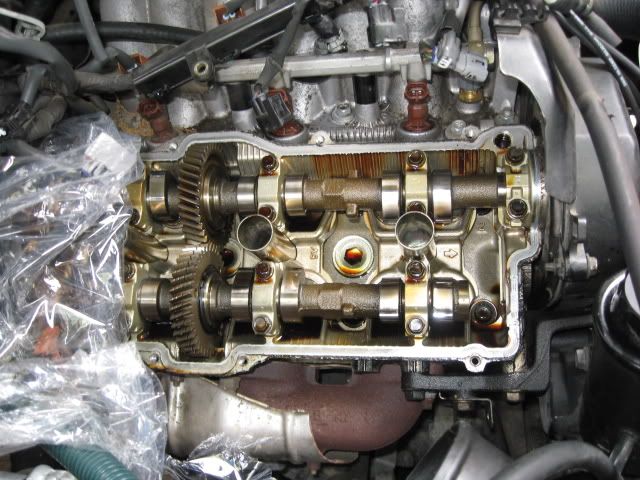
Per your request. I will try uploading some pictures of the passenger side camshafts and the valve cover.

In one pic on the head of the two bolts look to have green coolant on them. Is that just due to having to remove hoses to get the oil pan off?

If it is coolant, it could be b/c I had the valve cover off and a friend was looking at it and he blew on the hose from the reservoir to see if any oil was in the coolant. Some coolant then poured into the cylinder head with the VC off.
 

Attachments

  • P5150181.jpg
    P5150181.jpg
    140.4 KB · Views: 1,800
  • P5150183.jpg
    P5150183.jpg
    138.7 KB · Views: 1,481
  • P5150185.jpg
    P5150185.jpg
    138.6 KB · Views: 2,210
  • P5150188.jpg
    P5150188.jpg
    138.9 KB · Views: 1,478
All of these pictures were taken before I ran the SeaFoam through the oil, the gas, and the intake. I am curious to see what it looks like now after doing that.
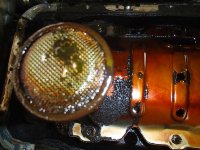
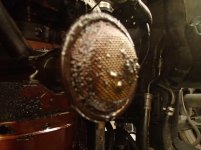
Here are some pictures of the strainer immediately after I dropped the pan without touching it. What do you think?
 

Attachments

  • P5170190.jpg
    P5170190.jpg
    143 KB · Views: 1,537
  • P5170193.jpg
    P5170193.jpg
    135 KB · Views: 2,074
  • P5170195.jpg
    P5170195.jpg
    125 KB · Views: 1,447
Here is what under my valve cover looked like just after 100,000 miles. Notice the difference:
IMG_0286.jpg~original


Somewhere in the life of this engine the oil was run for too long. Plus being in Houston it would not have hurt to be using a 10w-30 or 10w-40. Even Rotella T6 would have been good for it.

I have to ask if Firestone has been changing the oil since you have owned it? The Firestones around here in the South use Kendall oil, and is a pretty stout oil. The green stuff may also be the dye they used.
 
Here is what under my valve cover looked like just after 100,000 miles. Notice the difference:

Wow.

Somewhere in the life of this engine the oil was run for too long. Plus being in Houston it would not have hurt to be using a 10w-30 or 10w-40. Even Rotella T6 would have been good for it. . . I have to ask if Firestone has been changing the oil since you have owned it?

Yeah, since we owned it, my brother and I took it to Firestone for everything including oil changes. Clearly my engine has more sludge than it should, but to me it seems like it would have to be worse to cause the low pressure that I am experiencing. Do you think it would be a complete waste to look at the pump and get a new one if it is out of tolerance? Can't fix the past; trying to decide what to do going forward.
 
Wow.


Yeah, since we owned it, my brother and I took it to Firestone for everything including oil changes. Clearly my engine has more sludge than it should, but to me it seems like it would have to be worse to cause the low pressure that I am experiencing. Do you think it would be a complete waste to look at the pump and get a new one if it is out of tolerance? Can't fix the past; trying to decide what to do going forward.


Theres your issue. Stop going to firestone. I doubt they were actually changing your oil.
 
Not to throw Firestone under the bus quite yet, how long did you go between oil changes? Do you know what grade they were using? I know summers in Houston can be hot. Piranah may be correct in saying that they didn't change it once at least, but that is speculation on everyone's part.

You will need another engine or a rebuild. I'd go with the former. Nothing will bring the pressure back up for the long term. But for now I would use something as thick as Delo 15w-40 for oil. Then put the gauge back on and see if the thicker oil has helped with possibly increasing pressure. You may even add a quart of Lucas oil stabilizer if needed down the road.

Finding an independent mechanic wouldn't be a bad idea either. Show them the pics for sure.

I wouldn't pull the pump unless you have time to kill.
 

Members online

No members online now.

Forum statistics

Threads
278,315
Messages
3,554,130
Members
248,016
Latest member
Advally Service

Trending content

Back
Top