Mod Efficiency and Cost

I knew before lifting and installing all terrain tires I would loose power and mpg. My 4runner was did not full fill my needs stock. I off road a lot in the desert and need the extra clearance for rocks/washouts/sand etc and need tougher tires than stock. I do not mind giving up the 2-3 mpg I lost and would do it again. If someone is doing it just for looks it is harder to justify. The lose of power just takes some of the fun from the mods. This is a second vehicle for me now and I am retired so my 4runner does not see many miles in a year now (68k miles on my 03 I bought new).
 
I may not know more than Toyota engineers. However, I'm not constrained by corporate executives telling me an end product has to be within a certain price range for a particular demographic.

The fact of the matter is that if engineers were actually able to design an end product to their best of their ability with all the latest tech/gadgets with no price target in mind, you and I wouldn't be able to afford it. :)

Not only would you not be able to afford it you would not want it either because it would be dog ugly and have features that you could never figure out how to use nor had any real world application lol. What we have right now is good. What we would have if everything was left up to the engineers would be frightening.
 
What we would have if everything was left up to the engineers would be frightening.

Don't know about the rest of you but I sure will miss 1E once the Secret Society of Engineers sees this comment.

And since you may even not see THAT day.

:happy bda

RIP buddy.
 
Don't know about the rest of you but I sure will miss 1E once the Secret Society of Engineers sees this comment.

And since you may even not see THAT day.

:happy bda

RIP buddy.

It is so true, though. :lol: Engineers often lack the ability to segregate what they can design and what the customer wants/needs.

<-- now on the SSE hitlist.
 
I am sure there are many folks on this site who are very pleased with their results after modding their trucks, however it seems every forum I am a member of people comment about how most modifications do not actually make vehicles better.

I think for the majority of people if they did the analysis they would chose not to lift, upsize tires, and install roof racks etc. The truth is most of us do not have a $30k truck to use strickly for recreation, so take an honest look at the miles you drive even if you off-road every weekend I bet it only makes up 10% of the miles driven annually. Is the modest improvement in off road capability achieved through a 2 inch lift worth losing even 1 mpg?

First, this is an enthusiast web-site. So, I don't think most of us mod our trucks based on cost-analysis.

Many of us (including myself) installed lifts to improve the ride and correct nose-dive just as much as improve off-road performance. And there is no doubt it made my vehicle better....not to mention better-looking. As others have said, worrying about 1mpg after you buy a vehicle like this is ridiculous. The cost difference over a 1-year period is chump-change.
 
I like to look at the "Lifted Pic" thread every now and then to see what type of cool things members are doing to their vehicles. I have noticed questions every now and then on "what mpg's" people are getting after the lift and mods. I want to attempt to explain what happens to the "newer" members who are thinking of modding their vehicle so they go in with "eyes wide open" before picking their mods. I have not modded my 4Runner much but in the past I have heavily modified many vehicles. The 4Runner is no different than every other vehicle in respect to basic physics. I wanted to start a new thread with this so other threads would not go off topic. Here is a question asked in the "Lifted" thread:


I will be brutally honest:

If you lift it, you will lose efficiency
If you add bigger tires you will lose efficiency
If you add heavier wheels you will lose efficiency
If you add skid plates you will lose efficiency
If you add aftermarket bumpers you will lose efficiency
If you add any gear like drawers you will lose efficiency
If you add a cool Gobi roof rack you lose efficiency due to weight AND aerodynamics.
And the list goes on...

Basically if you lift it you will lose efficiency because you effectively are punching a bigger hole through the air and any added weight is a penalty too. In addition to adding weight in/on the vehicle by adding the weight in such items as wheels or tires there is an ADDITIONAL penalty of efficiency by having to accelerate the unsprung mass.
All of these items, taken by themselves, will not cause too much of a loss. You migt be able to make a slight mod from the above list and not see any efficiency penality. When you add them up however you could possibly lose up to 30-40% over your stock fuel efficiency. So if you average 20 mpg now with a stock unit you could go down to 12-14 mpg.
Let me put it to you this way: If you drove a stock unit getting 20 mpg 15K miles/yr with gas at $3.50/gal you would spend $2,625.00/yr. If you drove the same amount with mods getting 14 mpg you would spend $3,750.00 or a additional cost of $1,125.00/yr. Your call.

With that said, the mods I listed above can be extremely functional and needed depending on your application and look really cool to boot. I personally enjoy reading the mod threads and believe me, we have a talented group here who have turned their already capable stock vehicles into extremey capable modified machines. For the most part the guys who did these mods knew their efficiency would drop and were OK with that and the added cost of operation. I just wanted to start a thread for the new guys who might be modding to keep these things in mind. Thanks.

Very good point with the multiplicative efficiency hits, though I disagree with some of the things you've said; I noticed better efficiency with a Yakima SkyBox 12 center-mounted on my factory racks. Cross sectional area is important, but also how airflow is managed (e.g., management of turbulent eddies) plays a big role in efficiency. For instance, ski plates may reduce the apparent drag beneath the car and thereby enhance efficiency, but perhaps not significantly enough for someone to notice. The only real way to know if a particular modification has some kind of impact and to what magnitude is to run FEA flow simulation or measure MPG for several months before and several months after a mod (e.g., ANOVA).
 
Lots of good engineering tidbits above. I was taught that there are multitudes of challenges when moving any vehicle. In aeronautics these challenges usually fall under the umbrella called drag. There are two types of drag which the T4R roof could effect; Induced and Parasite. Induced being the far larger amount of drag which is simply the area of the T4R when looking at it straight ahead. Parasitic drag is created by friction and loads on items within our vehicles. Most of the time these things are unavoidable. When we install Baja and Gobi roof racks, then load them up with Pelican cases and canoes, we create a moving science project. Without getting into too much detail the parasitic drag is significantly lower than induced drag and only overtakes it at very high speeds.

Modern vehicle design and manufacturing technology have reduced many of these inefficiencies. The initial robber (where the rubber meets the road) of efficiency is our tires. The weight of a T4R pushes down on the tires, therefore a heavier vehicle, or one with greater downforce (when there is downforce), will cause a great amount of friction between the road and the tires. By placing less rubber on the road (like a 255 instead of a 285) and using more air pressure we can reduce rolling resistance. As some have opined, if fuel hypermileage was our goal, we’d all be driving a Prius.
 
Unfortunately, individual cases cannot be characterized. For example:

I notice your location is in the higher altitude region. What is your gas milage at sea level? This link Gas Mileage Tips - Driving More Efficiently gives you but a few variables that influence fuel economy from another 4Runner owner in, say Florida. You will notice it says (and I paraphrase) "every 100 lbs added leads to a 2% drop in efficiency." I think for our vehicles that could be a little less than 2% but not much. Add the bumpers and skid plates and you could be going from your 20 mpg to 18 mpg. Point is many factre influence your gas milage. My above post was to inform on what will happen as you add weight and lift. You WILL lose, how much depends on the individual.

My AT tires in stock size are over 1" wider than what came on the 4Runner. I have only noticed a marginal decrease (less than 1 mpg) in efficiency after 5000 miles on the new tires. I will know more as time goes on.

I did not buy a 4Runner for maximum efficiency. With that said I do want it to perform at expected efficiency of around 20 mpg. If I wanted max I would have got a little tiny car to drive lol.

I believe some empirical data points, including the one you provided, would be very helpful to the board. The idea that mods = decreased MPG is fairly obvious, it is the magnitude that is of interest. Surely the experiences of our membership can give an indication of whether an AT tire and mild lift will result in an average of MPG drop of 2, 4, 6, or 8 etc. If owners can state relevant mods (tint % not required), % city and % highway driving, and average MPG (making sure all entries adjust for non stock tire size), we could start to get a feel for MPG impacts. Then you, 1engineer, can develop some predictive equations with variables for lift height, tire size, altitude, driving style etc etc (mostly kidding). No small task but perhaps one this board would greatly benefit from.
 
I believe some empirical data points, including the one you provided, would be very helpful to the board. The idea that mods = decreased MPG is fairly obvious, it is the magnitude that is of interest. Surely the experiences of our membership can give an indication of whether an AT tire and mild lift will result in an average of MPG drop of 2, 4, 6, or 8 etc. If owners can state relevant mods (tint % not required), % city and % highway driving, and average MPG (making sure all entries adjust for non stock tire size), we could start to get a feel for MPG impacts. Then you, 1engineer, can develop some predictive equations with variables for lift height, tire size, altitude, driving style etc etc (mostly kidding). No small task but perhaps one this board would greatly benefit from.

LOL -- you want what's called a "design of experiment" =P
 
Road Trip Report aka I love this truck.

VERY interesting post. We gots some smart dudes on here.

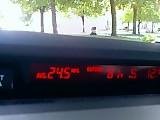
As this thread deals with mileage, I thought I’d post my recent experience. I have “upgraded” my 4R to correct it’s (IMO) driving/handling dynamics, which I did not care for after living with it awhile - and it is now dialed in to where it is a pleasure to drive. Specifically; caster set to 4* (thanks Harper), P-rated Continental tires at 35#, (thanks 1-E), and Bilstein 5100s all around.

I just returned from a 1,000 mile trip, which was my first extended trip in the 4R after above changes.

This was taken at the end of day 2 at ~ 450 miles - consisting of 30% Interstate (65-72 mph), 65% rural highway (45-55 mph), and 5% small town.
MPG2.jpg

Upon return home the mpg display read 22.1 for the trip overall, the return being more interstate, mostly at ~72 mph, and some 55 mph construction zones. Also, the A/C was run 85% of the trip as temps were 85-95* the entire trip, and yes, I’m a gentle driver.

This is a great road trip vehicle now. Handling, visibility, comfort, room, and what I call an on-road ‘presence’ that I like. We have decided that more road trips will be forthcoming.

I agree with most - I drive this truck because it’s what I want and like, and I honestly don’t care about the mileage, but it’s pretty good and that ain’t bad.

 

Attachments

  • MPG2.jpg
    MPG2.jpg
    3.9 KB · Views: 462
Bumping up an old thread here because I have gotten several pm's lately on the age old question "How much is my gas mileage going to drop if I _____(insert mod here)." Here is a thread created awhile back and yes, it applies to 2014+ 4Runners.
 
.....
My AT tires in stock size are over 1" wider than what came on the 4Runner. I have only noticed a marginal decrease (less than 1 mpg) in efficiency after 5000 miles on the new tires. I will know more as time goes on.

I did not buy a 4Runner for maximum efficiency. With that said I do want it to perform at expected efficiency of around 20 mpg. If I wanted max I would have got a little tiny car to drive lol.


1E - Thanks for bumping this thread today. I missed it the first time and today I have been able to read from start to last post.

Winter is coming and our original tires have 44K on them so I started researching. After reading all the posts, I find myself getting so worked up on the weight of the replacement tires and loosing efficiency/MPG. I believe my current Bridgestones weighed in at 39lbs each new (using Tirerack.com as a reference) and all the replacement tires I am looking at start at 42lbs and go up in weight from there. Am I getting worked up unnecessarily over a few pounds of unsprung weight or are my concerns worthy?

Just curious which stock sized tire you purchased that ended up being 1" wider than the stock tire? If my memory is correct I think you purchased Cooper's but I don't remember which ones. If possible, I hope to make the truck look slightly less anemic with the new tires I purchase.
 
1E - Thanks for bumping this thread today. I missed it the first time and today I have been able to read from start to last post.

Winter is coming and our original tires have 44K on them so I started researching. After reading all the posts, I find myself getting so worked up on the weight of the replacement tires and loosing efficiency/MPG. I believe my current Bridgestones weighed in at 39lbs each new (using Tirerack.com as a reference) and all the replacement tires I am looking at start at 42lbs and go up in weight from there. Am I getting worked up unnecessarily over a few pounds of unsprung weight or are my concerns worthy?

Just curious which stock sized tire you purchased that ended up being 1" wider than the stock tire? If my memory is correct I think you purchased Cooper's but I don't remember which ones. If possible, I hope to make the truck look slightly less anemic with the new tires I purchase.

If you were racing your 4Runner you should be worried. For normal driving, a few lbs of unsprung mass won't bother anything. Ten lbs or so per wheel will reduce the efficiency enough to see a difference at the pump, especially if you do a lot of stop and go driving.
I did purchase the Cooper AT3's and after 25K miles they are still doing a good job. The extra inch of width so far has not decreased my overall average by even a 1/10 according to my calculations. I'm sure it does reduce it some but not enough to really matter. Good luck!
 

Members online

Forum statistics

Threads
278,305
Messages
3,554,044
Members
248,016
Latest member
Advally Service

Trending content

Back
Top
