I am a new 4runner owner. This is also the first vehicle that is more or less my own. I did quite a bit or research before settling on this vehicle and a big thanks to 4-Ripcord for the 3rd gen buyers guide. I have lots of questions, some of them 4runner specific some of them are more general. If any of them are answered I will be more than grateful.
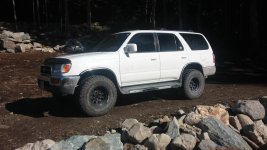
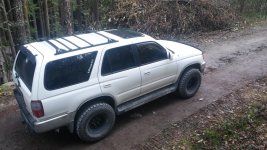
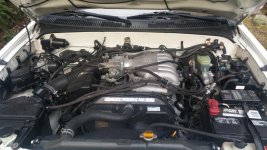
The vehicle: 1996 4runner SR5, 3.4L v6 4x4 automatic transmission. 264,000 miles and I picked it up for $4,500. The previous owner was a toyota technician and I believe the 4runner has been serviced at a dealership for most of its life. It appears well taken care of. The engine is clean, no leaks that I can tell and most everything is in good condition.
My driving conditions: I live in the mountains of British Columbia. It is 8 miles down the most heinous dirt road I have ever lived on to town. The roads where I live are mostly smooth highway or backwoods logging roads. They don't salt that much because down in town it usually rains and where it does snow is mostly just plowed and sanded.
What I have done to it: I replaced the PCV valve and grommet. I had the transmission fluid and differential fluid changed along with the oil change. I replaced the air filter in addition to a couple burnt out LED's and a marker bulb.
The big question: This is the highest mileage vehicle I have ever owned. How can I get the most out of it? Should I just drive it into the ground, doing just enough maintenance to keep it rolling? Or if I do preventive maintenance and try and keep everything as it should be will it go the distance?
MPG: I am getting pretty terrible mpg's. I go about 200 miles before I have to refuel, this roughly when the gas light comes on. I think this is a bit low even with all the vertical feet of climbing that it has to do every day. There is no engine light on, but perhaps the O2 sensors are bad. I don't know if they have ever been changed (it looks like $80 a sensor so I am hesitant to change it if it doesn't need it). Is there a way to check the O2 sensors myself? I also plan on changing the fuel filter when I find the time. And maybe run some SeaFoam right before my next oil change.
Brakes and tires: The tires that came with the vehicle are 32x11.50R15LT. They are a bit big and I don't go mudding, however I have come to fall in love with them anyway. I think they are contributing to my terrible gas mileage. I was very interested in doing the tundra brake upgrade because I am breaking so much when driving (rolling) down to town. After some research I realized that the calipers won't fit on 15" rims. I also need winter tires in the next month or so. Here is my conundrum, do I keep on going with the standard 4runner brake set up and get winter tires for the 15's or do I go out and buy bigger rims so I can fit the tundra calipers on there. I was told when I got it checked out that one of the front calipers is really sticky and will need to be replaced soon. Are calipers something that need to be replaced at the same time? For example, can I replace one caliper or will I need to replace both at the same time? I like the look of the big beefy tires, but I have heard that as far as winter tires go, the thinner the better in order to cut through the snow and ice. Any suggestions here? The last question is what sort of maintenance needs to be done to the rear drum brakes to keep them ship shape?
General questions: The road I live on has more washboards than the 19th century and pot holes that could comfortably fit a baby. I am afraid the whole vehicle is just going to rattle apart. I believe it still has the stock suspension and springs on it. Is there anything I can do to prolong the life of my 4runner on these conditions? New shocks? Different shocks?
There is shrieking noise when I am accelerating between 15 and 30 mph, I was told this could be a hole in the muffler or bent bits in the exhaust manifold (I don't really know). Any insight here? Perhaps it just needs some Tiger Patch tape?
Everything that I can do to my 4runner right now comes down to resources. Money is very tight right now and winter tires are pretty much all I can afford with a little extra left over to keep things running well. In a perfect world I would fix everything I could, but it doesn't work like that right now. What should I prioritize in terms of general preventive maintenance? Finally, any general tips for a new 4runner owner would be awesome. Thank you for reading the wall of text.
The vehicle: 1996 4runner SR5, 3.4L v6 4x4 automatic transmission. 264,000 miles and I picked it up for $4,500. The previous owner was a toyota technician and I believe the 4runner has been serviced at a dealership for most of its life. It appears well taken care of. The engine is clean, no leaks that I can tell and most everything is in good condition.
My driving conditions: I live in the mountains of British Columbia. It is 8 miles down the most heinous dirt road I have ever lived on to town. The roads where I live are mostly smooth highway or backwoods logging roads. They don't salt that much because down in town it usually rains and where it does snow is mostly just plowed and sanded.
What I have done to it: I replaced the PCV valve and grommet. I had the transmission fluid and differential fluid changed along with the oil change. I replaced the air filter in addition to a couple burnt out LED's and a marker bulb.
The big question: This is the highest mileage vehicle I have ever owned. How can I get the most out of it? Should I just drive it into the ground, doing just enough maintenance to keep it rolling? Or if I do preventive maintenance and try and keep everything as it should be will it go the distance?
MPG: I am getting pretty terrible mpg's. I go about 200 miles before I have to refuel, this roughly when the gas light comes on. I think this is a bit low even with all the vertical feet of climbing that it has to do every day. There is no engine light on, but perhaps the O2 sensors are bad. I don't know if they have ever been changed (it looks like $80 a sensor so I am hesitant to change it if it doesn't need it). Is there a way to check the O2 sensors myself? I also plan on changing the fuel filter when I find the time. And maybe run some SeaFoam right before my next oil change.
Brakes and tires: The tires that came with the vehicle are 32x11.50R15LT. They are a bit big and I don't go mudding, however I have come to fall in love with them anyway. I think they are contributing to my terrible gas mileage. I was very interested in doing the tundra brake upgrade because I am breaking so much when driving (rolling) down to town. After some research I realized that the calipers won't fit on 15" rims. I also need winter tires in the next month or so. Here is my conundrum, do I keep on going with the standard 4runner brake set up and get winter tires for the 15's or do I go out and buy bigger rims so I can fit the tundra calipers on there. I was told when I got it checked out that one of the front calipers is really sticky and will need to be replaced soon. Are calipers something that need to be replaced at the same time? For example, can I replace one caliper or will I need to replace both at the same time? I like the look of the big beefy tires, but I have heard that as far as winter tires go, the thinner the better in order to cut through the snow and ice. Any suggestions here? The last question is what sort of maintenance needs to be done to the rear drum brakes to keep them ship shape?
General questions: The road I live on has more washboards than the 19th century and pot holes that could comfortably fit a baby. I am afraid the whole vehicle is just going to rattle apart. I believe it still has the stock suspension and springs on it. Is there anything I can do to prolong the life of my 4runner on these conditions? New shocks? Different shocks?
There is shrieking noise when I am accelerating between 15 and 30 mph, I was told this could be a hole in the muffler or bent bits in the exhaust manifold (I don't really know). Any insight here? Perhaps it just needs some Tiger Patch tape?
Everything that I can do to my 4runner right now comes down to resources. Money is very tight right now and winter tires are pretty much all I can afford with a little extra left over to keep things running well. In a perfect world I would fix everything I could, but it doesn't work like that right now. What should I prioritize in terms of general preventive maintenance? Finally, any general tips for a new 4runner owner would be awesome. Thank you for reading the wall of text.