new engine knock after seafoam?

Scotty_h

New member
So I have just completed a motor/transmission installation on a 99 SR5 with 301 K on motor. I filled up the oil with NAPA 10W30 and have been driving for 140 miles. One thing that I had noticed was my low oil level light flicker on after about 25 minutes of driving. Since I had seen some (a shit load) of sludge build up that I had vacuumed out. I applied about 4/5 of a can of Seafoam to the oil as I was thinking that some port blockage had occurred.

Today, I drove 40 more miles and had the light flicker up again so I pulled off at the next exit with an engine knock. (all the while the oil level was good) I figured that it was a perfect time for an oil change. While changing out the dirty, it appeared thin. Maybe too thin?

Drove another 80 miles with no oil light flicker but the knock sounds like it is here to stay.:faint2:

so.... Could seafoam have thinned out my oil causing the new oil pump not to carry it, starving my engine and leaving me with this knock? I know it's an old engine, but this problem is without a doubt because of the recent fluid changes.
 
Register to hide this ad
Drain oil and run the oil through a paper filter, look for metal shavings. To me sounds like an old/failing oil pump causing oil pressure to sometimes drop, causing maybe the oil light and a bad rod bearing.
 
Drain oil and run the oil through a paper filter, look for metal shavings. To me sounds like an old/failing oil pump causing oil pressure to sometimes drop, causing maybe the oil light and a bad rod bearing.

New oil pump installed on this motor. I like the input though. Im gonna run a tank through it tmrw i guess and see how it goes. Considering going for a thick oil. Might wait until it warms up though
 
so.... Could seafoam have thinned out my oil causing the new oil pump not to carry it, starving my engine and leaving me with this knock? I know it's an old engine, but this problem is without a doubt because of the recent fluid changes.

It sounds like the main or rod bearings were washed out from the Seafoam. If the oil pump wasn't making pressure the oil light would have come on.

4/5 of a can seems like a lot. I have had good success using Seafoam to break down sludge on newly acquired cars by using 1/2 a can and letting it idle for 20 min (less load on the bearings) then doing an oil and filter change rite away, the oil is super dirty and thin coming out.
 
Sooo.... I will update that I did another oil change today with lucas oil stabilizer and 10W40. The knock is here to stay. I drove for another 100 miles with no check engine lights or power loss issues, but the knock is persistant.

What I believe happened was that after breaking loose all of my sludge underneath my valve covers, i ran the oil filter too long. It needed to be changed out within 100 miles or less. The amount of time that it took to have the oil light come on was a buildup of small fines that plugged up the filter, thus starving the motor of oil. I'm an idiot. Seafoam did not cause this, but I still should not have driven with it in.

So, expensive lesson, but lesson learned. Take the word of the ghost from engines past.
 
At least that happened to the motor/rig you're getting rid of...

If I can be thankful of anything, it is that. Kharma keeping me from making money on this vehicle I suppose.

If I found a new motor for this one, I guess I would make money by tossing it in....
 
The problem with Seafoam is when it breaks down all that sludge and other debris from the interior of your engine, that stuff can end up clogging the oil pick ups and pathways inside your engine, possibly starving your engine of oil.

It has happened to a few people I know and is the direct reason I prefer to not use the product. Now I'm not here to chew you a new one, but the above is a pretty good possibility of what happened, although I hope it didn't.

Good Luck, and I hope your other trusty steed enjoys its nice new powertrain. A fitting gift for an old pal.

Edit: seems you already figured out the problem. Tough luck. I guess at 301k you weren't the only one ready to throw in the towel.
 
Last edited:
Not the first time I've seen this happen saw a dodge taken to jiffy lube and they put sea foam in and ruined his engine.
 
The problem with Seafoam is when it breaks down all that sludge and other debris from the interior of your engine, that stuff can end up clogging the oil pick ups and pathways inside your engine, possibly starving your engine of oil.

It has happened to a few people I know and is the direct reason I prefer to not use the product. Now I'm not here to chew you a new one, but the above is a pretty good possibility of what happened, although I hope it didn't.

Good Luck, and I hope your other trusty steed enjoys its nice new powertrain. A fitting gift for an old pal.

Edit: seems you already figured out the problem. Tough luck. I guess at 301k you weren't the only one ready to throw in the towel.

This only applies to putting Seafoam in the OIL, right?
 
Same Thing Happened to Me

Don't feel so stupid Scotty h, almost the exact same thing happened to me.

Purchased a used '98 4Runner several years ago. It had 135k on it. Three hundred miles after I bought, (no joke....300 miles), it developed a whine in the engine that would come up about 20 seconds after start up and would continue until shut down. I thought it was a power steering pump or bad belt but I wanted another opinion so I took it to a mechanic I knew and trusted.

He changed the oil and said it looked like it hadn't been changed in quite some time. He even went to the trouble to show me the old filter and oil that came out of it. His exact words were "I have solved lots a problems by changing the oil." Well sure enough the whine disappeared.

He recommended I do several oil changes over the next few miles/months which I did. No problems at all from the engine and whine was gone and stayed gone. Even drove it from TN to TX and back. Best to my memory I got something like 18-20+ miles MPG on the trip.

Followed my mechanic's advice and changed oil 3 times over the next 5k miles. Again, no problems.

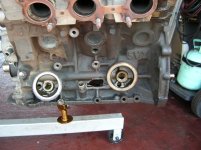
Then at 140,040 I got wise and Seafoamed the engine. Did exactly what the can said do, 1 oz. per quart of engine oil (think I got that right). Drove it for 78 miles to 140,118 and then changed oil. Used 5W-30 just as the manual said and Toyota oil filter. Then at 140,171.....63 measly miles later.......it threw a rod (see picture of engine below).

I think Seafoam is a good product and I don't know if it caused my problem or not, but looking back I wish I had followed my friends advice and just changed the oil more frequently. His advice worked for 5,000 miles. 63 miles after Seafoam I was walking.

The money I spend on a remanufactured engine would have paid for a whole bunch of oil changes. Several mechanic have told me the best way to clean an engine out is to just simply keep the oil changed.

I'm not an expert, but I agree with THatfield with what happened to me in my case.

On a simiar note, a friend of mine had a Ford 3/4 ton with a V8. It knocked too for what seemed like years. He wanted to fix it, but his mechanic told him not to but to drive it until it died.

It finally did one day. Threw a rod. He was towing a horse trailer that day. Needless to say he was very mad when it happened.

Knocks in engines just aren't good.
 

Attachments

  • DSCN1937.jpg
    DSCN1937.jpg
    134.8 KB · Views: 5,685
This only applies to putting Seafoam in the OIL, right?

Good question... I think so... I mean, i put in the 1/5 of the can in through the PCV suction. I think this may have something to do with me cleaning out the valve covers. A new filter should have gone on in 20 miles.
 
Yes only the oil. Putting it in your gas I have heard people say they saw improvement in gas mileage but never experienced it myself a friend put it in his Honda made a bunch of smoke and he said didn't make a difference in anything. He also put it in his oil (after I told him it was a bad idea) and he changed it soon after and then no joke 100 miles later broke connecting rod number 3. Unfortunately it didn't go through the block so the was no fun carnage.
 
Yes only the oil. Putting it in your gas I have heard people say they saw improvement in gas mileage but never experienced it myself a friend put it in his Honda made a bunch of smoke and he said didn't make a difference in anything. He also put it in his oil (after I told him it was a bad idea) and he changed it soon after and then no joke 100 miles later broke connecting rod number 3. Unfortunately it didn't go through the block so the was no fun carnage.
At least your friend and his Honda made it 100 miles. I only made it 63.
 
The problem with Seafoam is when it breaks down all that sludge and other debris from the interior of your engine, that stuff can end up clogging the oil pick ups and pathways inside your engine, possibly starving your engine of oil.

It has happened to a few people I know and is the direct reason I prefer to not use the product. Now I'm not here to chew you a new one, but the above is a pretty good possibility of what happened, although I hope it didn't.

Good Luck, and I hope your other trusty steed enjoys its nice new powertrain. A fitting gift for an old pal.

Edit: seems you already figured out the problem. Tough luck. I guess at 301k you weren't the only one ready to throw in the towel.

Hmmm, while it sounds suspicious that there are several stories of guys throwing a rod shortly after using seafoam, are y'all sure that the rod wasn't thrown because of the underlying reason folks out the seafoam in, and not because of the seafoam?

I know, that's an obvious point, but still should be made. I have heard a lot of other guys swear by seafoam, especially in motorcycles. I have used it several times in my engine oil and in my intake and I am satisfied enough with it to keep using it. I think problems really only arise when you have a high mileage vehicle that you suddenly load with seafoam. I bet if you added it gingerly just before oil changes for a while, giving it time to work slowly and wash everything into the filter, then you'd be fine. Kind of the same principle behind not switching a high mileage engine over from conventional to synthetic oil, it may clean out the engine and uncover leaks that were clogged by sludge.
 
I would have to agree... Seafoam is still a good product. The problem lies in not filtering the oil well enough afterward in my instance.
 

Members online

Forum statistics

Threads
278,309
Messages
3,554,071
Members
248,016
Latest member
Advally Service

Trending content

Back
Top