My first inclination was to not post another comment on this thread because I don’t want to get into an endless debate on Seafoam. But after a period of long thought, I realized these threads live long after many of us are gone and future Toyota 4Runner (car) owners need a well-rounded view of the use of the product and that involves hearing both sides of the debate. Their car engines depends on it. When I used it on my ill-fated adventure, I had read many, many threads from other websites.
In response to Nelsonmd’s comment regarding a high mileage vehicle that “….you suddenly load with seafoam. I bet if you added it gingerly just before oil changes for a while, giving it time to work slowly and wash everything into the filter, they you’d be fine.” I did add it gingerly, per Seafoam’s directions, and I had problems.
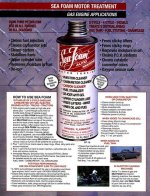
I have attached a flyer I obtained from the Seafoam website just prior to my use of it in my 4Runner. Please note I was correct in my previous (long winded) post when it directs to use 1 ½ oz. per quart of oil.
And nowhere did I see a limit on the flyer on how long it should stay in your oil. But it does recommend the product be used every 2,000 to 5,000 miles. I apologize that the flyer is hard to read but that is exactly how I downloaded it from their website in the fall of 2008.
Here is another website which also lists the directions for Seafoam’s use.
The Truth About Seafoam - Car Forums and Automotive Chat
My recommendation is if you want to try something that will help your vehicle run better, don’t ingest Seafoam through a vacuum hose but rather disassembly and clean your Throttle Body (TB) and Mass Air Flow (MAF) Sensor.
One very good post with excellent directions for this cleaning procedure is here:
Toyota 4Runner Highlander Throttle Body cleaning and O Gasket Mod
Another good post from this website with the cleaning and O-gasket change is here:
http://www.toyota-4runner.org/3rd-gen-t4rs/47063-trd-throttle-body-o-gasket.html
In case either of the two above websites disappear sometime in the future or the links fail to work, Google “Throttle Body Cleaning and 'O' Gasket Mod” or “Modification” and they, or similar links, should come up.
I also recommend disassembling your Idle Air Control (IAC) valve from the TB and cleaning that too. After following the above procedure, cleaning and reassembling those three things (TB, MAF, and IAC) did more good for my 4Runner than any can of Seafoam ever did. Period. It starts better, idles better (lower RPM and smoother), and responds much quicker.
And I agree with many others—including my trusted mechanic—who recommend using a good quality oil and oil filter and changing them frequently to avoid any serious engine problems. As I said in my previous post on this thread, I followed this advice and my 4Runner’s original engine ran for 5,000 miles after I purchased it. I used Seafoam in the oil once and it didn’t last 63 miles.
In my humbler opinion it’s not a coincidence my engine failed after I used Seafoam. It’s a fact. And yes, I think the product caused the failure.
But I also agree with: to each his own regarding products and which to use and not use. But I also felt a sense of responsibility to all the future Toyota owners who will read this thread and need to hear another story about its use.
Placing Seafoam in an engine’s oil is playing Russian roulette in my opinion. Sometimes the hammer falls on an empty cylinder and sometimes it doesn’t. In my case the hammer fell on a loaded cylinder on the very first time and my engine (and wallet) paid the price.
Once was enough for me. Never again.