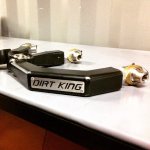
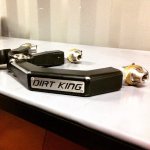
NPA: Dirt King Boxed Control Arms for the 2010+ 4Runner - Best UCAs for the money!

New product announcement from Dirt King Fabrication in San Diego, CA - Boxed Upper Control Arms for the 2010+ 4Runner (Fits Tacoma, FJ)

If you’re thinking of lifting your vehicle these arms are a must. These upper control arms increase caster for proper alignment and improved handling. They feature a fully boxed design that offers maximum strength and replace the factory ball joints with 1" stainless steel uniballs. The uniballs are lined with Teflon to help prevent noise. DK fully assembles their arms and include detailed instructions making installation quick and easy.

Boxed Upper Arm - Bushing - DK-811902


DK-811902 - Boxed Upper Control Arms
-Urethane Bushings
-Zinc Coated Bushing Washers
-1.0" Stainless Steel Uniballs (WSSX16T)
-Grade 8 hardware
-304 Stainless Steel High Misalignment Spacers
-Powder Coated Black

Boxed Upper Arm - Heim - DK-811903


DK-811903 - Boxed Upper Control Arms
-3/4” heims (JM12T)
-1.0” Stainless Steel Uniballs (WSSX16T)
-Grade 8 hardware
-304 Stainless Steel High Misalignment Spacers
-Powder Coated Black

Looking for more info? Click the part number links above, or the pictures to see the product page.

Want to buy? Click the links above, add to cart and enter the code T4R for an instant discount!!


We are one of four authorized Dirt King Suspension Dealers! We offer free shipping on all Dirt King products to the lower 48 states and can get you setup with international shipping if desired. Contact us at 702.979.1577 or email [email protected] for more info


Compatibility
2005+ Tacoma 6 lug 2WD/4WD
2003+ 4Runner 2WD/4WD
2007+ FJ Cruiser 2WD/4WD

International vehicles
2003-2009 Prado 120
2003-2009 Lexus GX 470
2005+ Hilux Vigo
2009+ Prado 150
 
Register to hide this ad
what is the advantage of a box style over a tube style? seems to me that with a boxed UCA, every time you change the angle along the radius of the arm, you have to cut and weld a new piece, whereas with a tube style, there are no welds throughout the radius, and therefore fewer locations for a possible failure.
 
Last edited:
what is the advantage of a box style over a tube style? seems to me that with a boxed UCA, every time you change the angle along the radius of the arm, you have to cut and weld a new piece, whereas with a tube style, there are no welds throughout the radius, and therefore fewer locations for a possible failure.

I'm not affiliated with OP / Dirt King, but I'll take a SWAG and these are generalizations that might apply to all control arms.

lb/lb they probably will have roughly the same strength. Welding shouldn't reduce the strength if done properly (base material, weld quality, post treat...). At least welding shouldn't reduce the strength of the material any more or less than bending a tube should (thinning, cracking, cold working, post treat...). So why does one company offer square tubes with miter cuts and weld vs. round tube with bends and weld (ends or are they tapping / threading / hogout...lots of ways to skin a cat). Probably is what they have available and is easy for them to do. They don't have to go out and buy other hardware, or they determined it's less expensive for them to meet all of the design requirements with the method they've chosen.

Now if someone wanted to buy control arms from every supplier and put them on a load table, that would be awesome!

My question is are the factory ball joints that bad and how long will the uniball last? I'm mostly concerned about reliablity and don't want to rebuild / remove & replace spherical bearings if rubber bushings and factory ball joints get the job done. (This question / comment is not specific to Dirt King but all of the aftermarket control arms)
 
I'm not affiliated with OP / Dirt King, but I'll take a SWAG and these are generalizations that might apply to all control arms.

lb/lb they probably will have roughly the same strength. Welding shouldn't reduce the strength if done properly (base material, weld quality, post treat...). At least welding shouldn't reduce the strength of the material any more or less than bending a tube should (thinning, cracking, cold working, post treat...). So why does one company offer square tubes with miter cuts and weld vs. round tube with bends and weld (ends or are they tapping / threading / hogout...lots of ways to skin a cat). Probably is what they have available and is easy for them to do. They don't have to go out and buy other hardware, or they determined it's less expensive for them to meet all of the design requirements with the method they've chosen.

Now if someone wanted to buy control arms from every supplier and put them on a load table, that would be awesome!

My question is are the factory ball joints that bad and how long will the uniball last? I'm mostly concerned about reliablity and don't want to rebuild / remove & replace spherical bearings if rubber bushings and factory ball joints get the job done. (This question / comment is not specific to Dirt King but all of the aftermarket control arms)

you raise some interesting points, and you're right in that a weld SHOULD not reduce the strength of a UCA. what this community has seen with Light Racing UCA's is that welds do break. What kind of quality control is going into these specific UCA's to ensure that the welds have good penetration and no porosity? it would appear that welds on the radius have been ground flat and heavily powder coated, so there is really no way to tell without x-raying the piece.

your point about aftermarket UCA's in general is more easily answered. Uniballs and misalignment spacers provide for more adjustment in castor, allowing a lifted vehicle to remain within alignment spec. As for maintenance, I recently replaced the spherical bearings on my Total Chaos UCA's. If you have the correct tool, and are comfortable turning wrenches, this can be done in about 90 minutes, and you do not need to remove the UCA's from the truck.

Total Chaos Uniball tool
96006.jpg


Edit: these UCA's use the exact same spherical bearing as the TC's, WSSX16T from FK Rod Ends. they're about $33 each to replace
 
Last edited:
you raise some interesting points, and you're right in that a weld SHOULD not reduce the strength of a UCA. what this community has seen with Light Racing UCA's is that welds do break. What kind of quality control is going into these specific UCA's to ensure that the welds have good penetration and no porosity? it would appear that welds on the radius have been ground flat and heavily powder coated, so there is really no way to tell without x-raying the piece.

your point about aftermarket UCA's in general is more easily answered. Uniballs and misalignment spacers provide for more adjustment in castor, allowing a lifted vehicle to remain within alignment spec. As for maintenance, I recently replaced the spherical bearings on my Total Chaos UCA's. If you have the correct tool, and are comfortable turning wrenches, this can be done in about 90 minutes, and you do not need to remove the UCA's from the truck.

Total Chaos Uniball tool
96006.jpg


Edit: these UCA's use the exact same spherical bearing as the TC's, WSSX16T from FK Rod Ends. they're about $33 each to replace

http://www.toyota-4runner.org/5th-gen-t4rs/151942-official-spc-light-racing-product-update.html
---
SPC's history
Version 1 - Rubber bushings, large washers on all sides (8 washers).
Version 2 - Poly bushings, large washers on all sides (8 washers). These are the ones that fail in high temp climates. The large washers "squeeze" the bushing to the point of collapse. This does not allow the control arm to pivot on the bushing. Effectively, making the control arm bend up and down at the welds.
Version 3 - Poly bushings, 4 large washers, 4 small (2 large washers on the outer most part of control arm, 2 small washers on the inside). This was SPC's solution to an extended sleeve. This does not allow the bushings to be completely compressed by large washers.
Version 4 - Poly bushings, 4 large washers (2 large washers on the outer most part of control arm). In this version the sleeve is longer and is completely butt up against the "tower tube".
---

Seems like the weld failures may have been due to an over constraint (clamped bushings) and the weld was probably at the end where the bushing tube gets welded on in either a formed tube or boxed weldment. Not sure that one design is really 'better' than another pound for pound, dollar for dollar.

Regarding the uniball, why not use the stock ball joints and build the offset into the control arm. Most people don't plan on changing their suspension geometry significantly (>1-inch) once setup. Toyota obviously has no problem allowing the stock ball joint to handle the new geometry on the 4Runner, Tacoma, and Tundra with their lifted TRD suspensions. Perhaps there is a small amount of travel to be gained but unless I'm going long travel I don't particularly want the uniball. This is really just a general comment and not directed at any of the aftermarket manufacturers as they all seem to follow the same trend.
 
what is the advantage of a box style over a tube style?
6n.jpg

The forces are not equal along the length of the tube. With welded arms you can -theoretically - increase the strength where loading is highest. It's not clear whether each panel of the form is the same thickness.

I suspect that the primary reason is manufacturing ability of the manufacturer and there is no optimization of weight/strength actually happening. If there were, we'd probably be seeing hydroformed aluminum UCAs for $1000 ea. I suspect the factor UCAs are better engineered than any of the aftermarket ones and have significantly better strength to weight ratio.
 
Last edited:
The forces are not equal along the length of the tube. With welded arms you can -theoretically - increase the strength where loading is highest. It's not clear whether each panel of the form is the same thickness.

I suspect that the primary reason is manufacturing ability of the manufacturer and there is no optimization of weight/strength actually happening. If there were, we'd probably be seeing hydroformed aluminum UCAs for $1000 ea. I suspect the factor UCAs are better engineered than any of the aftermarket ones and have significantly better strength to weight ratio.

mostly agree, but I'll stick with my TC's. I like that they race what they build
 
what is the advantage of a box style over a tube style? seems to me that with a boxed UCA, every time you change the angle along the radius of the arm, you have to cut and weld a new piece, whereas with a tube style, there are no welds throughout the radius, and therefore fewer locations for a possible failure.

The forces are not equal along the length of the tube. With welded arms you can -theoretically - increase the strength where loading is highest. It's not clear whether each panel of the form is the same thickness.

I suspect that the primary reason is manufacturing ability of the manufacturer and there is no optimization of weight/strength actually happening. If there were, we'd probably be seeing hydroformed aluminum UCAs for $1000 ea. I suspect the factor UCAs are better engineered than any of the aftermarket ones and have significantly better strength to weight ratio.

Probably is what they have available and is easy for them to do. They don't have to go out and buy other hardware, or they determined it's less expensive for them to meet all of the design requirements with the method they've chosen.

The boxed arm design is stronger. For one, boxed design has a larger surface area to weld to the cup (and the bushing on arms equipped). You wont see these breaking at the mount like SPC. There are not as many joints on the arm as youd expect, for example the top plate on the arm is a single piece. These are made from 4130 Chromoly.

Dirt king manufacturers several tube and boxed arms, their manufacturing ability is high - the old design was in fact a tube arm, they found this had more strength.

heimeducas.jpg


This is the design most offroad teams ues (other than billet arms) as they seem to be stronger. You can see the raw example of their arm below and see where additional supports are welded. You will see similar traits on their stock replacement UCA
titanracekit.jpg


What's the lifespan on the bushings?

The Bushings are poly and should last the life of the truck.
The Uniballs will get anywhere from 15k with heavy/hard use to over 100k with standard road use. They should be replaced as often as balljoints, and cost about 120 to do both. Ive seen people run Camburg and TC arms for close to 8 years with no replacement, depends on useage.

Regarding the uniball, why not use the stock ball joints and build the offset into the control arm. Most people don't plan on changing their suspension geometry significantly (>1-inch) once setup.

Ball joints cant handle the abuse of offroad as well as uniballs, they dont like being fully extended. These are designed for someone who is really working their truck.

(Just posted last week, SPC Uniball failure - (http://www.toyota-4runner.org/4th-gen-t4rs/197803-spc-uca-failed-today.html)

Camburg does offer an arm that uses a factory balljoint instead of the uniball, we offer this and the cost is pretty good. There is also the SPC / Light Racing arms.
 
There are not as many joints on the arm as youd expect, for example the top plate on the arm is a single piece. These are made from 4130 Chromoly.

so, if I understand you correctly, these are constructed from a one piece top plate, and several other segments which compose the walls and bottom plate? if this is the case, there are in fact many more welds than I would have thought were they constructed of segments of hollow square stock...
HollowSquare3.jpg
 
Im not really sure as to what you are thinking, so we went ahead and contacted the guys at Dirt King to hopefully jump in here and shed some more light on their design and answer any technical questions.

For now, here is a close up on the arm that might give you a better idea of how it all goes together.
 

Attachments

  • 11202549_401776780006388_1441137493_n.jpg
    11202549_401776780006388_1441137493_n.jpg
    100.7 KB · Views: 5,698
Im not really sure as to what you are thinking, so we went ahead and contacted the guys at Dirt King to hopefully jump in here and shed some more light on their design and answer any technical questions.

For now, here is a close up on the arm that might give you a better idea of how it all goes together.
Cool, looking forward to an explanation. Not trying to rag on your product, just interested in the pros and cons of each design philosophy
 
it looks like the arms arnt made from square tubing, rather two ends of metal that have been layered and put into a press brake to be formed and then welded together, like a jig saw piece.

if that is the case, they should be heavier duty than the DOM tubing versions, albeit much heavier.

look at the arm in the attached picture. there arnt any weld seams on the top, only on the sides - and if you look closely you can see a bead tracing the edge of the bottom of the arm. a welded clam shell if you will

that manufacturing technique, if they have a laser table to cut shit, a jig to build them in, and a CNC brake to bend them correctly every time - should net in very precise arms. that coupled with using heims would allow for some serious adjustment, especially in the anti-dive department (to alleviate nose dive, if you're savvy enough with alignments)

sounds to me like this is quite the winning combo, if you're willing to deal with the added maintenance
 

Attachments

  • 11202549_401776780006388_1441137493_n.jpg
    11202549_401776780006388_1441137493_n.jpg
    100.7 KB · Views: 1,645
Dirt King UCA

it looks like the arms arnt made from square tubing, rather two ends of metal that have been layered and put into a press brake to be formed and then welded together, like a jig saw piece.

if that is the case, they should be heavier duty than the DOM tubing versions, albeit much heavier.

look at the arm in the attached picture. there arnt any weld seams on the top, only on the sides - and if you look closely you can see a bead tracing the edge of the bottom of the arm. a welded clam shell if you will

... that coupled with using heims would allow for some serious adjustment, especially in the anti-dive department (to alleviate nose dive, if you're savvy enough with alignments)

sounds to me like this is quite the winning combo, if you're willing to deal with the added maintenance

Thanks Marshal,

Looking closely at the link in the OP from TAP LV and expanding the image, it appears there is a weld on the top inside edge and the bottom outside edge, suggesting that the arms are made from two halves joined at opposite corners of the tube shape. And the tubes are tapered down from the heim ends to the ends at the ball joint. Given the girth of the tube and steel construction these could be stronger than the solid billet aluminum UCA.

As a neophyte to alignment issues, what is the adjustment that can reduce nose dive? I can see how stiffere springs and shocks will reduce nose dive, but how does alignment affect that?

And what is the increased maintenance? Is it the uniball joint?
TIA,
Dave
 
[MENTION=115572]DesertCanyons[/MENTION]

the added maintenance would be regulated to the Uniball and the heim ends. the uniball will start acting up long before the heim joints do, simply because its on a horizontal plane and debris will have the opportunity to sit ontop of the joint and work its way into the race, as well its constantly exposed to road spray due to its proximity to the tires

the heim ends being mounted vertically (relatively) will fare far better. the key would be to be replacing them with high end ones when it comes due, like FK rod ends. their races are of much much higher quality and last a lot longer. 3-in-1 lube that they sell at lowes and home depot is the best lubricant you can give the joints.

that said, a nod towards icon and camburg, they both offer caps for the uniballs they use (Camburg uses a larger 1.25" uniball, the largest in the industry) that keeps the debris from entering and sitting on the top of the joint, but the bottom is still very well accessible to salt and shit

as far as anti-dive is concerned, i discussed this earlier this year with that retard ******* RESQLAB. hopefully you can sort through the bullshit

http://www.toyota-4runner.org/5th-gen-t4rs/197454-bilstein-6112-5160-vs-fox-2-0-a-2.html
 

Members online

Forum statistics

Threads
278,315
Messages
3,554,130
Members
248,016
Latest member
Advally Service

Trending content

Back
Top