Offroading 15" or 17" inch tires/wheels

CAN-03runner

New member
Anyone have some insight on offroading with 15" vs 17" rims/tires with the same overall outer diameter

Besides 15" is cheaper.

I'm wondering if when aired down, and the tire compressed the 15" compresses more and reduces overall ground clearance compared to 17" rims?

I'm also wonderin if the 15" rims are easier to turn over than the 17" rims.

Any other insight and/or debateis good.
 
Register to hide this ad
I don't really have an answer for the 15 vs 17 for offroading... which vehicle are you planning to put them on? If its for the 03 I don't think a 15" wheel would clear brakes... Just something to consider
...
 
You gotta keep in mind to that tires for 17" rims tend to be more expensive than ones for 15" rims. IMHO smaller rims with bigger tires look way better anyways.
 
I don't really have an answer for the 15 vs 17 for offroading... which vehicle are you planning to put them on? If its for the 03 I don't think a 15" wheel would clear brakes... Just something to consider
...

You're right, 15's won't clear the 03 brakes. It is for the 1st Gen. But I was asking as a general question. I found once an online article one time, that I can't find anymore with good arguments for 15" rims for offroading. Basically the gist was 15" rim and tire combinations are lighter, meaning less unsprung weight. All better for acceleration and braking, and easier on the drive train and fuel economy.

What I'm worried about is that with deflated 15" rim/tire for offroading that they would compress much more than the 17" equivalent giving less ground clearance since there is more sidewall to compress.

Most of what I'm finding is mostly based on preference of 15" because of lower cost, or 17" based on better street drivability and able to fit bigger brakes.
 
a friend of mine with 40s said that 15s would walk around more the the 17s would kinda like fishtailing if that makes sense
 
Assuming the same overall diameter of tire, you're going to have more sidewall with the 15 inch. That's gonna mean more deformation, which is going to be good or bad, depending. You'll get a bigger traction patch while aired down, which is going to help while wheeling, but there's a reason sports cars run low-profile tires ... they corner better.

So it's not that one is intrinsically better than another, they're just going to give different benefits in different situations.
 
Assuming the same overall diameter of tire, you're going to have more sidewall with the 15 inch. That's gonna mean more deformation, which is going to be good or bad, depending. You'll get a bigger traction patch while aired down, which is going to help while wheeling, but there's a reason sports cars run low-profile tires ... they corner better.

So it's not that one is intrinsically better than another, they're just going to give different benefits in different situations.

My 1st gen is pretty much strictly being built to be a trail truck. I will drive it to the trails that are within 2hrs or less from home, and probably trailer it if I'm going long distance.

It's riding on the 33's I had on my 4Th gen right now, that are on 17" rims. But I can fit 35's under my 1st gen, probably even bigger too.

With this being said, it is not a daily driver, and not going to need to be a speed demon, or cornering specialist, and I don't mind leaving 30mins earlier to meet up with the guys at the rendezvous point for the trail.

My big concern is that, maybe unfounded...is that if I install 35" tires, when they are aired down on a 15" rim, the will deform more coming closer to the 15" rim, that if the deformation was around a 17" rim.

Or, would a 35" tire, regardless of rim size; 15" or 17", when running a similar PSI, for example 15-PSI, would they deform down the same amount? so that, if the tires were supporting the weight of the truck, at 15psi; on a 15" or 17" rim the truck would be 1" shorter....for example.....not a real calculation, just a number I picked for simplicty, or would the truck on 15" rims be shorter?

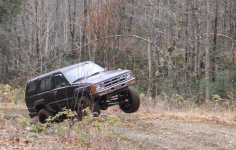
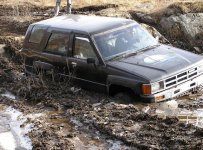
Here's a couple of pictures to keep you interested. Not really related. But you know what they say.

:worthless

 

Attachments

  • Picture430.jpg
    Picture430.jpg
    128.8 KB · Views: 6,575
  • MUD-1.jpg
    MUD-1.jpg
    102.6 KB · Views: 14,055
Or, would a 35" tire, regardless of rim size; 15" or 17", when running a similar PSI, for example 15-PSI, would they deform down the same amount? so that, if the tires were supporting the weight of the truck, at 15psi; on a 15" or 17" rim the truck would be 1" shorter....for example.....not a real calculation, just a number I picked for simplicty, or would the truck on 15" rims be shorter?

You're coming at that wrong, I believe. When you air down, it's not about a specific PSI, it's about getting the right traction patch for your situation. The only reason to check PSI is to provide a shortcut so you don't have to use trial-and-error every time you air down. The particular PSI is not the end result - getting good traction without blowing a bead is the end result, and the PSI needed to achieve that is going to vary depending on tire selection, rim size, surface characteristics, whether your tires are warm or cold, etc.
 
You're coming at that wrong, I believe. When you air down, it's not about a specific PSI, it's about getting the right traction patch for your situation. The only reason to check PSI is to provide a shortcut so you don't have to use trial-and-error every time you air down. The particular PSI is not the end result - getting good traction without blowing a bead is the end result, and the PSI needed to achieve that is going to vary depending on tire selection, rim size, surface characteristics, whether your tires are warm or cold, etc.

I know :hiding: you can't really compare different tires, on different trucks in different situations and come up with a formula that fits all. I see it all the time. I wheel mostly with Fj Cruiser guys. And they will have similar built trucks, with the same tires, aired down the same, on one guy makes it, and another gets stuck, or one guys scrapes his underside, and the other guy doesn't. Or similar trucks, similar tires, but not same brand. One guy airs down to 15psi, the other guys aires down to 18-19psi. The 18-19psi guy scrapes his underside, right after the 15psi guy just passed and scraped nothing.

I say 15psi, just to put some comonality, and not say I took half my air out, or I let my air out for 38seconds..... and even if that isn't the end goal, but it is to get best traction, between 15-18psi is where most people playing it safe would air down to.

So in general then. Same truck sitting on a level driveway, once wearing 35"x15" and once wearing 35"x17", aired down to similar values say between 15-18psi, does the 15" squish down more.

I would try this experiment myself, but everyone I wheel with has 16 or 17's on their FJ's or 4Runner's. But maybe some here has gone from 15's to 17's on an old school runner.
 
the amount you air down is dependent on how much "squish"you want. if you want it to be taller then don't air down as much. the amount of clearance you would lose with 15 rather than 17 inch wheels would be fairly negligible (my opinion not based on any study). It really comes down to preference. All things being equal, if one rig gets through a spot with 15 inch wheels and another gets stuck with 17 inch wheels then it probably more reflective on the drivers skill or luck than the wheels.
 
Assuming the same overall diameter of tire, you're going to have more sidewall with the 15 inch. That's gonna mean more deformation, which is going to be good or bad, depending. You'll get a bigger traction patch while aired down, which is going to help while wheeling, but there's a reason sports cars run low-profile tires ... they corner better.

So it's not that one is intrinsically better than another, they're just going to give different benefits in different situations.

/\ this!!!!!!!

You also have to consider width. For off-roading having a rim about 4inches narrower in the tire is good.
 
I realized that I do have a set of 31's on 17" rims for the 4th Gen and a set of 31's on 15" rims for the 1st gen. Both also happen to be yokohama geolander winter tires. When I get a chance I will attempt some tests and measurements at various psi and measure the amount of clearance difference. :bash: I know I'm beating on this too much. But nothing beats hands on experimentation.
 
The shorter the sidewall...
the better it will handle
the easier it will pop a bead at the same psi, when aired down
the rougher the ride, on or off road
the less the tire will wrap around an obstacle causing reduced traction

The taller the sidewall...
the smoother the ride
the more the tire will wrap around an obstacle

The larger the wheel diameter...
requires more torque to rotate (due to more weight, further out)
requires better brakes to stop the same distance (due to more weight, further out)

Personally, the goal of a wheeler is to be able to climb up obstacles and if I have to give up a little clearance for traction, I will. I would go with the 15" wheels. They will also give you a better ride.

A track car, running two different size wheels (same outside diameter of the tire) will have different track times. Actually the times with the smaller wheels will be faster to to increased braking and faster acceleration. It can be driven faster into the corners and accelerate faster out of the corners. True, if you increase power and add larger brakes, the low profile tires will be faster.
 
Thanks. I've been looking at pictures of tire/wheel combination online. And I'm leaning more and more towards a 15" rim tire. For the reason you mention Gerdo.

And I'm also thinking that for there to be a significant loss of clearance I would have to have a flat tire....or run really really low psi, which I shouldn't go extremely low without beadlocks.
 

Members online

Forum statistics

Threads
278,311
Messages
3,554,082
Members
248,016
Latest member
Advally Service

Trending content

Back
Top