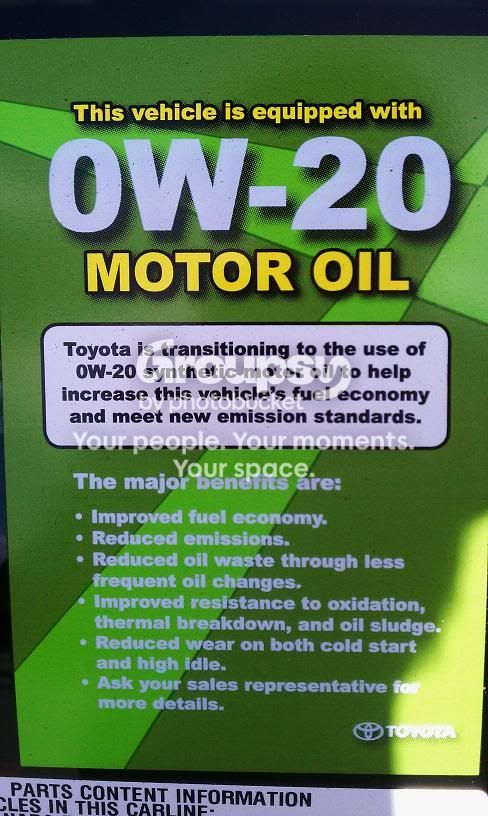
Oil Change... 0w20? wtf?

user name:

New member
im really shocked to see Toyota put 0w20 in a vehicle sold in Houston... The weather here feels like a gorilla's armpit year round. I just cant in good conscience leave this stuff in my motor. Are any of you Texas bro's running say 10w30? I usually run amsoil full synthetic but my TE only has 1k miles on it. I try to get the oil out asap so any of the "break-in" shavings will not have a chance to meld themselves into crevices or bearing surfaces.
 
Register to hide this ad
I think it just boils down to satisfying the EPA criminal cartel. Thinner oil = better mileage, not necessarily better wear characteristics or reliability.
 
0w 20

I havent but funny you bring this up I live up north and even here I feel the oil breaks down very quickly and it's really not protecting the engine as well as it should Ive been thinking of using and adiditive like a slick 50 or something just for the added protection or maybe move up to a heavier oil like you mention at this point I dont know what to do guys come on we need some input here :D
 
The ONLY reason they are running this thin stuff is for emissions and better mileage ratings. The EPA is tightening up drastically so Toyota is pulling out all the stops to meet requirements. This 0w20 offers better efficiency at the cost of wear protection.
 
0w 20

Let me just ask this since I do not know much about oil whats the next grade oil up from the 0 w20 I could put in my truck with out overworking the engine to much.
 
The choice of oil is not made by where you live anymore, it's by clearances of parts in the engine. Tighter tolerances uses thinner oil to make sure all the parts continuously get fresh oil. The MANUAL transmission in my Explorer uses Mercon ATF, not gear oil. Stay with what the mfg recommends.
 
Today's new engines have closer tolerances and to properly lubricate into those critical areas, the oil must be thinner (lower weight). Thicker is not better and it can actually starve those critical areas from lubrication.

I always run the weight oil that is specified by the manufacturer and is stated in the owners manual.
 
Let me just ask this since I do not know much about oil whats the next grade oil up from the 0 w20 I could put in my truck with out overworking the engine to much.

It's your engine, but if I wasn't willing to take 5 minutes to google "oil viscosity", I wouldn't be messing with the manufacturers' recommendation.

Maybe that's just me though.
 
A 4Runner will do many things but it will not travel in time. This is not 1972 and what your dad and granddad remember is not applicable today. I do not know how much you understand about synthetic fluids except that in reading your post I can assume not much. How can you be "shocked" to see Toyota putting a 0-20 Full synthetic fluid in Houston? I will try to explain.
I am citing Mobil 1 full synthetic specs as this is an average in the industry.

10W-30 Mobil 1
VI=146
Cst at 100c=10.1
Cst at 40c=63.2

0W-20 Mobil 1
VI=173
Cst at 100c=8.7
Cst at 40c=44.8

For your edification "VI" = "Viscosity Index" and "Cst" = "centistokes" which is a measurement of it's resistance to pour, or "thickness for purposes of this board. Most on here are not "Bobistheoilguy".

The higher the viscosity index the better. It means that the oil will maintain a usable viscosity over a greater range of temperatures.
As you can see the 0-20 Synthetic has a smaller delta (delta means rate of change) from 100C (212F) to 40C (100F) than the 10-30. This means that the 0-20 Fluid has a "flatter" curve throughout than the 10-30, which means that 0-20 will maintain a better viscosity throughout this temperature range.

What I explained above is really a moot point though. Either a 0W-20 or a 10W30 full synthetic will offer outstanding protection for your Houston summers. You have to remember these are full synthetics - they are different. Your engine won't be able to tell the difference under normal operating conditions.

In closing, the 0W-20 synthetic is a good all purpose choice no matter where you are in North America. The differences are small in the temperature ranges our engines operate - including Houston.

Now, break in shavings? C'mon. Toyota offers a 10 year bazillion mile warranty for under a thousand bucks on these vehicles - and they recommend their FIRST oil change to be at 10K under normal driving conditions. If you travel offroad a lot or pull a heavy trailer it is 5K. NOT 1K to get rid of "break in shavings". Do you really think they are going to offer this warranty with this maintenance schedule if there are shavings in the motor at 1K miles? No, I don't think so either. Trust the manual. It was written by some smart guys.

"Texas bro's???"
 
Those darn Toyota engineers are so stupid! :redbrick:

The correct answer was given in post #2.

Every single owner on the forum lauds the 4R's reliability and longevity, yet some seek to second guess the world class engineering that goes into it.

I don't get it ...
 
very informative, thanks. The information I was getting by a few local ase mechanic guys was basically stating 10w30 will be a better choice for houston heat. Toyota went to 0w20 to meet FDA mileage regulations, not for lubrication reasons like you mentioned. So youre saying the tolerances of moving parts in the lower end of a dual vvti engine is tighter than that of the 1GR-FE engine, thus needing thinner oil? Toyota didnt use lighter oil for epa and mileage reasons, its for proper lubrication?


A 4Runner will do many things but it will not travel in time. This is not 1972 and what your dad and granddad remember is not applicable today. I do not know how much you understand about synthetic fluids except that in reading your post I can assume not much. How can you be "shocked" to see Toyota putting a 0-20 Full synthetic fluid in Houston? I will try to explain.
I am citing Mobil 1 full synthetic specs as this is an average in the industry.

10W-30 Mobil 1
VI=146
Cst at 100c=10.1
Cst at 40c=63.2

0W-20 Mobil 1
VI=173
Cst at 100c=8.7
Cst at 40c=44.8

For your edification "VI" = "Viscosity Index" and "Cst" = "centistokes" which is a measurement of it's resistance to pour, or "thickness for purposes of this board. Most on here are not "Bobistheoilguy".

The higher the viscosity index the better. It means that the oil will maintain a usable viscosity over a greater range of temperatures.
As you can see the 0-20 Synthetic has a smaller delta (delta means rate of change) from 100C (212F) to 40C (100F) than the 10-30. This means that the 0-20 Fluid has a "flatter" curve throughout than the 10-30, which means that 0-20 will maintain a better viscosity throughout this temperature range.

What I explained above is really a moot point though. Either a 0W-20 or a 10W30 full synthetic will offer outstanding protection for your Houston summers. You have to remember these are full synthetics - they are different. Your engine won't be able to tell the difference under normal operating conditions.

In closing, the 0W-20 synthetic is a good all purpose choice no matter where you are in North America. The differences are small in the temperature ranges our engines operate - including Houston.

Now, break in shavings? C'mon. Toyota offers a 10 year bazillion mile warranty for under a thousand bucks on these vehicles - and they recommend their FIRST oil change to be at 10K under normal driving conditions. If you travel offroad a lot or pull a heavy trailer it is 5K. NOT 1K to get rid of "break in shavings". Do you really think they are going to offer this warranty with this maintenance schedule if there are shavings in the motor at 1K miles? No, I don't think so either. Trust the manual. It was written by some smart guys.

"Texas bro's???"
 
The correct answer was given in post #2.

Every single owner on the forum lauds the 4R's reliability and longevity, yet some seek to second guess the world class engineering that goes into it.

I don't get it ...

this is my first Toyota, so I am not "lauding" anything yet.
 
The ONLY reason they are running this thin stuff is for emissions and better mileage ratings. The EPA is tightening up drastically so Toyota is pulling out all the stops to meet requirements. This 0w20 offers better efficiency at the cost of wear protection.

I have a Lifetime Powertrain Warranty, so I'm not very worried about it.
 
A good write-up on this very issue: Toyota's reasoning for 0w20 viscosity engine oil - Bob Is The Oil Guy


IMAG0392-2.jpg~original
 
very informative, thanks. The information I was getting by a few local ase mechanic guys was basically stating 10w30 will be a better choice for houston heat. Toyota went to 0w20 to meet FDA mileage regulations, not for lubrication reasons like you mentioned. So youre saying the tolerances of moving parts in the lower end of a dual vvti engine is tighter than that of the 1GR-FE engine, thus needing thinner oil? Toyota didnt use lighter oil for epa and mileage reasons, its for proper lubrication?

You are getting things confused:
First, my information comes from engineering and design texts. Next, yes 0W-20 synthetic WILL give you better fuel economy but that's not all: It will also give you better lubrication characteristics across a broader temperature range, hence the higher viscosity index. Sure, the 0W-20 will better in cold temps but will also be just fine for Houston temps as you are nowhere near getting to the high range of 0W-20 just because you live in Houston. I did not mention anything about specific engine types. There is no need as the two engines you cited will be just fine with either synthetic.

Bottom line: The 0W-20 full synthetic will give you better efficiency and lubricate across the temperature range of vehicle operation. If you want to listen to the mechanics that is your right. I tend to listen to the guys who design stuff. They are responsible for it.
 
Wow! Has anyone done any research on the new Toyota 0w-20 synthetic oil. First of all, this oil has already proven to be VERY good oil. It was specially formulated for Toyota and is different from any other oil of this grade. The UOAs for this has shown that it provides equal protection on par to ANY of the top brands.

If you look at the spec sheets for all the recommended oil grades (viscosity), you will find there is not too big of difference between each, as far as thermal breakdown. The differences that could make a difference are the pour rate (how well the oil pours when cold) and the TBN (total base number).

The pour rate is very important because up to 80% of engine wear is from cold starts. This does not only pertain to cold weather. Cold start means the first start of the day after the engine has completely cooled/drained down. This wear accrues in the time the oil takes to get to the vital parts of the engine (bearings, cams, lifters, etc). The quicker the oil gets to those vital areas the less wear. The lower the weight the better/faster the oil will flow during start-up. The best viscosity to use is the lowest viscosity that falls within the OEM recommended range. That being said 0w-20 would be best. After many UOAs (used oil analysis) I've come to the conclusion that either 0w-20 and 0w-30 are the two best and the 0w-30 lasts a little longer.

The TBN is a number that is used to determine how much life is left in the oil. You would use this by having a sample of used oil analyzed when you are near the change interval. For the 5th gen 4Runner it's 10K miles.

Koz

 
Last edited:

The image you posted is a sales pitch: Nothing more. If you read the research paper listed in the posts below THEN you would understand why Toyota and Honda and others have went to 0W-20 synthetic and 10K changes. Bob is the oil guy is a good website. Unfortunately it has the same problems as everywhere else in the fact some of those guys know what they are talking about and some don't. Take it with a grain of salt, do research and do what you think is right.
 
Wow! Has anyone done any research on the new Toyota 0w-20 synthetic oil. First of all, this oil has already proven to be VERY good oil. It was specially formulated for Toyota and is different from any other oil of this grade. The UOAs for this has shown that it provides equal protection on par to ANY of the top brands.

If you look at the spec sheets for all the recommended oil grades (viscosity), you will find there is not too big of difference between each, as far as thermal breakdown. The differences that could make a difference are the pour rate (how well the oil pours when cold) and the TBN (total base number).

The pour rate is very important because up to 80% of engine wear is from cold starts. This does not only pertain to cold weather. Cold start means the first start of the day after the engine has completely cooled/drained down. This wear accrues in the time the oil takes to get to the vital parts of the engine (bearings, cams, lifters, etc). The quicker the oil gets to those vital areas the less wear. That being said, the lower the weight the better/faster the oil will flow during start-up. The best viscosity to use is the lowest viscosity that falls within the OEM recommended range. That being said 0w-20 would be best. After many UOAs (used oil analysis) I've come to the conclusion that either 0w-20 and 0w-30 are the two best and the 0w-30 lasts a little longer.

The TBN is a number that is used to determine how much life is left in the oil. You would use this by having a sample of used oil analyzed when you are near the change interval. For the 5th gen 4Runner it's 10K miles.

Koz

Yes, I have done a little research haha. Good post. I probably should have posted something like yours (easier to understand) because sometimes I forget that words like "centistokes" and "seybolt universal seconds" and "viscosity indexes" are not common terms in the real world, nor are the definitions.
 
So would I see any benefit whatsoever to go to a 0w30 amsoil synthetic?

Wow! Has anyone done any research on the new Toyota 0w-20 synthetic oil. First of all, this oil has already proven to be VERY good oil. It was specially formulated for Toyota and is different from any other oil of this grade. The UOAs for this has shown that it provides equal protection on par to ANY of the top brands.

If you look at the spec sheets for all the recommended oil grades (viscosity), you will find there is not too big of difference between each, as far as thermal breakdown. The differences that could make a difference are the pour rate (how well the oil pours when cold) and the TBN (total base number).

The pour rate is very important because up to 80% of engine wear is from cold starts. This does not only pertain to cold weather. Cold start means the first start of the day after the engine has completely cooled/drained down. This wear accrues in the time the oil takes to get to the vital parts of the engine (bearings, cams, lifters, etc). The quicker the oil gets to those vital areas the less wear. The lower the weight the better/faster the oil will flow during start-up. The best viscosity to use is the lowest viscosity that falls within the OEM recommended range. That being said 0w-20 would be best. After many UOAs (used oil analysis) I've come to the conclusion that either 0w-20 and 0w-30 are the two best and the 0w-30 lasts a little longer.

The TBN is a number that is used to determine how much life is left in the oil. You would use this by having a sample of used oil analyzed when you are near the change interval. For the 5th gen 4Runner it's 10K miles.

Koz
 
Last edited:

Members online

Forum statistics

Threads
278,312
Messages
3,554,089
Members
248,016
Latest member
Advally Service

Trending content

Back
Top