**Photography Talk**

i just know that if you want to get into photographjy you need to get yourself a digital SLR camera.

not necessarily true take a look at the Sony NEX line. Not quite point and shoot cheap, but I have seen some amazing pics from them and not an SLR.

Couple quick out the truck window pics I took on the way back from dinner tonight.

Zeiss%20test0004.JPG


Zeiss%20test0002.JPG


Zeiss%20test0001.JPG


Minimal to no post processing, all shot at 16mm, 400 iso, and wide open at f3.5. Other than the unintended vignette at the wide end I'm pretty happy with my new purchases.
 
I'm more in it for picture collection ie: i have no intention of it being sold or seen even. I care more about the end result of the picture Not what gear i use. If i find a setup i lke i'll more likely stay with it. The term "SLR" is very new to me, i just know that if you want to get into photographjy you need to get yourself a digital SLR camera.

Allow me to tap into this. There is quite a wide range of things one can get and enjoy out of photography. For some it is capturing the moment and the memory, for others it is about capturing realism in the most perfect manner, while others seek qualities beyond reality, employing artistic photography that generate true art, along with so many other things. One cannot be clear of their needs until they try it. This is why I do recomment that you get yourself a capable gear that let you explore and find your corner where you want to excel at and enjoy.
The basics of photography need to be learned, and without a fully manual capable camera, this will not be possible. A point and shoot is a waste of money for someone who wants to take on photography beyond the ordinary.

A capable gear should include a DSLR with at least one prime lens at normal focal length, and a tripod. A full frame is great but pricy, you could start off with half frame and 50mm prime lens and a solid tripod. In the process of learning, I recommend avoiding all automatic features, in both camera and lens and get used to adjusting all parameters manually. It is the best way to learn photography and take it to the next level in no time.
 
Allow me to tap into this. There is quite a wide range of things one can get and enjoy out of photography. For some it is capturing the moment and the memory, for others it is about capturing realism in the most perfect manner, while others seek qualities beyond reality, employing artistic photography that generate true art, along with so many other things. One cannot be clear of their needs until they try it. This is why I do recomment that you get yourself a capable gear that let you explore and find your corner where you want to excel at and enjoy.
The basics of photography need to be learned, and without a fully manual capable camera, this will not be possible. A point and shoot is a waste of money for someone who wants to take on photography beyond the ordinary.

A capable gear should include a DSLR with at least one prime lens at normal focal length, and a tripod. A full frame is great but pricy, you could start off with half frame and 50mm prime lens and a solid tripod. In the process of learning, I recommend avoiding all automatic features, in both camera and lens and get used to adjusting all parameters manually. It is the best way to learn photography and take it to the next level in no time.
You sir got it right on point, thanks for the advice!


Also it'd be really great if the camera has video recording with sound capability as well, any suggestion is appreciated.
 
Last edited:
Canon 60D, Canon EF-S 18-200 IS lens / f/5.6, 1/2000, 200mm, ISO 400
IMG_1837_zpsba18187f.jpg~original


Canon 5D MK III, Canon EF 24-105L IS lens / f/4, 1/500, 105mm, ISO 100
692A2471_zpsb305b296.jpg~original


Canon 5D MK III, Canon EF 24-105L IS lens / f/4, 1/200, 105mm, ISO 100
692A2478_zpsbf0bcd75.jpg~original


Canon 5D MK III, Canon EF 24-105L IS lens / f/22, 30 sec, 105mm, ISO 100
692A2240_zps23bd2733.jpg~original


Canon 5D MK III, Canon EF 24-105L IS lens / f/16, 8 sec, 105mm, ISO 100
692A2236_zps41747f4b.jpg~original


Canon 5D MK III, Canon EF 24-105L IS lens / f/16, 8 sec, 105mm, ISO 100
692A2256_zps0aed943d.jpg~original
 
Last edited:
Not a pro by any means, but these are various shots to share..
Hardware: Nikon D7000, Voigtlander 58mm F/1.4, Manfrotto 190XPROB,
 

Attachments

  • 291511_3841276944359_701285785_o.jpg
    291511_3841276944359_701285785_o.jpg
    134.6 KB · Views: 276
  • 333501_2871193492879_1026049477_o.jpg
    333501_2871193492879_1026049477_o.jpg
    130.7 KB · Views: 265
Last edited:
Allow me to tap into this. There is quite a wide range of things one can get and enjoy out of photography. For some it is capturing the moment and the memory, for others it is about capturing realism in the most perfect manner, while others seek qualities beyond reality, employing artistic photography that generate true art, along with so many other things. One cannot be clear of their needs until they try it. This is why I do recomment that you get yourself a capable gear that let you explore and find your corner where you want to excel at and enjoy.

I actually completely agree with this... actually you nailed it.

The basics of photography need to be learned, and without a fully manual capable camera, this will not be possible. A point and shoot is a waste of money for someone who wants to take on photography beyond the ordinary.

A capable gear should include a DSLR with at least one prime lens at normal focal length, and a tripod. A full frame is great but pricy, you could start off with half frame and 50mm prime lens and a solid tripod. In the process of learning, I recommend avoiding all automatic features, in both camera and lens and get used to adjusting all parameters manually. It is the best way to learn photography and take it to the next level in no time.

Here is where I sort of disagree, and will give my .02

There are a TON of photography fundamentals that can be learnt on non-fully manual cameras. Framing, lighting, processing, ISO, basic flash etc. etc. You do NOT need a SLR to get into photography. I do agree that most point and shoots are pretty basic and you would probably outgrow them in no time, if you were planning on getting more into photography as a hobby.

Cameras like the Canon G11, G12, G1X are basically advanced point and shoot cameras though, and you can definitely get some stunning images with those. They are small, compact, portable, have manual focus and most, if not all of the DSLR manual adjustments. They even have "L-Series" glass however, the lenses are not interchangeable. I would not hesitate to recommend those cameras to anyone looking to get into photography. Plus, if you outgrow those cameras and decide you need a true SLR, you could remain as an excellent compact backup camera for times when you don't want to haul the SLR. Worth a look at the very least, and I am sure Nikon has some equivalents as well.

 
Here is where I sort of disagree, and will give my .02

There are a TON of photography fundamentals that can be learnt on non-fully manual cameras. Framing, lighting, processing, ISO, basic flash etc. etc. You do NOT need a SLR to get into photography. I do agree that most point and shoots are pretty basic and you would probably outgrow them in no time, if you were planning on getting more into photography as a hobby.

Cameras like the Canon G11, G12, G1X are basically advanced point and shoot cameras though, and you can definitely get some stunning images with those. They are small, compact, portable, have manual focus and most, if not all of the DSLR manual adjustments. They even have "L-Series" glass however, the lenses are not interchangeable. I would not hesitate to recommend those cameras to anyone looking to get into photography. Plus, if you outgrow those cameras and decide you need a true SLR, you could remain as an excellent compact backup camera for times when you don't want to haul the SLR. Worth a look at the very least, and I am sure Nikon has some equivalents as well.

What he said.

I do think that learning the basics can be easier on an actual SLR. The mechanics are there as well as most dials and such are easier to navigate. Either way, just make a point to not use any auto feature if there is one and you'll figure it out pretty fast. Just know where your limits are as far as aperture, ISO and speed. Oh and have fun. Hobbies are supposed to be fun!
 
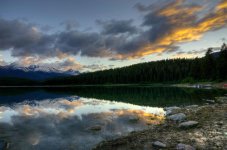
View from my home town.

<a href="http://www.flickr.com/photos/willgentry/8573319600/" title="DSC_0067 by willgentry, on Flickr"><img src="http://farm9.staticflickr.com/8101/8573319600_c53be6488e_b.jpg" width="1024" height="683" alt="DSC_0067"></a>

Anybody got any tips for landscapes? Just went out and shot in auto...:confused:
 
Anybody got any tips for landscapes? Just went out and shot in auto...:confused:

The basics of it are to have a pretty small f-stop so as to get as much of the landscape you are trying to shoot at in focus. Sometimes as small as 20+. So if you're shooting at that range, a tripod is usually a must and in some cases a remote shutter comes in super handy.

The other tips I would have would be in the framing. And there, often times the rule of thirds applies as well. In the photo you posted, I would say it helps quite a bit to frame it where the both the mountain lines and the distant ground line fall within the thirds. I think the end effect is much stronger. But that's my opinion.

<a href="http://photobucket.com/" target="_blank"><img src="http://img.photobucket.com/albums/v493/jayswang/8573319600_c53be6488e_b_zpsdd99ab5f.jpg" border="0" alt=" photo 8573319600_c53be6488e_b_zpsdd99ab5f.jpg"/></a>
 
Last edited:
The basics of it are to have a pretty small f-stop so as to get as much of the landscape you are trying to shoot at in focus. Sometimes as small as 20+. So if you're shooting at that range, a tripod is usually a must and in some cases a remote shutter comes in super handy.

The other tips I would have would be in the framing. And there, often times the rule of thirds applies as well. In the photo you posted, I would say it helps quite a bit to frame it where the both the mountain lines and the distant ground line fall within the thirds. I think the end effect is much stronger. But that's my opinion.

<a href="http://photobucket.com/" target="_blank"><img src="http://img.photobucket.com/albums/v493/jayswang/8573319600_c53be6488e_b-1_zpsb7cf6c2d.jpg" border="0" alt=" photo 8573319600_c53be6488e_b-1_zpsb7cf6c2d.jpg"/></a>

Do my mountains look out of focus? I can't really tell. The foreground seems pretty sharp, though. I will definitely try aperture mode with a smaller f stop next time.
 
Anybody got any tips for landscapes? Just went out and shot in auto...:confused:

I generally use a Tripod (Manfrotto), remote shutter, and manual mode. As a tip, I sometimes click over to video mode and play with settings in their to find the correct ISO, f stop, white balance, grid, etc. This helps me visually see the image I am going to take and allows me to dial in the setting I want without taking numerous pictures to try and get the shot I desire. Picture looks good though!
 
Last edited:
As it is mentioned, landscape shots need smaller aperture to obtain deep depth of field which brings it to sharp focus, and a tripod with a remote trigger, or a timer. But, I wouldn't go above F/11 in most cases, to maintain sharpness.
But, there is also an important aspect in landscape photography that has little to do with the camera and more with the light conditions of the environment.
Midday hazy sky will generate hazy photos with hard shadows and limited dynamic range that will result in overexposure and underexposure in various areas of the photograph. Try to target the golden hour, where the sun is low, sky is colorful, and shadows are softer, and you will see more details and some wonderful unexpected color spills in it.
 
Anybody got any tips for landscapes? Just went out and shot in auto...:confused:

Sunrise and sunset are your friends. Try to avoid shooting in mid-day when the sun is directly overhead and the shadows are harsh.

As said, use a smaller aperture but try to stay at f/16 or bigger to avoid losing sharpness due to diffraction (although this depends entirely on each lens). I'm usually always in Aperture mode unless I have tricky lighting or have a specific effect in mind.

Expose for the highlights. As long as you don't blow out your highlights you'll be fine editing your photos. Noise hides in the shadows so if you expose a little to the right but avoid blowing out the highlights you can easily back off the exposure in whatever editing program you use while maintaining the most dynamic range in your photo. Shooting in RAW will make your life easier.

Be good in post production.

Try to have a foreground, middle ground, and background in your photo. A foreground makes a photo much more interesting and gives it more depth.

Tripod and cable release are a must. If you don't have a cable release set your camera to 2 second timer then don't touch the camera.

Learn the typical rules (rule of thirds, no horizon line dead center) and then learn when to break those rules.

I often use live view and manually focus through that.
 
This is a little off topic, but I figured this was the best place to pose a question of this nature.

What is the best photo sharing website? I have used Photobucket for years, but they are constantly changing the layout of the site and changing things. I take pics, load them to the computer, transfer them to this site, not a whole lot more. For my limited needs, you'd think Photobucket would work, but I am now unable to copy any of the IMG links for any of the photos I've previously loaded. So, any suggestions would be appreciated.

*Since I don't spend much time in this thread, please quote my message with your response so I know to check back for the answer. Thanks - Jeff
 
Experimented with my variable neutral density filter. I'm already loving this thing.

<a href="http://www.flickr.com/photos/willgentry/8594166520/" title="DSC_0074 by willgentry, on Flickr"><img src="http://farm9.staticflickr.com/8104/8594166520_f94ca18273_b.jpg" width="1024" height="683" alt="DSC_0074"></a>
 

Members online

Forum statistics

Threads
278,309
Messages
3,554,071
Members
248,016
Latest member
Advally Service

Trending content

Back
Top