**Photography Talk**

Thanks for the info! I honestly never even thought of mirrorless, I really hadn’t heard of it before this. Been looking at these you mentioned online and they seem like a solid choice. I like the idea of having something more carry-friendly and less bulky. From what I’ve seen on them, the major difference is no manual viewfinder like on a DSLR, does that really make much of a difference?

This really was some great info, thank you for taking the time to share!

I switched over to mirrorless (Fujifilm) two years ago from using Canon DSLRs and they are great!

IMO they are much lighter and easier to travel with and lenses tend to be more affordable (Fujinon). On top of that, Fujifilm is a Japanese company and their products are fantastic.

If you can shell out extra cash look into the Sony alpha cameras as well.
 
Recently I've been trying to do some night sky photography and not getting good results. The biggest issue is focus. In the dark I can't see well enough through the viewfinder to tell if it's in focus or not - I can barely even tell where the horizon is. So I've tried turning the focus ring all the way to what should be infinity. But when I get the pics onto the computer, I can see that the stars, horizon, and distant objects are all slightly out of focus.

Is my lens crap, or is something else going on? I'm using a very solid tripod and triggering the shutter by wire, so it's not a motion blur.
 
Recently I've been trying to do some night sky photography and not getting good results. The biggest issue is focus. In the dark I can't see well enough through the viewfinder to tell if it's in focus or not - I can barely even tell where the horizon is. So I've tried turning the focus ring all the way to what should be infinity. But when I get the pics onto the computer, I can see that the stars, horizon, and distant objects are all slightly out of focus.

Is my lens crap, or is something else going on? I'm using a very solid tripod and triggering the shutter by wire, so it's not a motion blur.

What aperture, at what focal length, how many seconds, and what ISO?

Are you setting your lens to manual focus before setting it to infinity? Sounds like a dumb question but sometimes it’s overlooked or forgotten.

Last thing I’d want to check is whether you are centering the infinity symbol with the focus line or if you’re just maxing out the focus to the infinity end of the lens. I use the red setting on my headlamp to constantly check if it stays centered on the infinity point. It’s easy to bump.

Feel free to message me on Instagram @PinnacleExposure
 
Recently I've been trying to do some night sky photography and not getting good results. The biggest issue is focus. In the dark I can't see well enough through the viewfinder to tell if it's in focus or not - I can barely even tell where the horizon is. So I've tried turning the focus ring all the way to what should be infinity. But when I get the pics onto the computer, I can see that the stars, horizon, and distant objects are all slightly out of focus.

Is my lens crap, or is something else going on? I'm using a very solid tripod and triggering the shutter by wire, so it's not a motion blur.

[MENTION=28474]HB 4X4[/MENTION] got most of the questions out. that is correct on the manual focus and never dial it all the way to infinity. you'll get the results it sounds like you have. dial to infinity then roll back a hair. most lenses have a line right before the infinity logo. that's your sweet spot. I would test that out during the day time so you can see better. if you have help, something I usually do is have someone stand far away with a bright light. ill focus on them then set to manual. or ill park my car far away and focus on that if I don't have help.

the other big big big things is the aperture, ISO and shutter speed. these all have to be dialed in for night. They are different for each night setting for what you are trying to accomplish. astrophotography, I almost always use 20-30" exposure, f/2.8 (my fastest lens) and 16mm. the ISO varies though from 1600-3200.

here is a shot of the Milky Way, I shined a light on that road sign for my focus then changed it to manual. I knew I wanted f/2.8 and around 20-25" to keep it more crisp. adjusted ISO based on this, which was 2000. I tried 1600 originally and it was too dark


35332689016_8c0073821d_c.jpg
 
Recently I've been trying to do some night sky photography and not getting good results. The biggest issue is focus. In the dark I can't see well enough through the viewfinder to tell if it's in focus or not - I can barely even tell where the horizon is. So I've tried turning the focus ring all the way to what should be infinity. But when I get the pics onto the computer, I can see that the stars, horizon, and distant objects are all slightly out of focus.

Is my lens crap, or is something else going on? I'm using a very solid tripod and triggering the shutter by wire, so it's not a motion blur.

Ray, here are a few YouTube Videos that may help you get night sky photography going more efficiently! :)

How to Manually Focus Your Camera at Night to Shoot Stars

How to: Focus In The Dark - Finding Infinity on your lens tutorial

A little longer, but a good primer for astrophotography

How To Photograph The Night Sky With Your DSLR: A Beginners Guide

And finally, something a bit more on the creative side (the guys at FStoppers do some pretty cool stuff):

How to photograph stars and photoshop an astrophotography image:
 
Thanks guys. I guess the main problem is that my lens doesn't have an infinity mark, so I was just adjusting it all the way out. I'll have to set it up in the day, find the true infinity, and make a mark on the lens.

The lens I'm using is a Canon EFS 18-55, set to wide angle (18), f 3.5. I don't recall what aperture I used.

One of these days I'd like to get a good, fast wide angle lens, if I can find one that won't break the bank. Wide angles seem to be more expensive than zoom lenses.
 
Thanks guys. I guess the main problem is that my lens doesn't have an infinity mark, so I was just adjusting it all the way out. I'll have to set it up in the day, find the true infinity, and make a mark on the lens.

The lens I'm using is a Canon EFS 18-55, set to wide angle (18), f 3.5. I don't recall what aperture I used.

One of these days I'd like to get a good, fast wide angle lens, if I can find one that won't break the bank. Wide angles seem to be more expensive than zoom lenses.

You're shooting APS-C? I'd go with a prime, but I only shoot primes at this point. Value for money, I'm not sure you can beat a prime. I'm shooting FF and my widest lens is 35mm. It has limitations, but I'm happier with it than I thought. Previously I shot a Rebel XTI with a Sigma 10-20 glued to it - it almost never came off. I buy almost all of my crap used from Keh. I may pick up a 24mm eventually, but I'd rather upgrade my 50 first.

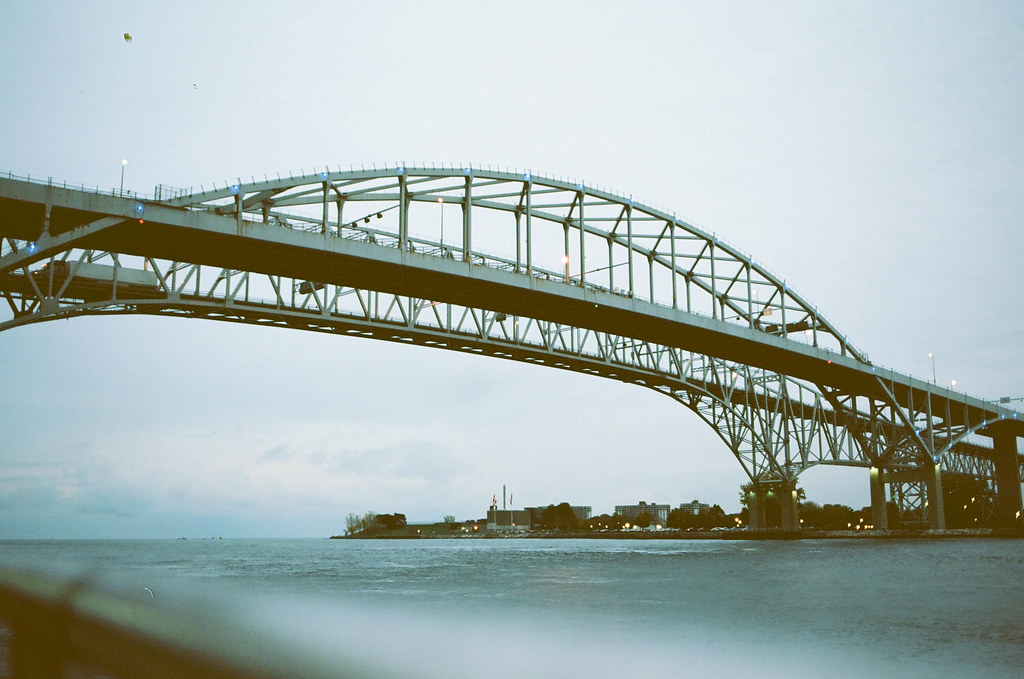
Blue Water Bridge, Port Huron Mi. Canon Rebel G, Kodak Ektar, 35mm f2 IS.
38542053556_acc829ae29_b.jpg


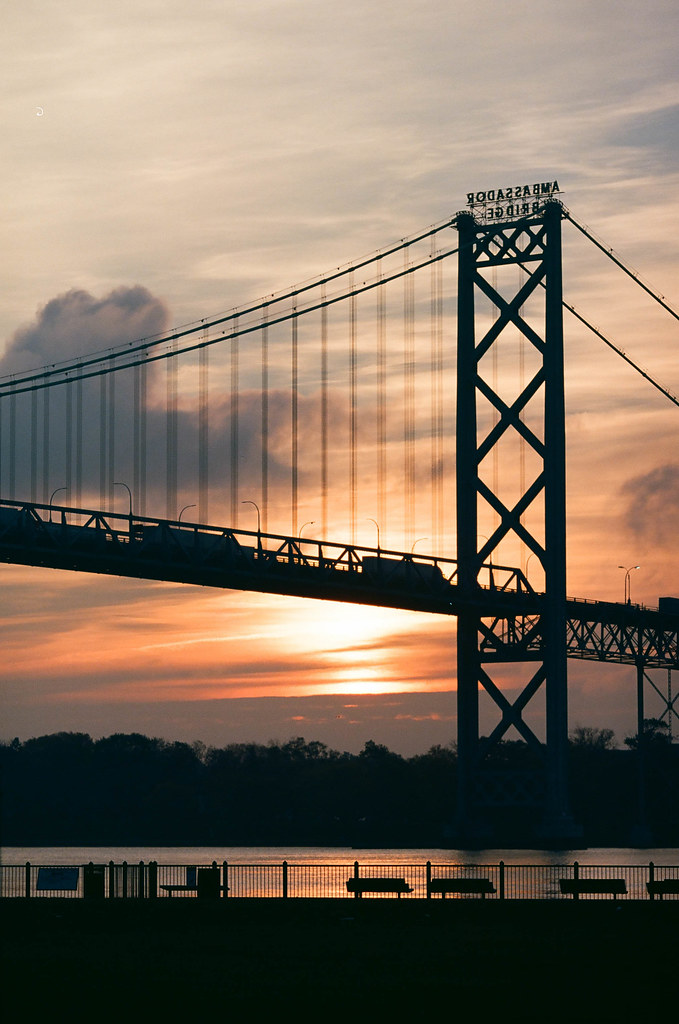
Ambassador Bridge, Detroit Mi. Canon Rebel G, Kodak Ektar, 135L.
24726381598_9c2e8a6952_b.jpg


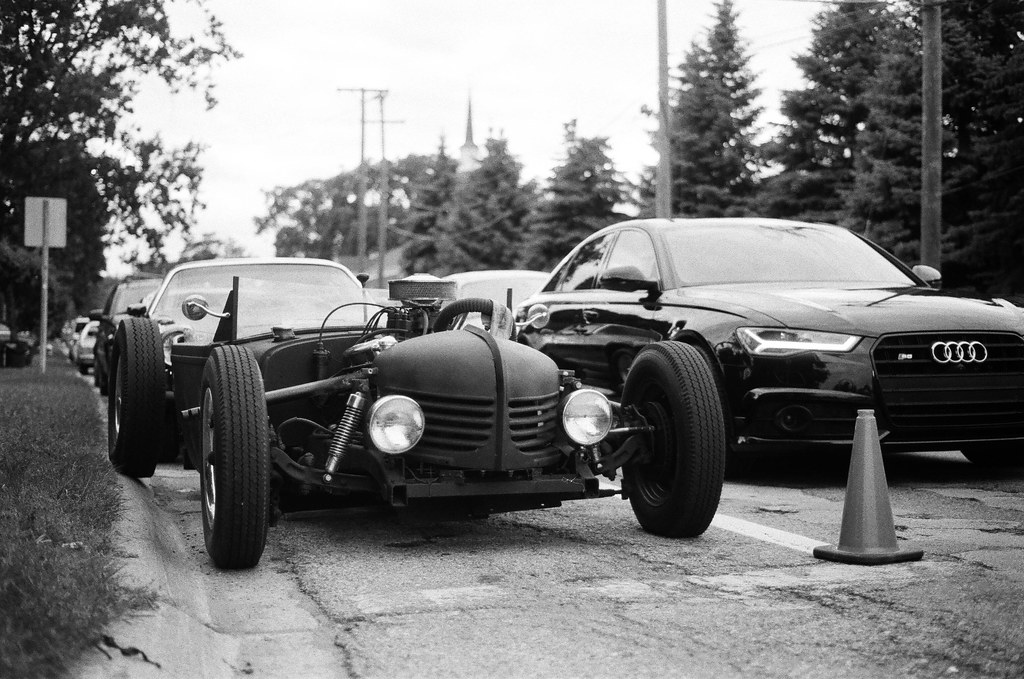
Not bad for a $4.50 camera.
 
Thanks guys. I guess the main problem is that my lens doesn't have an infinity mark, so I was just adjusting it all the way out. I'll have to set it up in the day, find the true infinity, and make a mark on the lens.

The lens I'm using is a Canon EFS 18-55, set to wide angle (18), f 3.5. I don't recall what aperture I used.

One of these days I'd like to get a good, fast wide angle lens, if I can find one that won't break the bank. Wide angles seem to be more expensive than zoom lenses.

Ray,
In one of the videos I shared, the presenter provides a method to 'find' your lenses infinity point, which you can then mark with a silver sharpie (so you can actually see it @ night).

FWIW, for much of my night sky shooting, I use ISO1600, f/2.8, 15-20sec at 16mm. Depending on light pollution level, I may even drop down to ISO800. I try not to go beyond ISO3200, mainly because I feel like there is too much noise-potential (even for my 5D Mk III). Crisp & clean, lowest ISO & shutter speed to accomplish the goal.

This image is on the cusp of having stars too blurry (I got distracted by the few people who remained that chilly night at 1:15am at Maroon Lake, wanting to chat about night-sky photography, so my timing was a hair off whilst using bulb mode [lol]).

Perseid Into Milky Way.jpg
 

Attachments

  • Perseid Into Milky Way.jpg
    Perseid Into Milky Way.jpg
    87.9 KB · Views: 238
I've been trying to insert images with the icon here but nothing happens! I cut and paste the URL into the box that pops up, but then when I check the post, there is just a blank line.

It used to work just fine, so has something changed? Apparently it is working for others, but not me anymore :(

Ted
 
I've been trying to insert images with the icon here but nothing happens! I cut and paste the URL into the box that pops up, but then when I check the post, there is just a blank line.

It used to work just fine, so has something changed? Apparently it is working for others, but not me anymore :(

Ted

if you have an image URL all you have to do is [ img ] URL [ / img ] with no spaces.
be sure to check size
 
37774698534


Still not working!

See that space above the above sentence? That is where the photo should be! There are no spaces in the url and the size is smaller than some of the others I see posted here. (1770x1180 pixels and about 1.7 MB file size). Same as I have used in the past.....

Ted
 

Members online

Forum statistics

Threads
278,310
Messages
3,554,078
Members
248,016
Latest member
Advally Service

Trending content

Back
Top