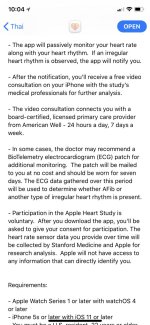
Prediction: This is what makes Apple Watch a game-changer!

Apple Watch and apps/devices like AliveCor are huge for the medical community. It opens up diagnostic and monitoring possibilities that are just a pipe dream 5 years ago. Does symptoms correlate with data? Is treatment working? This is very exciting for patients and doctors.

Link: Study seeks to prevent strokes with Apple Watch, Cardiogram HealthKit-enabled app

Researchers from the University of California, San Francisco, in partnership with developers of Apple Watch app Cardiogram, are conducting a study to determine whether heart rate sensing hardware in consumer devices can detect atrial fibrillation, a serious medical condition that can lead to stroke.

"This is the very first baby step to using the Apple Watch as a medical device that can affect people's lives," Ballinger said. "We've been incredibly impressed with the work Apple put in and the little details it got right."

mRhythm officially kicked off on Wednesday and researchers expect to publish results in a peer-reviewed journal by year's end.
 
Between the two? Sit at home, but there's a lot of territory between your two options.

I'm sure you don't like my answer. That's okay, but the one thing I want you to understand is that I come at this from an attempt to leverage the science of evaluating the efficacy of treatments, not from the kind of simplistic, uninformed attitudes you're undoubtedly familiar with like "they're holding back the cure for cancer" or "I don't want any chemicals in my food" etc.

Understood. But your decision not only affect you but your loved ones around you. Be careful though. I am not sure what territory you're talking about...but glad that you're staying informed.
 
Digging through the AliveCor website also showed some research articles backing this type of technology: AliveCor

How good at this tech vs. normal ECG?

Link: http://www.abstractsonline.com/Plan/ViewAbstract.aspx?sKey=d2695427-e78e-4378-b26a-99ab3c784107&cKey=29c04967-5c66-4f5a-85d0-f3338f010359&mKey={BAEF2DB4-7615-4F2C-851A-E5D7461EBD4E}

Results/Applications
In 62 patients, 2 physicians found the QRS morphology to be the same between device recordings, though the iPhone-based ECG had more baseline noise than the standard ECG (Figure 1B). The mean/SD of the R-wave amplitudes for the standard and iPhone recordings respectively were 0.77/0.24 (mV) and 0.78/0.24 (mV), P<0.0001. In the 5 patients with pacemakers, pacing spike artifacts were clearly identified in all 5 enabling verification of pacing capture (Figure 1C).

Next Steps
The iPhone-based event recorder is an accurate clinical tool for ECG assessment and could prove to be a new tool for allowing immediate recording and analysis of an ECG rhythm.

g9662_1.jpg
 
Last edited:
I thought some of the newer "Smart Watches" already had this built-in and some BlueTooth enabled wristbands that worked with phones already did this?

In closing, suffice it to say I'm personally unexcited about the "game changer" at this point in time.

How could a device like this help? In the link above, there is a case study:

This is a single case study of a 22-year old admitted to the hospitalfor an episode of tachycardia at a rate of 150 BPM. Upon discharge from the hospital, the patient had an exercise ECG test in attempt to provoke the arrhythmia, then wore a 24-hour ambulatory ECG, and finally was issued a patient-activated event recorder for two weeks.

None of these methods captured abnormalities despite symptoms recurring approximately every three months.

The patient then purchased an AliveCor Mobile ECG and used this device to record a lead II ECG upon a subsequent attack of palpitations. A consultant cardiologist used this recording to diagnose probable atrioventricular nodal re-entrant tachycardia. Treatment followed.

--------------------------------------------------------------------------

Another:

Use of the device caused 24% of subjects to reach out to see
a physician for a consultation and 16% felt that they discovered
a health condition unknown to them because they were able to
correlate a symptom of rapid heart rate or palpitations to an event
recorded that they recognized in the tracing and felt needed
medical consultation.


---------------------------------------------------------------------------------
Another case study:

This is a single case study of a 58-year-old AF patient with multiple
cardiac risk factors who failed to remain in normal sinus rhythm
after two ablations and one cardioversion. Following a second
cardioversion, the patient was given an AliveCor Mobile ECG for
mobile monitoring of any symptomatic events. Within days, the
patient began feeling symptomatic again and used his device to
transmit an ECG to his healthcare provider. The novel technology
led to more timely detection of recurrent AF. Since approximately
one-third of patients with AF are asymptomatic, a daily ECG
transmission in those who have undergone a prior cardioversion or
AF ablation may prove useful in detecting silent AF.

---------------------------------------------------------------------------------
As someone in the medical field, a device like this is indeed a game-changer!

Or how about a device that can reliably measure blood sugar based on sweat analysis? (This is still a few years away.) That's the beauty of a smartwatch that can do these things.
 
Last edited:
More:

AF patients undergoing ablation (60 enrolled, 55 completed
study) were provided an AliveCor Mobile ECG and traditional
transtelephonic monitor
. Patients were asked to record their
rhythm using both monitors simultaneously whenever they had
symptoms and at their weekly scheduled transmissions. AliveCor
Mobile ECG recordings had blinded reviews by an independent
electrophysiologist. Transtelephonic monitor recordings were
reviewed by the primary electrophysiologist. The kappa coefficient
was 0.82, indicating excellent agreement between the two
methods. The AliveCor Mobile ECG had 100% sensitivity and
97% specificity for detection of AF/atrial flutter compared to the
transtelephonic monitor
. The AliveCor Mobile ECG can provide
an alternative method for monitoring AF patients after ablation
procedure. Most patients found the AliveCor Mobile ECG easy to
use and preferred it to the transtelephonic monitor.
 
I'm waiting to see if the 2nd Gen will be worth it. There's just not enough battery life.

How much battery life do you want? Even with working out, my Watch is 25-30% at end of day. Then I charge it while I eat dinner and shower and then wear it again for bed. (BTW, while working out, the Watch takes your pulse constantly...thus eats battery.). It is a routine, just like charging your iPhone. The Watch has a small battery...so charging it is very quick.

I think that Apple is OK on 1 day battery life for most of its products. Given what Apple Watch has feature-wise and the sensors, I do not think that you will see many day battery life anytime soon.
 
Just an update on this thread...AliveCor finally got FDA approval for the Kardia band: https://store.alivecor.com/products/kardiaband

UNFORTUNATELY, to use it requires a $99/year or $9.99/mo subscription fee. This is unlike their other products.

It is rather unfortunate because this could have appeal to a lot of folks.
 

Members online

Forum statistics

Threads
278,316
Messages
3,554,120
Members
248,016
Latest member
Advally Service

Trending content

Back
Top