Problems with changing transmission fluid

:plane:
Like many others here I just pop the trans pan plug out every other engine oil/filter change which I do at 5K intervals.
Just did this today and noted 4 1/2 quarts drained out. Refilled with fresh Valvoline Max full synthetic.
Original trans with 191K.

i like this by sarki

But can you safely mix it with the WS that's in there?
 
Kinda semi-moot, I guess. I plan on installing the trans cooler before I leave and doing that will spill some and add capacity as well, that will need to be topped up. I'll count that as a partial drain/refill.

Trans fluid isn't pristine but not dark and doesn't stink, either. My feeling is that lubricating qualities are prob'ly OK, but like the idea of fresh plus fresh additives.

I'm debating adding a thermostat control on the cooler to keep temps in a good range in cooler weather....but I'm on a tight budget and can't spend $100's on it. Any suggestions would be welcome.

Also very open to the idea of manual shut off valves to cooler so I can choose when to use it. Ideas for which valves would be useful, too. I want to be very sure that anything I put on there would be temperature and fluid compatible.

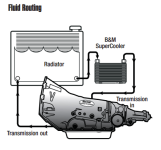
no need to add a thermostat control to an aux trans cooler, run it as designed in series with the rad cooler & the fluid will get heated in cold weather by the radiator, then the fluid goes to the aux cooler to get cooled some & then back to t he trans. this is how all aux cooler companies suggest doing it & is how toyota does it on vehicles with trans coolers/towing package. check out b&m or hayden stacked plate style coolers, mid size haydens are less than $100 & work great.

running on just the cooler as some do is not a good idea, in cold weather the trans fluid doesnt get to operating temp fast enough & when it stop go traffic the cooler doesnt get any airflow that is needed to function, causing too high of fluid temps.

& i agree with everyone else that says changing trans fluid at 100k or more will not harm a healthy trans, old worn out fluid will. the stories on this came from neglected trans that had other issues or more so from shops doing a power flush with a machine that may dislodge some debris & cause problems. doing a pan drain & fill or using the engine to pump out ~2qts at a time & adding the same 2 qts wont harm a healthy trans.
 

Attachments

  • Transmission-fluid-cooler-routing.png
    Transmission-fluid-cooler-routing.png
    19.2 KB · Views: 704
My experience with adding a B&M trans cooler in series with a new radiator has has been problematic as far as getting trans fluid to a reasonable temperature during the colder months here in the northeast.
Even after driving 30-45 minutes fluid temp would remain between 95-115 and rarely reach 120. Outside temps weren’t typically below 30F.
Even mildly cold outside temps would keep trans fluid below 120.
Have been considering removing the cooler though it does come in handy when stuck in summer city traffic when temps are above 90F.
Thinking that prolonged trans fluid temps between 100 - 125 F can’t be good for long term trans health.
Trans temp monitored by Scangauge.
 
My experience with adding a B&M trans cooler in series with a new radiator has has been problematic as far as getting trans fluid to a reasonable temperature during the colder months here in the northeast.
Even after driving 30-45 minutes fluid temp would remain between 95-115 and rarely reach 120. Outside temps weren’t typically below 30F.
Even mildly cold outside temps would keep trans fluid below 120.
Have been considering removing the cooler though it does come in handy when stuck in summer city traffic when temps are above 90F.
Thinking that prolonged trans fluid temps between 100 - 125 F can’t be good for long term trans health.
Trans temp monitored by Scangauge.

im in iowa where winters can be below 0f for weeks straight, even in mild temps it takes the trans fluid quite a while to fully warm up. doing the fluid check at temp via toyotas jumper process can take 15-20+ minutes to get to the 115-130 range but after that it gets to 150+ pretty quick, so its not really "prolonged" or going to harm the trans. i monitor my temps with OBD scan gauge & the torque pro app.

trans fluid temps take awhile to get to the 160-170 ideal temps even with a factory aux cooler so i dont think 30-45 minutes time causes any harm to the trans or fluid, much better to be on the cool side than too hot. was just saying that bypassing the rad cooler is not a good idea & will take a lot longer to get to temp in the winter without the rad cooler in series & can cause severe damage to only use the aux cooler in summer stop & go traffic or towing. but you can always slip in a piece of cardboard to block the trans cooler in the winter if needed.

i have ran aux coolers for 20+ years in my daily driver SUV's that do some light towing as well as higher horsepower street/strip muscle cars, never had a too cool problem & probably saved the trans in my previous jeep cherokee i towed regularly with for long trips in 90f temps for welll over 100k miles.

just wanted to post what the transmission & cooler manufactures say is the best way to run a cooler.
 
Actually your suggestion about blocking the radiator with cardboard in the winter is something I’ll be trying this coming winter.
This past winter even after driving for 1-2 hours in 30-40 degree temps my trans fluid stayed below 120-125.
It would never exceed 125 regardless of how many hours I drove.
 
strange they stay that low that long, but i supposed each case is different. maybe the aux cooler is too large for your needs, i use a mid size coolers for my vehicles, about 12" wide by 10" tall.

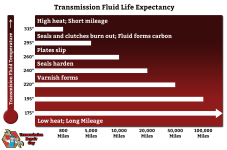
heres a good chart for trans temps, 125f isnt terribly low, i think the damage at prolonged low temps is more like 100 or below.
 

Attachments

  • trans temps.png
    trans temps.png
    132.3 KB · Views: 550
strange they stay that low that long, but i supposed each case is different. maybe the aux cooler is too large for your needs, i use a mid size coolers for my vehicles, about 12" wide by 10" tall.

heres a good chart for trans temps, 125f isnt terribly low, i think the damage at prolonged low temps is more like 100 or below.
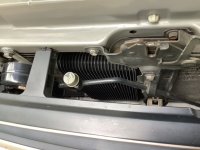
Installed B&M 70264 which is on the small side. Have been very surprised at the low temps it’s generated.
Great in the summer but not so great in the winter.
 

Attachments

  • 2F9582A0-8E8D-4F5A-AC39-8A8E77489435.jpeg
    2F9582A0-8E8D-4F5A-AC39-8A8E77489435.jpeg
    98.1 KB · Views: 475
Installed B&M 70264 which is on the small side. Have been very surprised at the low temps it’s generated.
Great in the summer but not so great in the winter.

those stacked plate coolers are very efficient compared to the tube style. i use about the same size on my cars but the hayden brand thats priced a little cheaper.

the cardboard should help a lot.. or use a smaller cooler?
 
Performed a full flush and installed the transgo shift kit with a Hayden 699 cooler with thermo fan. Around 230k miles on the clock, ZERO trans issues, flushed it via running with hose off, remove 2 qts add 2 qts. No problems in cold weather 25-32 degrees it takes about 35 mins to get to temp and stays around 140 ish.

I don't understand why people freak out about flushing the trans. If your that worried why do you change engine oil? Do it at regular intervals along with diff/s and the tc if your 4wd.
 
After watching this excellent video, it makes no sense to me to only do a partial flush unless you just don’t want to mess with the full flush. Since you’re already pushing new fluid thru the torque converter, you might as well catch it before it goes back to the pan. I’ll be doing this on my 2006 very soon. Thanks for that video.
 

Members online

Forum statistics

Threads
278,307
Messages
3,554,054
Members
248,016
Latest member
Advally Service

Trending content

Back
Top