Propeller Shaft Maint????

wesgo

New member
Ok I see that this has been brought up before in other posts, but I'm still not sure exactly what part on the 4runner is the propeller shaft. Is it the drive shaft? and if it is what do you lubricate and torque? Are we talking about the universals? Sorry about the lack of knowledge of terms but it seems to me something got lost in the translation of the owners manual.

Thanks for any help,

Bill
 
Register to hide this ad
Sorry about the lack of knowledge of terms but it seems to me something got lost in the translation of the owners manual.
LOL. I don't have the answer to your question but I have commented before about the poor quality of the owners manual. I would have expected Toyota to be able to find a tech writer who was fluent in both Japanese and English.
 
It is not the u-joints. The propeller shaft is essentially the driveshaft. The nipple to lube is at the front end of the drive shaft. I could swear someone took pictures of this and posted them in a thread about greasing these.
 
toybox said:
It is not the u-joints. The propeller shaft is essentially the driveshaft. The nipple to lube is at the front end of the drive shaft. I could swear someone took pictures of this and posted them in a thread about greasing these.

They did, I bet they were deleted because they won't allow pictures of someone lubing a nipple on this forum. :D
 
LOL, thats great,

Thanks for the info. I figured that it was the drive shaft, and guess now its time to take a look under the 4runner. I believe that the owners manuals are kinda vague on purpose. Thank goodness for web sites like this!!

Bill
 
wesgo said:
Ok I see that this has been brought up before in other posts, but I'm still not sure exactly what part on the 4runner is the propeller shaft. Is it the drive shaft? and if it is what do you lubricate and torque? Are we talking about the universals? Sorry about the lack of knowledge of terms but it seems to me something got lost in the translation of the owners manual.

Thanks for any help,

Bill

The propeller shaft is the drive shaft, which includes the universal joints. If you have a 2wd, the drive shaft has no lubrication points (zerk fittings) on either the shaft or u-joints. If you have a 4wd, you should have zerks for lubrication on each u-joint, and the drive shaft slip (expansion) joint. As others have already said, use a good quality, water resistant grease.
 
I was under my 4R last weekend doing a fluid change of both front and rear differentials and the tranfer case and noticed a grease fitting on the front propeller shaft (the one driving the front wheels) near the transfer case. I have been greasing the rear propeller shaft (the one driving the rear wheels)and U joints faithfully every 8K Kms since I bought the vehicle new. Until Now, I did not know there was a grease fitting on the front shaft (Slip Joint) until now at 48K Kms. Unlike the rear shaft, there are no grease fittings on the front U joints though just on the front slip joint and its near the transfer case.
I will be greasing that fella up this weekend.

4WD users please make note, if you are like me, this fitting may be long overdue for some grease.

-TM-
 
Last edited:
Larry said:
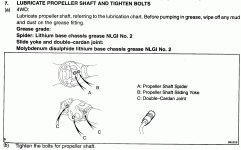
Those two fittings on the front of the drive shaft, each take a different spec grease.

Technically the slip joints take a different, but similar, type than the universal joints. I think many people have just used the one type. I actually bought both and have two grease guns.
 
The service booklet for my '98 4Runner specified NGLI-2 grease for the U-Joints and NGLI-2 with molybdenum disulfide for the slip yokes. The manual for my '03 no longer carries the recommendation to use moly disulfide for the slip yokes. Apparently, Toyota felt that specifying different greases for these similar applications was a bit much.

Valvoline markets a synthetic grease that meets NGLI-2 specs and includes a moly disulfide additive. I'm now using that for everything on the truck. It seems to be working just fine at 47K miles.
 
this is in 2004 repair mannual
 

Attachments

  • lub2.gif
    lub2.gif
    56.1 KB · Views: 24,745
So are most of us agreeing that since BOTH are lithium based greese (according to the picture), that a high quality synthetic lithium greese will be fine for all joints? Anyone have any arguments against? :awais:

Thanks. .
 
ellsworb said:
So are most of us agreeing that since BOTH are lithium based greese (according to the picture), that a high quality synthetic lithium greese will be fine for all joints? Anyone have any arguments against? :awais:

Thanks. .

As you have probably seen, there are those that follow the manufacturers recomendations to the letter. And there is nothing wrong with that. But, on MY vehicle, I do not have any quams about using a GOOD quality synth-lith grease on all joints.

The choice is yours........:D
 
naturally. . it almost makes me wonder if it isn't another translation issue. . who knows. . i too feel that a high quality synthetic lithium has better characteristics than regular. thanks guys.
 
I just greased my 2004 V8 4X4 SE. There are 3 zerks on each driveshaft as it leaves the transfer case. Then there is one more zerk as the drive shaft enters the front and rear differential. All can be accessed without fuss. With my 3" lift, I can access each zerk without ramps. I had to move the 4Runner forward a bit to position a couple of the zerks to make reaching them easier.

I pump the Amsoil Series 2000 synthetic grease until I see fresh blue appear around the grease seals. Yes, there is some splatter on the underside of the 4Runner from this. Better too much than too little.

The two slip joints take a lot of grease. I add over 20 pumps each time I lube them.
 
RL Lemke said:
Better too much than too little.

The two slip joints take a lot of grease. I add over 20 pumps each time I lube them.

I read this quote from "TechWrench" in another post regarding the propeller shaft maintenance, and I believe I have seen others offer similar advice:

"The driveshaft slip joint is NOT supposed to be completely filled when you grease it. It is designed to 'slip' in and out in order to allow for suspension compression and expansion. If you fill this joint too much, it will not be able to compress and this can cause stress on the suspension/transfer connection."
 
Last edited:
Baba Booey said:
I read this quote from "TechWrench" in another post regarding the propeller shaft maintenance, and I believe I have seen others offer similar advice:

"The driveshaft slip joint is NOT supposed to be completely filled when you grease it. It is designed to 'slip' in and out in order to allow for suspension compression and expansion. If you fill this joint too much, it will not be able to compress and this can cause stress on the suspension/transfer connection."

So what is the RIGHT amount?

I put 5 or 6 pumps in every year. I noticed on the u-joints you will see it come out, but on the slip joints you could pump many, many times.

Does the manual give the proper amount to be put in?
 
toybox said:
So what is the RIGHT amount?

I put 5 or 6 pumps in every year. I noticed on the u-joints you will see it come out, but on the slip joints you could pump many, many times.

Does the manual give the proper amount to be put in?

I don't think there is a 'right' amount. The rule of thumb when applying grease to a lubrication fitting was to look for 'old' grease to be forced from the seals of the component. This is still OK for static type joints (u-joints, ball joints steering knuckles and the like). But because the driveshaft slip joint is constantly expanding and compressing, this method, IMHO, isn't valid. The exact amount to use is subjective. I apply 4-5 pumps when I do mine. Not sure if that is the 'right' amount, but so far it works. Also, the actual amount of grease dispensed by 4-5 pumps will vary, depending on the type of grease gun used (mini gun or full size one). The manual does give the procedure to disassemble and clean the slip joint, so I would assume that this would be a good idea every couple of years or so. But I bet that most shops never do it. So, I don't think anyone can give you an 'exact' answer that can be documented anywhere.
 

Members online

Forum statistics

Threads
278,307
Messages
3,554,049
Members
248,016
Latest member
Advally Service

Trending content

Back
Top