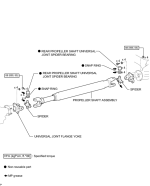
Propeller Shaft torque spec.

ron in sc

New member
I have not been able to find the torque spec. for the propeller shaft. I do not have access to TIS. Anyone know what it is?

I found Mijfwb23's thread about the correct lube and lubrication in shaft lubrication in general. For my 2012 four wheel drive SR5 I plan to use molybdenum disulphide lithium base chassis grease NLGI No 2

If there is a sticky I missed that has this information please advise.
 
Register to hide this ad
INSTALLATION

1. INSTALL PROPELLER SHAFT ASSEMBLY
(a) Align the matchmarks on the propeller shaft flange and differential flange.

(b) Install the propeller shaft assembly with the 4 washers, 4 bolts and 4 nuts.

Torque: 88 N·m (899 kgf·cm, 65ft·lbf)
(c) Align the matchmarks on the propeller shaft flange and transfer flange.

(d) Install the propeller shaft assembly with the 4 washers and 4 nuts.

Torque: 88 N·m (899 kgf·cm, 65ft·lbf)


It's the same for the front and rear shafts.:cheers:
 

Attachments

  • C218835E01.png
    C218835E01.png
    79.8 KB · Views: 26,551
Last edited:
Thank you for chiming in.

I am going to put some lube in zerks on drive shaft and check torque of bolts on the propeller shaft per owner's manual.

For anyone else that does this be aware that two of the zerks on one of the shafts has a small shield that needs to be removed. You also need a 14mm socket, a 14m and 17mm crowsfoot the type that look like the end of a fuel line wrench; the grip much, much better than the other type.
 
Thank you for chiming in.

I am going to put some lube in zerks on drive shaft and check torque of bolts on the propeller shaft per owner's manual.

For anyone else that does this be aware that two of the zerks on one of the shafts has a small shield that needs to be removed. You also need a 14mm socket, a 14m and 17mm crowsfoot the type that look like the end of a fuel line wrench; the grip much, much better than the other type.

Your vehicle might be different, but I think you might be able to just rotate the driveshaft until you can access all 6 zerks? I did this on the ground with the rear axle jacked up, and was able to eventually reach each zerk with the grease gun w/o removing any shields at all. Mine is a part time 4wd though, I've heard the full-time 4wd are different and need all 4 wheels off the ground.
 
For anyone else that does this be aware that two of the zerks on one of the shafts has a small shield that needs to be removed.
Are you talking about the heat shield between the header and the U joint nearest the transfer case on the front driveshaft? I use a grease gun with a flexible end to avoid removing that.
 
Has anyone done a DIY for this? Would be helpful to have some pics of this "shield" covering the zerks.
 
Yeah, what Jeremy and Eddie said, no need to remove shield. Get a Lincoln grease gun that takes full sized grease carts and a flexi hose.
The how to in the link above has great pics of what you'll see even if you've taken your truck in for several "lube and oil" changes...untouched zerks still with factory paint!!
Gee, wonder why all the driveshafts are clunking?

I went with M1 synth pink grease (no moly) on my replacement shaft...so far so good!
 
Yeah, what Jeremy and Eddie said, no need to remove shield. Get a Lincoln grease gun that takes full sized grease carts and a flexi hose.
The how to in the link above has great pics of what you'll see even if you've taken your truck in for several "lube and oil" changes...untouched zerks still with factory paint!!
Gee, wonder why all the driveshafts are clunking?

I went with M1 synth pink grease (no moly) on my replacement shaft...so far so good!

This! At first I was wondering how the heck the zerks got so dirty already, then I realized it was the black paint the factory painted the driveshafts with, lol.

Since we're on the subject of grease, I found this Valvoline one that was pretty highly rated by those oil fanatics on the oil forum:
p63.png

Valvoline.com > Products > SynPower > Grease SynPower > SynPower® Synthetic Grease

Seems like a nice compromise for our driveshafts because it sorta meets both factory specs for the slip yokes and the u-joints (it's NLGI #2 and moly fortified). Might be a worthwhile grease to check out if some of you are still undecided.

I can't comment on how well it works besides that it seems to have reduced my light driveshaft thud to nothing after one application :)
 
I checked mine, SR5 and it appears to be the same. Looks like I did not have to remove the shield. That said there are only two 12mm bolts to remove it and doing so may give me a little extra room with little effort.

Exactly. I've used both methods (4th gen identical) and find it hard to say which one is easier. Either way, a flexible hose is a must, imo.
 
This! At first I was wondering how the heck the zerks got so dirty already, then I realized it was the black paint the factory painted the driveshafts with, lol.

Since we're on the subject of grease, I found this Valvoline one that was pretty highly rated by those oil fanatics on the oil forum:
p63.png

Valvoline.com > Products > SynPower > Grease SynPower > SynPower® Synthetic Grease

Seems like a nice compromise for our driveshafts because it sorta meets both factory specs for the slip yokes and the u-joints (it's NLGI #2 and moly fortified). Might be a worthwhile grease to check out if some of you are still undecided.

I can't comment on how well it works besides that it seems to have reduced my light driveshaft thud to nothing after one application :)

I think both applications called for an NLGI #2 but one was with moly, the other without.
 
I think both applications called for an NLGI #2 but one was with moly, the other without.

Correct. On page 643 of my 2012 Owner's Manual it specs. Lithium base chassis grease, NLGI No. 2 for the Spider.

For the Slide yoke it specs Molybdenum-disulfide lithium base chassis grease NLGI no. 2 or lithium base chassis grease, NLGI No. 2


Why would they not want you to put moly grease in the spider?
 
Why would they not want you to put moly grease in the spider?

Apparently moly is great for sliding applications but has the potential to cause problems when used with rolling needle bearings. That said, a lot of moly grease has been used in a lot of 4th gen spiders over the years. Never heard a report of a u-joint going out.

I used a moly grease for both applications for 100k miles. I only switched to a second, non moly grease (M1) for the spiders because I found the non-moly grease to flow through the zerks with less effort making it easier to deal with tight spots.
 
Reviving this thread for a bit. My last couple vehicles before my 4Runner have been front wheel drive with a transaxle, and the last vehicle I had with rear wheel drive I drove it to 265k miles and never touched the driveshaft for anything. So I could really use some help here on torquing the driveshaft bolts. I have attempted (cautiously), but have been unable to get myself positioned to get enough leverage to click my wrench set at 65 lb-ft. I'm not concerned that any are loose just based on feel and I'm not due for it, but just wanna make sure I can do this when it's directed at 15k miles. So a few questions:

1) Can anybody elaborate on exactly what tooling (sockets, crows feet, wrenches, etc.) you're using where?
2) Any tips on getting positioned properly for better leverage?
3) Should you or can you do this with the wheels lifted to allow rotating the driveshaft for easier access to all the bolts and just to get it a little higher?
4) I thought I read somewhere that you should hold either the bolt or the nut still and torque the other, i.e. something like you do not want the bolt rotating? Anything significant here?
5) Should vehicle be in neutral?
6) Anything else that could go wrong, damage something (like a differential or transfer case) inadvertently somehow?

Appreciate any help. Any helpful pics would be great too.
 
Last edited:
Reviving this thread for a bit. My last couple vehicles before my 4Runner have been front wheel drive with a transaxle, and the last vehicle I had with rear wheel drive I drove it to 265k miles and never touched the driveshaft for anything. So I could really use some help here on torquing the driveshaft bolts. I have attempted (cautiously), but have been unable to get myself positioned to get enough leverage to click my wrench set at 65 lb-ft. I'm not concerned that any are loose just based on feel and I'm not due for it, but just wanna make sure I can do this when it's directed at 15k miles. So a few questions:

1) Can anybody elaborate on exactly what tooling (sockets, crows feet, wrenches, etc.) you're using where?
2) Any tips on getting positioned properly for better leverage?
3) Should you or can you do this with the wheels lifted to allow rotating the driveshaft for easier access to all the bolts and just to get it a little higher?
4) I thought I read somewhere that you should hold either the bolt or the nut still and torque the other, i.e. something like you do not want the bolt rotating? Anything significant here?
5) Should vehicle be in neutral?
6) Anything else that could go wrong, damage something (like a differential or transfer case) inadvertently somehow?

Appreciate any help. Any helpful pics would be great too.

Did you get any follow up on this?

Thanks
 

Members online

No members online now.

Forum statistics

Threads
278,306
Messages
3,554,045
Members
248,016
Latest member
Advally Service

Trending content

Back
Top