Re-gearing for Performance?

I've got true 33's...

Exactly. This is honestly a bigger factor than gearing.
I know you are keeping the stock tire size, and I think that's great. I'm just mentioning this since it's a discussion about re-gearing.
Case in point: my 315/70R17 KO2 measured 33.5" brand new. On the truck and off measured the same height. The "35x12.50x17" BFG KO2 measure the same, for those wanting to argue the 315/70R17 isn't supposed to be close to 35" tall. BFG website states the tire stands at 34.4". Simply not true.
All that said, my '97 auto felt the same(power wise) on 315/70R17 as it did on 265/70R16 tires. I had both sets of tires on the '01 auto, and it also felt the same with either set of tires. I drove the '97 for 20k miles on the 315/70R17 KO2's, and then 2-3k miles on the 265/70R16 highway tires when I put it back to stock to sell. So I had plenty of time with both sets to be familiar with the power.
But maybe mileage is a bigger factor than how it FEELS power wise.
Of course, much of this is my opinion, and you can take or leave whatever you'd like. It's all what I have experienced first-hand for myself. YMMV. Literally.
 
Last edited:
Tru trac

So this is new territory for me. I normally just ignore all the re-gearing threads since they pertain to tire size and I'm not switching sizes ever, stock tires here. I am getting a Truetrac installed by a local differential shop in about a week's time. He asked if I was also re-gearing and I said no, but I'm thinking maybe I should?

I currently have 4.10 gears. If I switch to 4.30 or possibly even 4.56 gears, I have two questions for those who have done it:

1. Does it change your speedometer reading?

2. How much higher are your RPMs (if I'm understanding this correctly), say at freeway speed around 65-70 MPH?

All opinions are much appreciated! I've never re-geared before so this is all new.

EDIT: Thanks all for the ideas and help. I also found this site which was super helpful in explaining things: https://www.roundforge.com/articles...gine_do_you_have?_Is_it_modded?_Is_it_tired?_

My rig is very similar to yours in a similar location. I have 4.10 gears in my supercharged, 7th inj....blah blah, In the Sierra Foothills, about 3-4000ft the truck runs strong! The supercharger really made up for the lack of NA power the 3.4 had. Climbing Donner pass from Truckee heading west, the truck has lots of power left in 5th going 75mph, never had to down shift unless someone cuts in front of me. I can accelerate at anytime. I also run the 265/75/16. I wouldn’t regear without larger tires or more weight.

That aside, when I had my tru trac installed my truck had 145k on the stock rear diff. When the diff was installed by a reputable 4x axle shop, it was never able to set up the rear diff exactly the same as before because of the wear on the ring and pinion. This resulted in a very slight rumble when goinging about 65. I’ve had it checked for metal particles in the diff oil and it’s all normal. In retrospect I would have replaced the 4.10 ring and pinion since I may have to down the road anyway with the same ratio.

.02 cents
 
Last edited:
1. Your 4Runner has ABS, so it uses the ABS system for the speedometer. Regearing will not change your speedo accuracy, only changing tire size will.

2. You can calculate this change yourself. Take your current RPM at whatever speed, multiply by the 'new' ratio and divide by the old ratio:

For a current 2000rpm cruising in top gear (mine is at 2k rpm in OD around 67 mph indicated):
4.1 to 4.3 = 2100rpm (~5% increase in engine RPM and wheel torque)
4.1 to 4.56 = 2225rpm (~11% increase)
4.1 to 4.88 = 2380rpm (~19% increase)
etc.

From those numbers, you can see why guys go straight to 4.88's most of the time... (going from 30.6" stock tires to 35" tires is a 14% change)

-Charlie

Are you sure it’s in the ABS and not in the transfer case ? Because I cut my rear ABS completely out. Removed the bulb from the dash and my odometer still works.

I’m running 285/75/16 with 4.30 load E. It’s fine for my needs. I’m not weaving in and out of traffic. Fits my needs. If you have a friend who knows how to set up gears. That would be cheapest way to regear. Actual gears aren’t expensive compared to labor. With that said. Higher gear ratio will make your truck sit at
Higher Rpms at higher speed.
 
My rig is very similar to yours in a similar location. I have 4.10 gears in my supercharged, 7th inj....blah blah, In the Sierra Foothills, about 3-4000ft the truck runs strong! The supercharger really made up for the lack of NA power the 3.4 had. Climbing Donner pass from Truckee heading west, the truck has lots of power left in 5th going 75mph, never had to down shift unless someone cuts in front of me. I can accelerate at anytime. I also run the 265/75/16. I wouldn’t regear without larger tires or more weight.

That aside, when I had my tru trac installed my truck had 145k on the stock rear diff. When the diff was installed by a reputable 4x axle shop, it was never able to set up the rear diff exactly the same as before because of the wear on the ring and pinion. This resulted in a very slight rumble when goinging about 65. I’ve had it checked for metal particles in the diff oil and it’s all normal. In retrospect I would have replaced the 4.10 ring and pinion since I may have to down the road anyway with the same ratio.

.02 cents

Thanks for the heads up. I am having a guy in Gold River off highway 50 rebuild it, all he does is differentials. I will ask him to let me know how the ring and pinion looks and if it should be replaced.

If it does, I'll probably just regear to a higher ratio all at once.
 
Are you sure it’s in the ABS and not in the transfer case ? Because I cut my rear ABS completely out. Removed the bulb from the dash and my odometer still works.

Higher gear ratio will make your truck sit at

Higher Rpms at higher speed.

1) Yes; all ABS 3rd gen 4Runners use the ABS sensors for the speedo. You can cut either front or rear and retain the speedo, but if you cut all 4, your speedo won't work. Your tcase has a plug where the VSS can go. I swapped to a VSS, so my speedo runs off the rear output now. Just like Tacoma's, and non-ABS 3rd gen 4Runners.
2) Taller gears will make your RPM actually lower at any given speed. Unless you were referring to the ratio when you said "higher". In that case, yes- the RPM will be higher with lower gearing- but again- at any given speed. Higher RPM at higher speed is just across the board with any gear ratio.
 
1) Yes; all ABS 3rd gen 4Runners use the ABS sensors for the speedo. You can cut either front or rear and retain the speedo, but if you cut all 4, your speedo won't work. Your tcase has a plug where the VSS can go. I swapped to a VSS, so my speedo runs off the rear output now. Just like Tacoma's, and non-ABS 3rd gen 4Runners.
2) Taller gears will make your RPM actually lower at any given speed. Unless you were referring to the ratio when you said "higher". In that case, yes- the RPM will be higher with lower gearing- but again- at any given speed. Higher RPM at higher speed is just across the board with any gear ratio.
1. 100% right on that one.
2. We all have to be careful with the meaning of 'higher' - there is numerically higher (higher number), which most people call lower gearing (as in, a lower gear number in a transmission). Both are considered correct...

-Charlie
 
If you already have 4.10's I would not bother with the time and expense to regear unless you made a serious step change like 4.88. The 4.30 or 4.56 options just aren't that different.

After playing with some online calulators, I think you are right. I knew 4.30's wouldn't be too hard but was hoping I just just snag a used complete unit.

4.56's would add about 10% torque down low, but 4.88's are where it's at. The question would be, could I live with cruising the freeway at 2600 RPMs? I should turn off OD and see how noisy it is with my headers/exhaust.
 
After playing with some online calulators, I think you are right. I knew 4.30's wouldn't be too hard but was hoping I just just snag a used complete unit.

4.56's would add about 10% torque down low, but 4.88's are where it's at. The question would be, could I live with cruising the freeway at 2600 RPMs? I should turn off OD and see how noisy it is with my headers/exhaust.

Assuming a 32" tire @ 75 MPH
4.10 with Auto (1:1) 3315
4.10 with AOD (0.70 OD gear) 2260

4.30 with Auto (1:1) 3477
4.30 with AOD (0.70 OD gear) 2370

4.56 with Auto (1:1) 3687
4.56 with AOD (0.70 OD gear) 2514

4.88 with Auto (1:1) 3946
4.88 with AOD (0.70 OD gear) 2690
 
I've got true 33's and am not so patiently waiting for ECGS to get my locked 5.29's to me. It was a pretty hard decision to make. Almost everyone runs 4.88 in that size. I'll let you know how bad of a mileage hit I take and how spun up the RPM's are at 75. lol
Generally, I say go too lower rather than not low enough.

Exhibit A) On my old Samurai, I geared it low enough to turn 4000 rpm at 70 RPM on 31s. Not only was that the only way to actually hit 70mph in that vehicle, but I got better economy than with stock gearing at 60-65.

Exhibit B) I got pretty good at hypermiling my previous honda fit 5peed; it was not uncommon for me to see periods of 45mpg. On two separate occasions i deliberately cruised in 4th instead of 5th for an entire tank, and saw less than a .5mpg average reduction (i.e. almost negligible).

Exhibit C) In my 3.4 Auto, I have been experimenting with driving around with Overdrive off, and even cruising around town in just 2nd gear. I am waiting for more data, but so far I have no indications of significant reductions in mileage. Of note, with my 3.73s, disabling overdrive gives me a drive ratio almost identical to 5.29s in overdrive.

Exhibit D) A 3.4 with a 5speed and factory tires has a 5th gear drive ratio almost identical to the above, with 80mph coming around 3k rpm. That tells us that, first, cruising around 3k rpm is clearly no big deal for this engine, as Toyota would not have configured it like this if that were the case; moreover, there is no user-based evidence of reduced engine longevity with 5 speeds. And second, back to economy, 5speeds seem to almost universally get better economy both in the city and on the highway than autos. I believe even on the highway, much of that discrepancy comes from autos unlocking the torque converter or down shifting entirely, which reduces driveline efficiency. A dramatic reduction in gear ratio (i.e. 3.73 to 5.29) would also dramatically reduce that inefficiency by nearly eliminating unlocking and down shifting while cruising at highway speeds.


Bottom Line:I am getting more and more convinced that most assumptions we see about reduced economy from lower gears are likely not well-supported, and there is no reason to assume that cruising at even 3k rpm would cause any significant reduction in engine longevity. Thus, I am actually about to order 5.29s to go with my 33s. It will put me a hair over 3000rpm at 80mph which is about as fast as I would ever cruise. In turn, I should get significantly more everyday pep, about 30% slower crawl speeds, and essentially eliminated hill-induced gear hunting while cruising on the highway.
 
Great post. I am going to reply to the sections I can comment on from experience but your opion and experiences are appreciated.

Exhibit C) In my 3.4 Auto, I have been experimenting with driving around with Overdrive off, and even cruising around town in just 2nd gear. I am waiting for more data, but so far I have no indications of significant reductions in mileage. Of note, with my 3.73s, disabling overdrive gives me a drive ratio almost identical to 5.29s in overdrive.

I drive like this all the time in mine, only using OD over 50 MPG on the fwy,.taking it out of OD to engine brake. I have 4.1 gears and 32" tires and get an average of 17mpg city and 20.5 fwy

Bottom Line:I am getting more and more convinced that most assumptions we see about reduced economy from lower gears are likely not well-supported, and there is no reason to assume that cruising at even 3k rpm would cause any significant reduction in engine longevity. Thus, I am actually about to order 5.29s to go with my 33s. It will put me a hair over 3000rpm at 80mph which is about as fast as I would ever cruise. In turn, I should get significantly more everyday pep, about 30% slower crawl speeds, and essentially eliminated hill-induced gear hunting while cruising on the highway.

This is interesting, and from I have experienced in both trucks in my sig, driving without OD creates more engine vacuum, which is an old school measure of economy (drive with a vacuum gauge keeping the needle in the green) and allows the vehicle to take advantage of its gearing.

Interesting observations, thanks for posting


Sent from my Pixel XL using Tapatalk
 
Great post [MENTION=148869]Lindenwood[/MENTION]! I completely agree.
I was averaging 15MPG, and then got 19.87MPG on a trip that was full of long hill climbs where I was 4K+ RPM for minutes at a time. It blew my mind. This was on my current 315/70R17 KO2 tires. It was at that time I threw everything I thought I knew about fuel economy out the window. I started shifting at higher RPM, and now get 18MPG consistently- rarely do I see under 18.
The '97 got better mileage with ECT on, and so did our '08 IS250. As far as I know, ECT rides the gears out longer; shifts later/downshifts sooner. I much more like the way both cars drive with ECT on, and the better fuel economy was an added bonus.
I guess the benefits of lower gearing might be greater than I was thinking- even on stock tire sizes.
 
What size are your "stock" tires. I don't think that was ever asked.

265/70 R16's, or 30.5" tires like what most come with. Thankfully I don't have the little R15's on 3.9 gears or I would not have even asked, I would have swapped out the gears ASAP lol.

Generally, I say go too lower rather than not low enough.

Exhibit A) On my old Samurai, I geared it low enough to turn 4000 rpm at 70 RPM on 31s. Not only was that the only way to actually hit 70mph in that vehicle, but I got better economy than with stock gearing at 60-65.

Exhibit B) I got pretty good at hypermiling my previous honda fit 5peed; it was not uncommon for me to see periods of 45mpg. On two separate occasions i deliberately cruised in 4th instead of 5th for an entire tank, and saw less than a .5mpg average reduction (i.e. almost negligible).

Exhibit C) In my 3.4 Auto, I have been experimenting with driving around with Overdrive off, and even cruising around town in just 2nd gear. I am waiting for more data, but so far I have no indications of significant reductions in mileage. Of note, with my 3.73s, disabling overdrive gives me a drive ratio almost identical to 5.29s in overdrive.

Exhibit D) A 3.4 with a 5speed and factory tires has a 5th gear drive ratio almost identical to the above, with 80mph coming around 3k rpm. That tells us that, first, cruising around 3k rpm is clearly no big deal for this engine, as Toyota would not have configured it like this if that were the case; moreover, there is no user-based evidence of reduced engine longevity with 5 speeds. And second, back to economy, 5speeds seem to almost universally get better economy both in the city and on the highway than autos. I believe even on the highway, much of that discrepancy comes from autos unlocking the torque converter or down shifting entirely, which reduces driveline efficiency. A dramatic reduction in gear ratio (i.e. 3.73 to 5.29) would also dramatically reduce that inefficiency by nearly eliminating unlocking and down shifting while cruising at highway speeds.


Bottom Line:I am getting more and more convinced that most assumptions we see about reduced economy from lower gears are likely not well-supported, and there is no reason to assume that cruising at even 3k rpm would cause any significant reduction in engine longevity. Thus, I am actually about to order 5.29s to go with my 33s. It will put me a hair over 3000rpm at 80mph which is about as fast as I would ever cruise. In turn, I should get significantly more everyday pep, about 30% slower crawl speeds, and essentially eliminated hill-induced gear hunting while cruising on the highway.

Yup. I think the low RPM's like how it comes from the factory was to reduce engine noise and eek out at tiny bit of MPG's if possible. But seeing that our highway mileage is pretty pitiful anyway it's not going to change a whole lot.

I haven't convinced the wife to drop the extra bucks on gears though... so this will be added to my "to-do" list along with cams.
 
Great post [MENTION=148869]Lindenwood[/MENTION]! I completely agree.
I was averaging 15MPG, and then got 19.87MPG on a trip that was full of long hill climbs where I was 4K+ RPM for minutes at a time. It blew my mind. This was on my current 315/70R17 KO2 tires. It was at that time I threw everything I thought I knew about fuel economy out the window. I started shifting at higher RPM, and now get 18MPG consistently- rarely do I see under 18.
With a manual, your goal should be to get to top gear as soon as possible - but only once you have actually reached your cruising speed! This means that higher RPM shifts are perfectly fine and actually the goal.

You want to accelerate around the peak efficiency range of the engine (peak torque, normally) while keeping the engine control in closed loop (so, not floored). Once at your target speed, lower engine RPM becomes important instead, but you still have to be reasonably close to a good efficiency range for the engine. Lugging an engine is very inefficient.

-Charlie
 
With a manual, your goal should be to get to top gear as soon as possible - but only once you have actually reached your cruising speed!
Yeah, I mean, that's what I was taught, and that's how I've driven manuals for the last 18 years. That's also how I was driving my '01 for the first 9 months. In general, that may be true. However, I definitely don't wanna be in 5th if my cruising speed is only 45-50mph. I would be having to give too much throttle input, and my fuel mileage would definitely suffer. I mean, it did suffer. I've played with the "real-time MPG" needle on the BMW, and it behaves the same way. Just a TINY bit greater throttle input in top gear- say, coming up a very slight grade- can equate to far lower MPG than the same speed in the next lower gear.
I guess some parts of the country are flat, and this "get to the top ASAP" makes the most sense on flat ground.
We really have no flat ground here in Oregon [emoji23]
 
However, I definitely don't wanna be in 5th if my cruising speed is only 45-50mph. I would be having to give too much throttle input, and my fuel mileage would definitely suffer. I mean, it did suffer. I've played with the "real-time MPG" needle on the BMW, and it behaves the same way. Just a TINY bit greater throttle input in top gear- say, coming up a very slight grade- can equate to far lower MPG than the same speed in the next lower gear.
I observed the same things with the very-useful MPG gauge on my Honda Fit. Fuel efficiency was almost solely dependent on load, with RPM (+\- a gear) having essentially no effect.

Funny enough, I actually figured out today that I have 4.10 axle gears, rather than 3.73. But, that only provides an even more extreme comparison for this week's fuel economy testing. Plus, this provides even more motivation to go 5.29s over 4.88s.
 
Yeah, I mean, that's what I was taught, and that's how I've driven manuals for the last 18 years. That's also how I was driving my '01 for the first 9 months. In general, that may be true. However, I definitely don't wanna be in 5th if my cruising speed is only 45-50mph. I would be having to give too much throttle input, and my fuel mileage would definitely suffer. I mean, it did suffer. I've played with the "real-time MPG" needle on the BMW, and it behaves the same way. Just a TINY bit greater throttle input in top gear- say, coming up a very slight grade- can equate to far lower MPG than the same speed in the next lower gear.
I guess some parts of the country are flat, and this "get to the top ASAP" makes the most sense on flat ground.
We really have no flat ground here in Oregon [emoji23]
I hope I didn't make it sound that simple. Top gear at all costs is NOT what you want to do.

And by 'as early as possible' I don't mean at the lowest speed possible. Early as in time and distance, not speed.

You should:
- Use the engine in its best VE (volumetric efficiency) operating load/RPM range. This is different for each engine design. Often higher RPM than you might think. At full throttle, max VE is around peak torque. Lower throttle openings will be different.
- Once you have met the 'good VE range' criteria, you want the engine RPM to be as low as possible. In some cases, that might mean still keeping it above 2500RPM in a small 4-cylinder (or, in a diesel, maybe above 1200rpm).

If you have to use large throttle openings to maintain speed, you are in the wrong gear. If you are truly cruising on flat ground you can usually be in a higher gear than in uneven terrain.

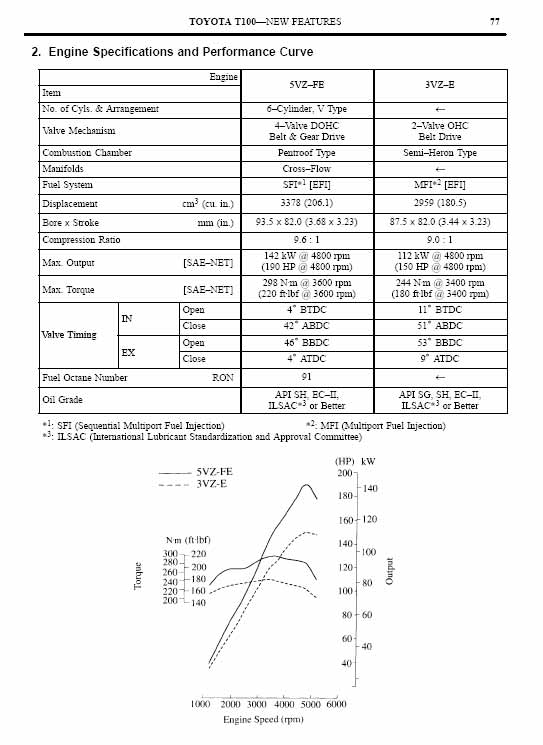
Here's a graph from Toyota:
163949d1436140901-stock-n-3-4-powerband-regear-3vzevs5vzfe.jpg~original.jpg


Looks like 3k RPM is where things actually start improving for VE under high loads... So, don't be afraid to use that rev range! Also, notice that precipitous drop off below 1800-2000rpm - you don't want to be there, basically ever, while under load.

-Charlie
 
I hope I didn't make it sound that simple. Top gear at all costs is NOT what you want to do.

And by 'as early as possible' I don't mean at the lowest speed possible. Early as in time and distance, not speed.

You should:
- Use the engine in its best VE (volumetric efficiency) operating load/RPM range. This is different for each engine design. Often higher RPM than you might think. At full throttle, max VE is around peak torque. Lower throttle openings will be different.
- Once you have met the 'good VE range' criteria, you want the engine RPM to be as low as possible. In some cases, that might mean still keeping it above 2500RPM in a small 4-cylinder (or, in a diesel, maybe above 1200rpm).

If you have to use large throttle openings to maintain speed, you are in the wrong gear. If you are truly cruising on flat ground you can usually be in a higher gear than in uneven terrain.

Here's a graph from Toyota:
163949d1436140901-stock-n-3-4-powerband-regear-3vzevs5vzfe.jpg~original.jpg


Looks like 3k RPM is where things actually start improving for VE under high loads... So, don't be afraid to use that rev range! Also, notice that precipitous drop off below 1800-2000rpm - you don't want to be there, basically ever, while under load.

-Charlie

Excellent post! I was actually about to say many of the same things, specifically with respect to VE and Torque--I even have another tab open looking for factory 5vz dyno graphs :p --but you beat me to it!
 
In the first week of testing, I saw essentially no change.

The MPG for the last several fillups were as follows:
13.88
14.96
15.24
14.30
15.44 (after a week of driving 60% in 2nd and 40% in 3rd--no Overdrive!).

I am going to do a few more weeks of testing and ser where I get. This weekend I will be driving about 350 miles round-trip, mostly on the interstate. The plan is to do 75mph in 3rd in one direction (about 3100rpm :0 ), then 75mph in O\D going back.
 

Members online

Forum statistics

Threads
278,307
Messages
3,554,056
Members
248,016
Latest member
Advally Service

Trending content

Back
Top