SAE or Metric?

SAE or Metric?

  • SAE

    Votes: 17 16.2%
  • Metric

    Votes: 88 83.8%

  • Total voters
    105
Interesting thread title, since SAE = Society of Automotive Engineers. They didn't come up with English/American/Imperial/Standard units. (Look, there's not even a standard terminology for this system!!!)

Everything metric makes sense to me, having come from outside the US. But even in Australia, the 'old' units still remain in common everyday language although never in actual measurements. Some examples;
If something is far away, we say "it's miles away", not "kilometers away"
Peoples height is usually spoken in feet and inches, but always in written in cm on documents.
Aviation still uses feet and knots for altitude and velocity
"A couple of inches" is commonly used to describe an approximate small distance.

I don't know how many of you actually realize just how alienated the US is from the rest of the world in terms of units of 'things'. Here's some examples
The US is the only country to still use inches, feet, yards and miles.(The UK does use miles for road distances since it was too expensive to change all the road signs)
The US is the only country that still use acres
The US is the only country that uses Fahrenheit
The US is the only country that still uses ounces and pounds
The US is the only country that uses gallons, quarts and fluid ounces
The US even has it's own paper size system (8.5x11 instead of A4)
 
I'm surprized there is even an agument here. everyone on this site is driving a metric vehicle. metric is so much easier for calculations. you just add or take away 0's instead of memorizing a bunch of ratios and equations.

the only thing imperial is good for is height or weight. i live in canada and everything here is kilometres, metres etc etc etc. but i only know my wieght in pounds and my height in feet/inches

i couldnt tell you how many metres tell i am or kilograms i wiegh for the life of me
 
I "liked" 3 posts before realizing that I should probably just post a comment saying I agree/like everyone comments for metric side of the arguement, it's just so much easier. Unfortunately I work in aviation so I have to deal with SAE but thankfully Toyota is metric, makes weekend tickering alittle less like a math class lol

centimeter to meter isn't very helpful.
Thats why there is decimeter, its really simple no large gaps:
10mm = 1cm
10cm = 1dm (not sure on that abbreviation, its been awhile)
10dm = 1m
 
Metric makes sense, everything is based on units of 10, freezing happens at 0 degrees, boiling at 100 degrees, etc. Standard makes you scratch your head wondering if they just spun a wheel to come up with some of their units, completely illogical in today's world.

That being said, I know my height in inches, and weight in pounds, and I doubt that will ever change.
 
I "liked" 3 posts before realizing that I should probably just post a comment saying I agree/like everyone comments for metric side of the arguement, it's just so much easier. Unfortunately I work in aviation so I have to deal with SAE but thankfully Toyota is metric, makes weekend tickering alittle less like a math class lol


Thats why there is decimeter, its really simple no large gaps:
10mm = 1cm
10cm = 1dm (not sure on that abbreviation, its been awhile)
10dm = 1m

As stated earlier no one uses the decimeter. "Oh hey I'm 17.9 Decimeters tall!" never heard anyone say that, but i have heard "Oh hey, I'm 5'10"
 
As stated earlier no one uses the decimeter. "Oh hey I'm 17.9 Decimeters tall!" never heard anyone say that, but i have heard "Oh hey, I'm 5'10"

And when was the last time you heard someone state their height in furlongs? Come on man, there's got to be some common sense applied here and there, just because a unit of measurement exists doesn't mean it's the right one for the job.
 
And when was the last time you heard someone state their height in furlongs? Come on man, there's got to be some common sense applied here and there, just because a unit of measurement exists doesn't mean it's the right one for the job.

Using decimeters would be more accurate than meters.
 
Using decimeters would be more accurate than meters.

Sure it would, but that's just not how things are done.

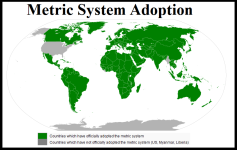
Stole these from the random/funny/strange thread, lol.
 

Attachments

  • 800px-Metric_system_adoption_map_svg.png
    800px-Metric_system_adoption_map_svg.png
    99.4 KB · Views: 23,646
  • science.jpg
    science.jpg
    109 KB · Views: 2,697
Haha. I saw those the other day too.

I don't ever expect for the US to change. It would cost way too much and causes a ton of headaches.
 
The Metric system is BY FAR better than the US/English system. Everything is by 10's, simple and easy.
Sadly, in the US we don't use the Metric system and that's what we've been accustom to using. So seeing things in Metric appears "odd".

As an example of how screwed the US system is:
Volume:
1 tsp = 1/6 oz, 8 oz = 1 cup, 2 cups = 1 pint (16 US oz), 2 pints = 1 quart (32 US oz), 4 quarts = 1 gallon (128 US oz). Imperial measurements are different.

Length:
less than an inch are measured in fractions, 12 inches = 1 foot, 3 feet = 1 yard, 5280 ft = 1 mile.

Area:
There's the whackedness of square inches, sq feet, sq yards, acres, sq miles.

Everything is so odd.

i concur 100%
 
As stated earlier no one uses the decimeter. "Oh hey I'm 17.9 Decimeters tall!" never heard anyone say that, but i have heard "Oh hey, I'm 5'10"

So what, who cares about the decimeter. I could say 1.7m or 1.8m.

5/16 5/32 17/32 hun.....what da.... oh but 1mm is smaller than 2mm, and 3mm is smaller than 4mm which is smaller than 5mm and so on. It's as easy as counting 1-2-3, oh no wait it is like counting 1-2-3. no calculation needed, higher numbers are bigger wrenches and smaller numbers are smaller wrenches. But jesting aside.....

But Fahrenheit, that I will never understand.

taken from Wikipedia....I know it's wikipedia maybe not totally reliable, bla bla but anyway here it is. Try to follow this story!

"According to an article Fahrenheit wrote in 1724, he based his scale on three reference points of temperature.[4] In his initial scale (which is not the final Fahrenheit scale), the zero point is determined by placing the thermometer in brine: he used a mixture of ice, water, and ammonium chloride, a salt. This is a frigorific mixture which stabilizes its temperature automatically: that stable temperature was defined as 0 °F (−17.78 °C). The second point, at 32 degrees, was a mixture of ice and water without the ammonium chloride. The third point, 96 degrees, was approximately the human body temperature, then called "blood-heat".[6]

According to a letter Fahrenheit wrote to his friend Herman Boerhaave,[7] his scale was built on the work of Ole Rømer, whom he had met earlier. In Rømer’s scale, brine freezes at 0 degrees, ice melts at 7.5 degrees, body temperature is 22.5, and water boils at 60 degrees. Fahrenheit multiplied each value by four in order to eliminate fractions and increase the granularity of the scale. He then re-calibrated his scale using the melting point of ice and normal human body temperature (which were at 30 and 90 degrees); he adjusted the scale so that the melting point of ice would be 32 degrees and body temperature 96 degrees, so that 64 intervals would separate the two, allowing him to mark degree lines on his instruments by simply bisecting the interval six times (since 64 is 2 to the sixth power).[6][8]

Fahrenheit observed, somewhat incorrectly, that water boils at about 212 degrees using this scale. Later, other scientists decided to redefine the degree slightly to make the freezing point exactly 32°F, and the boiling point exactly 212°F or 180 degrees higher.[citation needed] It is for this reason that normal human body temperature is approximately 98° (oral temperature) on the revised scale (whereas it was 90° on Fahrenheit's multiplication of Rømer, and 96° on his original scale)."
 

Members online

Forum statistics

Threads
278,310
Messages
3,554,080
Members
248,016
Latest member
Advally Service

Trending content

Back
Top