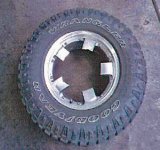
So i'm thinking of buying some of the black rock 942-series type D wheels 17x8 6x5.5 offset of 0 with 4.5 backspacing. I was wondering if there would be any issues? because i heard some problems that people were having with steel wheels.
that looks sick man. my cousin doubted me getting some steelies until i showed him this pic haha
Correct me if I am wrong but I believe steel wheel are significantly heavier then aluminum wheels and that added weight will negatively effect gas mileage (especially if you mount heavy off-road tires on them to boot)?the steel rims don't pose any other issues to speak of. I've had them off-roading numerous time and they are rock solid!
Correct me if I am wrong but I believe steel wheel are significantly heavier then aluminum wheels and that added weight will negatively effect gas mileage (especially if you mount heavy off-road tires on them to boot)?
I know some people don't give a rats ass about gas mileage but I thought that might be something worth mentioning for those that do.
I was curious so I looked it up...I'm sure they are heavier than their aluminum counterparts, but I have no idea if it's significant or not
I was curious so I looked it up...
Black Rock Type D Series 942
Material = Steel
Size = 17x8
Bolt pattern 6x5.5
Offset = 0
BS = 4 1/2
Shipping weight = 38lbs
Load Rating = 2000lbs
vs.
Black Rock Type D Series 909B
Material = Aluminum
Size = 17x8
Bolt pattern 6x5.5
Offset = 0
BS = 4 1/2
Shipping weight = 23lbs
Load Rating = 2200lbs
The steel wheels weigh almost twice as much and surprisingly have a lower load rating?
Don't get me wrong, for a trail rig I'd go steel but for a daily driver, alloy is the way to go IMO.
I don't give a rats ass about the difference in load rating. I was just surprised the alloys where rated higher so I noted it.By your own math, the difference between the alloys is 15lbs per wheel or 60 lbs (unless you swap out the spare as well in which case it's 75lbs.
This is for a vehicle that curbs around 4300lbs (V6 - the V8 is 200lbs heavier) and has a GVWR of around 5600lbs. That means it increases your vehicle's curb weight by 1.7% and GVWR by 1.3%.
As far as the load difference, 2000lbs x 4 = 8,000lbs, which exceeds the 4runner's GVWR by more than 2,000lbs so what difference does it make that the alloy wheels can hold 200lbs more? Are you planning on hauling 3500lbs of gear in your 4runner?
So, yeah, I'd call that "insignificant."

As for the wheel weight however, I think you're kidding yourself if you honestly believe that 60 additional pounds of unsprung weight is insignificant. I think markiadan's experience strongly indicates the contrary.
I do not agree with your conclusions, you do not agree with mine. That's fine, In the end each of us has to determine for ourselves what is or is not significant or important."significant" for what purpose
I once heard that the reason police vehicles run steel wheels instead of alloy...cost not being a factor...is that if you hit something, steel will bent and give whereas alloy may crack and break.
Don't know about you guys, but would rather have bent wheel vs. a cracked/broken wheel.
I'm sure it is somewhat true for offroading as well...
FWIW I have never heard of anybody getting a cracked wheel off road, and when you consider that most modern 4x4s come from the factory with alloys, you would think that if this was a problem, you'd hear about it more.
True...but most 'modern' 4x4s hardly ever see the 'dirt'...also, there are different types of offroading.
However, any type of wheel can crack or fail...but it is just that cracking in aluminum can be more 'disastrous' than steel...
I once heard that the reason police vehicles run steel wheels instead of alloy...cost not being a factor...is that if you hit something, steel will bent and give whereas alloy may crack and break.
Don't know about you guys, but would rather have bent wheel vs. a cracked/broken wheel.
I'm sure it is somewhat true for offroading as well...