Tire Pressure Sensors

  • Thread starter Thread starter iamtwonice
  • Start date Start date
I

iamtwonice

Guest
On the 2006 4Runner are the tire pressure sensors the direct monitoring type or the indirect? The direct type are far superior but cost more. Also does the spare tire have a sensor in it?

If you get new tires of the same size that came with the vehicle, does any body know if you have to get the sensors calibrated again?
 
Register to hide this ad
I visited this site for comparison of the direct/indirect mount system: http://www.tirerack.com/tires/tiretech/techpage.jsp?techid=44

From the explanation I can surmise that the 4Runner system uses the Direct mount system because there is a sensor in each tire/wheel combo including the spare. I am making that assumption because the TPMS goes off if the spare tire is not inflated to the proper PSI while the other 4 tires are fine. An indirect system would not know the spare is not inflated correctly because it relies on the ABS wheel speed sensors. Also it is a known fact on the boards that the sensor itself attaches to the valve stem.

As far as I know you don't have to recalibrate the sensors when changing tires. Also numerous members have plus sized tires without any document issues.

Hope that helps and anyone correct me if I'm wrong on anything. I personally hate to spread misinformation...
 
this system could be a lot better

We do have a direct system, but unfortunately almost none of the benefits like individual tire pressure readouts, so not only can you not monitor pressures for each wheel, but when a tire is low enough to set it off but not obviously low u have to check em all 1by1. or when the system screws up which seems to happen more than expected u have a harder time figuring out the problem. My system failed after a couple of weeks.
 
Last edited:
Thank you rossmon1 and sharp4runr for you answers. I called toyota and requested that individual tire pressure be displayed since a sensor is located in each tire. This would also notify you long in advance to a slow leak, long before the warning system would normally go off. Hopefully they will do this for future 4runners.
 
Tire pressure monitoring will be mandatory by law. If you want an elaborate system that gives real time pressure readings it will drive the cost of the vehicle up. This feature would be nice but it is really not needed. What
 
rossmon1 - what failed on your TPMS?

My big beef with the TPMS is that in the winter time when the temperature drops you get a false positive and the idiot light comes on. The system alerts you because the drop in temperature causes the pressure in the tires to lower as well. Once you get driving on the road and the tires warm up, then the light goes off.

Other than that, I haven't had issue with my TPMS.
 
sharp4runr said:
rossmon1 - what failed on your TPMS?

My big beef with the TPMS is that in the winter time when the temperature drops you get a false positive and the idiot light comes on. The system alerts you because the drop in temperature causes the pressure in the tires to lower as well. Once you get driving on the road and the tires warm up, then the light goes off.

Other than that, I haven't had issue with my TPMS.

What pressure are you running? Increase your pressure one lb. at a time untill it stops. My light never comes on, but I run 40 psi. You can also put a lot more pressure in the spare so it will not trigger the light. Just keep a air pressure guage in the truck (which I have in all my cars). There's nothing worse then going to get air and not having an accurate guage.

Koz
 
Last edited:
sharp4runr said:
rossmon1 - what failed on your TPMS?

My big beef with the TPMS is that in the winter time when the temperature drops you get a false positive and the idiot light comes on. The system alerts you because the drop in temperature causes the pressure in the tires to lower as well. Once you get driving on the road and the tires warm up, then the light goes off.


Keep in mind that your tire pressure drops 1 pound per sq in for every 10 degree change of air temperature. So I really don't think you were getting a false positive. Your tires really are low and driving is causing the tire pressure to rise because the tires heat up causing the system to turn off. Tire pressure should always be checked cold before driving. I always check first thing in the morning.
 
I had them set to the recommended 32psi all around (including spare) before it started to drop in the single digits.

I do have a tire gauge in the truck, what self respecting guy doesn't ;):

I've since upped the PSI to 40 in an effort to wear them out faster so I can go get some new BFG AT KOs :D So I probably won't have the false positives this year.
 
pressure continued

My system kept indicating a fault when there was no problem. pressure was 32 all arround including spare. tried increasing pressure all arround especially the spare still an error. My wife dropped it off so don't know what was eventually fixed.
Many of the hi-end vehicles that i deal with have nice little computer graphics of all 4 wheels with individual pressures or just a text listing of each wheel like;
FL 30psi FR 29psi etc.
Not very expensive to do on an existing lcd display like the one 4runners already have under the radio.
Yeah the carrera gt has a actual pic of a chassis and wheels with readings, well thats a 1/2 million $ car and a bit overkill for a 30k SUV! But nothing too expensive about a text display and a little bit of programming to interface with the sensor hardware that is already built in.
 
I've always heard to check tire pressure 'cold', before driving. I like the fact the TPS warns of low pressure when the tremperature starts to drop - it is a reminder that to add some air to keep pressure whjre it should be.
 
Dead Wrong

Koz said:
Not, you should check your pressure at operating temp.

Koz

Koz

I am not sure who taught you to check tire pressure. Even the tires read cold pressure on the side. Get out your manual and read the section on tires. Ask any tire shop and they will tell you to check the pressure when cold.:headslap:
 
This is what screwed me up, I read this a long time ago.

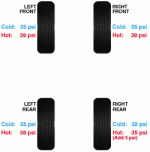
Most times you must drive more than one mile for air, check and record the air pressure in all your tires before you leave. Once at the air pump, measure each tire's inflation again and then note the difference. Inflate the tires with low pressure to a level that is equal to the recommended cold pressure plus the difference at the higher temperature.
 

Attachments

  • airpressure.gif
    airpressure.gif
    7 KB · Views: 602

Members online

Forum statistics

Threads
278,309
Messages
3,554,075
Members
248,016
Latest member
Advally Service

Trending content

Back
Top