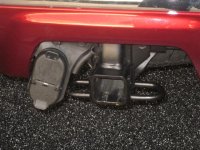
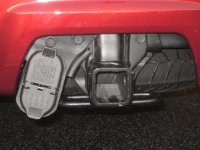
Towing Hitch Electrical Connection

Jtraskell

New member
So far, this is my ONLY real complaint about the new T4R. I knew about this prior to purchasing, but I thought I would get it changed later. To that end, has anybody figured out a better location for the trailer electrical receptacles? For those who have been replacing bumper’s etc, have you noticed if there is enough extra wire to relocate the receptacles to a mount at the bumper, or even through the bumper cover without splicing? (If I cut the bumper cover and trimmed out the hole)? The current location under the rig is an absolute pain to get to. Not to mention since the connection points downwards, it logically would be easier for a plug to come out of the receptacle while driving. There has got to be a better way.
Thanks in advance for any advice.
 
Register to hide this ad
I complained about this earlier last year and I got a couple of good ideas as stated above. However, what did not change was the fact one has to get on their hands and knees to plug in a trailer, or the extension cord for the trailer connection. Either way, a terrible design by Toyota.

Since I live on a lake and do not have to trailer my boat much, I did not do anything until recently. But this year we purchased two Sea Doo's with a dual trailer. They were delivered to my home by the dealer. However, when I went to park the trailer on another part of the property, just for giggles I thought I would connect the electrical in order to check and make sure all was well. Much to my surprise the trailer's electrical cord would not even reach to TR4's reciprocal where it is located under the vehicle! What a PAIN!

Well, I finally got off my fat A.. and got busy. It is NOT PRETTY. But it works a hell of a lot better. Only took about 8 hours of PITA work, but it got done.
 

Attachments

  • IMG_2250 (Small).JPG
    IMG_2250 (Small).JPG
    70.3 KB · Views: 4,934
  • IMG_2249 (Small).JPG
    IMG_2249 (Small).JPG
    52.2 KB · Views: 4,382
Last edited:
Looks good, how much extra wiring was required?


Thanks for the kind words. There are 7 wires, I put 1 extra foot on each wire. The wires are different gages. I think they were 3-10 Gage, 2-12 and 2-14.

I did not need a foot to make the connection, but I put the extra slack in there so I could lift the wiring harness and zip tie it above the spare near the bumper so the slack would not "dangle" from the receptacle to the connections.

The bracket had to be cut in order to fit. That was the hard part. If you mess up cutting the bracket, you can't buy just the bracket from Toyota. You have to buy the whole harness at about 250.00 dollars! I got lucky. Even though the bracket did not come out exactly as I envisioned, it works.

Here is a tip. If you do not want to remove the bracket, there is about 4 to 6 inches of wire coiled up in that webbing near the bracket. Not enough to remove the bracket and reset it somewhere else, but one could at least bend the bracket forward towards the rear bumper which makes it a little easier to plug things in. Just a thought.
 
After using the receptecle many times, for two trailers.....I've come to the conclusion it was designed and installed by some idiot who has never towed a DAMN THING!!

To the tow plug engineer......"may the fleas of a 1000 yaks infest your crotch".....:moon:


Rant over
 
After using the receptecle many times, for two trailers.....I've come to the conclusion it was designed and installed by some idiot who has never towed a DAMN THING!!

To the tow plug engineer......"may the fleas of a 1000 yaks infest your crotch".....:moon:


Rant over

I have to agree.

my boat harness wouldn't even reach my receptacle the first morning i got up at 4:30 to tow my boat an hour to the lake. talk about being ticked off.

luckily i had a spare tailer harness and butchered that harness lengthening my trailer harness.

I've since gone to the coil harness extension, and i'm still not happy.
 
After using the receptecle many times, for two trailers.....I've come to the conclusion it was designed and installed by some idiot who has never towed a DAMN THING!!

To the tow plug engineer......"may the fleas of a 1000 yaks infest your crotch".....:moon:


Rant over

Ditto.......
 
Looks good, how much extra wiring was required?

Update to all who may be thinking of splicing the wires to lengthen the harness and move the bracket, use solder. I tried using the tube type connectors, got everything changed over and plugged in my trailer, no lights.

The ground wire had slipped out of the connector. Off came everything again, and this time I soldered all the wires. Works great now.
 
Update to all who may be thinking of splicing the wires to lengthen the harness and move the bracket, use solder. I tried using the tube type connectors, got everything changed over and plugged in my trailer, no lights.

The ground wire had slipped out of the connector. Off came everything again, and this time I soldered all the wires. Works great now.

Just a note for those not comfortable with soldering- they make heatshrink butt connectors ( tube type ) that you crimp on- then heat them up which causes the ends to shrink, and glue themselves to the wire. This makes a very good, strong connection, especially if you heatshrink over the entire shebang as well. Solder is always the best, though- provided you do it correctly! Nice job OP!
 
Update to all who may be thinking of splicing the wires to lengthen the harness and move the bracket, use solder. I tried using the tube type connectors, got everything changed over and plugged in my trailer, no lights.

The ground wire had slipped out of the connector. Off came everything again, and this time I soldered all the wires. Works great now.

There is no reason that a properly terminated crimp connector should fail. If you pulled the wire out you either used too large a connector for the wire or didn't compress the connector fully. Many moons ago I was a car electronics installer. We rarely ever soldered anything (too much time, cost.) Our response to anyone who questioned the integrity of a crimp connection was this: "If you can show me a factory solder joint in the vehicles' wiring harness, your install is free." We always got paid.
 
There is no reason that a properly terminated crimp connector should fail. If you pulled the wire out you either used too large a connector for the wire or didn't compress the connector fully. Many moons ago I was a car electronics installer. We rarely ever soldered anything (too much time, cost.) Our response to anyone who questioned the integrity of a crimp connection was this: "If you can show me a factory solder joint in the vehicles' wiring harness, your install is free." We always got paid.

True- I have years of experience with these crimps as well. The factory uses compound crimps which grip the insulation along with the wire, and actually bury the crimp straight down versus standard crimps which smash the wire tight- but I'm sure you already knew that :). Point is the average person that tries this may have problems- like the OP did, and the shrink connectors make it easy. I wouldn't use butt connectors without shrink for anything exposed to the weather- unless you like connection failures 2-3 years down the road. That said- a properly soldered joint is the best possible connection you can make. My 2 cents.
 
Thanks for the input guys. I did not know about the shrink connectors. If I did, I sure would have tried that first. Soldering took forever, but as Antman said, I think it will last forever! As to the original tube type connectors I used, well, all I can say is I used two sizes, 10-12 gauge for those size wires and 12-14 gauge for those wires. I crimped them so hard I broke two of them in the process.....and I think a tube connector splicing a wire that will never move would work just fine.

But in my case I had to "fish" the harness around a spare tire, up towards the rear bumper, then do almost a 90 to attach the harness connection by the drivers rear wheel. With all that movement and twisting, I am not surprised at least one of the wires escaped the "Crimp"!
 
Resurrecting an old thread.

The location of the outlets is by far the most irritating thing I’ve ever found with my ‘18 SR5. It is tough for a senior like me to get down on gravel on my arthritic knees, lay down in the gravel (or snow/ice) to plug in or remove; and then the difficulty and pain to get back up. Just about every SUV on the market mount them within the back bumper, generally near the license plate.
 

Members online

Forum statistics

Threads
278,307
Messages
3,554,049
Members
248,016
Latest member
Advally Service

Trending content

Back
Top