Towing with a hybrid

jerseygeorge

New member
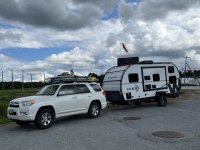
I tow a 4500 pound Winnebago and a 4000 pound boat regularly. Having owned a 2002, 2007, and now a 2012 4Runner I am anxiously waiting 6th Gen, but really attracted to Tacoma (6500 pound capacity), new Landcruiser (6000 pound towing capacity).

Here is my question. The newer Toyota hybrids have great torque and horsepower. But a friend says... when towing you will deplete the battery quickly, and the electric motor is part of the torque/horsepower numbers. Once the battery charge is depleted one is left with a less powerful gas motor to haul you down the highway, up hills, etc. His recommendation is to avoid the hybrid.

Thoughts? experience? Insights anyone? TY
 

Attachments

  • IMG_1037.jpg
    IMG_1037.jpg
    136.1 KB · Views: 2,451
Register to hide this ad
There are plenty of other hybrid trucks and SUV’s out there. Most say that towing does deplete the battery more quickly but that isn’t to say there is no benefit, just less benefit. It will discharge quickly going up hill but still get some regen going back down. Regardless the base 2.4T you are left with minus the hybrid still has 278 hp and 317 lb ft of torque and will have an 8 speed transmission so on its own it will tow better than the V6 / 5 speed. Also remember NA engines are impacted much more by elevation change than the new Turbo engine.

Bottom line, the hybrid will be most beneficial when you aren’t towing but it should still be a better tow vehicle than the current drivetrain.


Sent from my iPad using Tapatalk
 
I tow a 4500 pound Winnebago and a 4000 pound boat regularly. Having owned a 2002, 2007, and now a 2012 4Runner I am anxiously waiting 6th Gen, but really attracted to Tacoma (6500 pound capacity), new Landcruiser (6000 pound towing capacity).

Here is my question. The newer Toyota hybrids have great torque and horsepower. But a friend says... when towing you will deplete the battery quickly, and the electric motor is part of the torque/horsepower numbers. Once the battery charge is depleted one is left with a less powerful gas motor to haul you down the highway, up hills, etc. His recommendation is to avoid the hybrid.

Thoughts? experience? Insights anyone? TY

4500 lbs is a lot to tow with a 4Runner especially with a loaded vehicle. Four adults can max out the payload in one of these.

I think the new vehicle will be great for towing but if you are constantly going up and down hills not so much but most people don't drive in those conditions. I'm more concerned with the life of the turbo, especially towing.
 
The new 4Runner will come with both turbo 4 and turbo 4 hybrid. The hybrid does very little to help towing in the current Toyota format. You can see that the Tundra towing videos generally show that the hybrid system is not used while under heavy continuous load like pulling up hills. It just doesn't have enough energy in the batteries to help with that task. It does help on the on-ramp.

Either way, the next gen should pretty easily out-pull the 4.0 5AT combo. It has about twice as much power at 2500 rpms as the 4.0, so it'll downshift a lot less especially at elevation. And it has closer ratio gears, so it should make pulling up the long passes a lot nicer experience than the 4.0L. We should get a really good idea of how well it does as soon as people start being able to do tow testing on the new Tacoma. The current info is that the next gen 4Runner is basically a Tacoma with a cap on the back. Everything the Tacoma is will directly translate to the 4Runner. No word yet on 3rd row seating, tow capacity, or pricing though.

One pretty positive test result I have seen is the TFL 60 mile highway mpg test loop. They got just over 24mpg in a crew cab 4x4 Limited trim iirc tacoma non-hybrid. IMO - that's pretty darn good at 75mph on the highway. If the 4Runner matches that non-hybrid and probably 27-28mpg with the hybrid, it'll be a big win in my eyes.
 
Last edited:
https://www.youtube.com/watch?v=jljyV_5cxW0&

The video is about crossover with the planetary CVT hybrid system so not the "engine-electric motor-conventional auto transmission" layout that Toyota has in their trucks but my guess is that battery capacity will be a factor solely on long uphill climbs and that the engine without the electric boost will probably still be able to rev up more and buzz you up the rest of the hill.

Normal non-plug-in hybrids drain/charge the battery pretty quickly so I bet going downhill and hitting level terrain will help.

Maybe you can see how the hybrid Tundra and Sequoia tow today?

Now that I said that last sentence I wish I thought of that when I started the post.
 
Last edited:
I tow a 4500 pound Winnebago and a 4000 pound boat regularly. Having owned a 2002, 2007, and now a 2012 4Runner I am anxiously waiting 6th Gen, but really attracted to Tacoma (6500 pound capacity), new Landcruiser (6000 pound towing capacity).

Here is my question. The newer Toyota hybrids have great torque and horsepower. But a friend says... when towing you will deplete the battery quickly, and the electric motor is part of the torque/horsepower numbers. Once the battery charge is depleted one is left with a less powerful gas motor to haul you down the highway, up hills, etc. His recommendation is to avoid the hybrid.

Thoughts? experience? Insights anyone? TY

I'd suggest checking the specific details of the hybrid setup. Toyota's latest hybrids come with cool tech that sorts out power for different driving situations, even when you're towing. See how well the hybrid handles heavy loads and switches between electric and gas power without a hiccup. Also, take a peek at how the cooling and power delivery systems hold up when you're towing. These systems are key to making sure everything runs smoothly. Hybrid or not, Toyota has a reputation for robust performance, so I wouldn't discount the option without giving it a fair shot.
 
With all the dead Tesla's reported around the country in the extreme cold this past week, we've been near zero here in North Texas, with the wind chill down to -5, now I'm wondering how wise a hybrid or plugin hybrid really is? Their batteries are going to be rapidly drained, just like EV's, in the extreme cold. Of course, the gas engine will help, but it will have limited battery power assistance, potentially.

So [MENTION=118321]Jetboy[/MENTION] and others, who know the ins and outs of the hybrid characteristics, what are your thoughts?

'Dead robots': Chicago's extreme cold knocks out Tesla cars
 
Last edited:
I know the MPGs take a significant hit in the winter. It's been 23 f here and my hwy mpg has gone from 40 mpg in Sept to 30 mpg now in my 2023 RAV4 hybrid. My V8 4Runner only lost about 2 MPGs in the winter.
 
With all the dead Tesla's reported around the country in the extreme cold this past week, we've been near zero here in North Texas, with the wind chill down to -5, now I'm wondering how wise a hybrid or plugin hybrid really is? Their batteries are going to be rapidly drained, just like EV's, in the extreme cold. Of course, the gas engine will help, but it will have limited battery power assistance, potentially.

So [MENTION=118321]Jetboy[/MENTION] and others, who know the ins and outs of the hybrid characteristics, what are your thoughts?

'Dead robots': Chicago's extreme cold knocks out Tesla cars

I have no idea how this system does with extreme cold. I'm sure the car runs fine. Toyota does pretty extreme testing. Although I've read that flex fuel tundras won't start sometimes in cold weather due to the flex fuel map flooding the engine. But my ffv starts every day without a hesitation in all temps.

The battery is inside the cabin. I think that's partly too keep it in warmer place. Panasonic nimh cells (I think what Toyota uses mostly) are tested at -40c for a year and retain 85% charge. But I'm not sure if those are the same. And IIRC they do lose a significant amount of discharge amps at cold temps, so they'd be slower to charge and output less on demand. Either way the truck should warm them up with the engine waste heat pretty fast. So I'd guess they'll work well once warmed up, but have some losses at first. Especially in the deepest cold temps. But also not get bricked like an EV might.

The worst part of the EV issue is if you. Leave them for a few weeks in those temps. Then you might be really screwed. The hybrid should just fire up as normal. Only get worse mpg for a few miles.
 
How do you think Toyota's hybrid system, especially in extreme cold conditions, compares to electric vehicles like Tesla, considering recent reports of EVs struggling in severe winter weather?
 
My PHEV did fine. I even drove it in all EV mode.

EVs do fine in the cold also. Yes, you can lose 20 to 30 percent range and need to be cautious about battery drain. Most problems reported on stem from lack of charging infrastructure and people who are overly reliant on DC fast charging and allowing their car to drain to a 20 to 30 percent state of charge or less (and were not prepared for the time delta L3 charging takes once below about 30 degrees F).

I've seen some commentators point out that running your car down to an empty tank of gas isn't a good idea when it is zero degrees out either...

Having an EV now, I stand by the fact that if you cannot charge at home or work, it'd be very questionable to me if it was worth it. I'm absolutely loving mine though and $5 or less to charge up a battery sure beats feeding an equivalent gas car premium that would get around 15 mpg or less in city driving.
 
What was the lowest temperature you reached this last week?

I live in Colorado. I think at night it was -20 at one point. The coldest I drove it in was probably -4, but maybe -10.

If it matters, my vehicle is in a SFH's attached garage and I have a home charger.
Garage is not insulated so its usually only 10-15 degrees warmer in the garage than it is outside. But that does help.

However, I go to the gym in the mornings (hence driving it at below 0 F) and was inside for over an hour. Cranked up fine when I came out.

Our other vehicle is a HEV Rav4. No problems with that one either but it was driven less during this period.

I agree with AZ Craig but would take it a step further. Having a BEV or PHEV makes no sense if you can't charge at home IF you live in cold climates.
 
Last edited:
I know the MPGs take a significant hit in the winter. It's been 23 f here and my hwy mpg has gone from 40 mpg in Sept to 30 mpg now in my 2023 RAV4 hybrid. My V8 4Runner only lost about 2 MPGs in the winter.

Assuming your V8 4Runner was normally around 16mpg, a 2mpg drop is 12.5%. Going from 40mpg to 30mpg in the Rav4 is a 25% reduction. Most likely the reason for the bigger drop in the hybrid is the fact that hot engine coolant is used to heat the cabin. In order to keep the coolant temps up, the engine probably has to run more in the winter than it normally would, thus the larger dip in gas mileage.

The Rav4 parallel hybrid system saves fuel because it is really aggressive in kicking the engine off and the electric motors do all the work at start stop unless you are really leaning into the throttle. If it can't kick the engine off, it can't save as much fuel.

I expect the efficiency difference in the 1 motor style hybrid from Tundra and Sequoia is smaller than 25% in the winter. That system very much seems to keep the engine running and instead using the electric motor to blend between low load and higher load situations which lets the engine run at a more efficient load condition. That's also why it doesn't seem to see the efficiency bump that the systems used in Toyota's transverse hybrids. It's a slightly different approach for a different buyer segment.

When the Lexus GX 550h comes out with the 2.4T hybrid we will get a really apples to apples comparison between the V6TT and 2.4T from a performance and efficiency perspective. As it stands, the hybrid in the Tundra, Tacoma, Sequoia, 4Runner, and Land Cruiser is there for a performance bump with no efficiency hit versus keeping performance the same and looking for more efficiency. Toyota has addressed the complaints about sluggish performance. They haven't built a version of their body on frame trucks that is OK with "5th gen 4Runner performance" but wants efficiency on par with a Highlander.

The Grand Highlander is a neat case where they offer the 2.5 hybrid (mid 30s gas mileage, low 8 0-60), 2.4T (high 20s gas mileage, low 8 0-60), and 2.4T hybrid (high 20s gas mileage, mid 5s to 60). They cover all the use cases. On the Tacoma and 4Runner, it seems like we will get only the choice of OK performance or High performance and both versions will get just OK gas mileage. That said, maybe that's the right call from a business perspective. There may not be many buyers that are OK with 250hp in a 4Runner that can manage 28mpg.

 
Last edited:
The Grand Highlander is a neat case where they offer the 2.5 hybrid (mid 30s gas mileage, low 8 0-60), 2.4T (high 20s gas mileage, low 8 0-60), and 2.4T hybrid (high 20s gas mileage, mid 5s to 60).

I dont believe that GH is going to see mid-30s with the 2.5 hybrid. We have that engine in our Rav4 and only see low mid-30s (34-35).
The GH weighs a good bit more.
 
I dont believe that GH is going to see mid-30s with the 2.5 hybrid. We have that engine in our Rav4 and only see low mid-30s (34-35).
The GH weighs a good bit more.

I pretty consistently get 38-40mpg when I have the company rav4. I pull 35-37 in the company Sienna. I don’t think 33-34 is out of the question on a GH.
 
Do you have a higher mix of highway miles? We're mostly city.

And we may have a heavier foot. :p

Just throwing it out there, but doesn't a naturally aspirated engine lose a non-trivial amount of power (something like 2 to 3 percent) for each 1000 feet above sea level?

This would suggest a NA vehicle being driven in the Denver area would probably be down on power by at least 10 to 15%. That could easily explain a loss of 5 to 10 percent gas mileage.
 

Members online

Forum statistics

Threads
278,312
Messages
3,554,083
Members
248,016
Latest member
Advally Service

Trending content

Back
Top