u-joints????

hunnybunn5

New member
I have a '97 Runner that has been having some vibration problems for a while now. I've been taking it to shops to get it balanced, aligned, new tires, etc thinking those were my problems. Recently I took it to the dealership for other scheduled maintenance and they told me I had two bad u-joints. What is the purpose of a u-joint? Is having bad u-joints a life or death matter for your car? How does it affect the car (other than the vibrating)? If someone could please help me understand what it is thats going on with my car I would greatly appreciate it (they were jerks at the dealership). Thanks so much!
 
Register to hide this ad
Ujoints are used to connect the transmission to the drive-shaft and the drive-shaft to the differential. They are also commonly used for short shafts for some 4WD vehicles in the front axle.

Unfortunately these are life or death kind of things. If they fail, you can't move (best case) or worst case can cause you to throw your drive shaft causing harm to the tranny or the differential. This will often show up initially as a vibration when driving. Get them replaced and eliminate that concern.
 
U-joint

I think that a bad u-joints can cause vibration issues...my dodge dakota started a loud squeek as a sign of wear. Don't know the cost of replacing them on a T4R but it can't be all that bad.

This is a definition I found via google

Universal Joint (U-joint)

The Universal joint (U-joint) connects the drive shaft to the transmission output shaft and the differential pinion gear shaft. This joint must be flexible enough to allow changes in the driving angle (road incline) and the drive shaft. This way, the torque is constantly transmitted when the rear axle is moving up and down. Smaller U-joints are used to route the turning motion of the steering wheel through the steering column to the steering box. There are two types of U-joints, the cross and roller type and the ball and trunnion type. The cross and roller type is used the most; it allows the drive shaft to bend. The ball and trunnion type less frequently used; it allows the drive shaft to bend and also permits backward and forward motion of the drive shaft.
 
thanks so much for the info. that helps a lot! I have one more question...if the vibration gets worse when i let off the gas could that be from the bad u-joints as well or do you think thats being caused by something else? thanks again!
 
That could definitely be caused by the U-Joint. As you left off the gas the tranny output spindle is no longer pushing against the U-Joint, so you could get more "wiggle" which is what you are feeling.
 
oh ok. i'll take it to another shop to get confirmation before i get it fixed. hopefully they come back with the same u-joint diagnosis! thanks for all your help:)
 
i am about to do my "number 6" U-joint (the one between the rear diff and the drivesharft)

I am having similar problems..A u-joint from a parts store costs from 9-20 bucks.

Depending if you get a sealed, greasable, and how high quality you get.

I hear they are pretty fair priced to get done by a mechanic, and they are not TOO difficult to do by yourself.
 
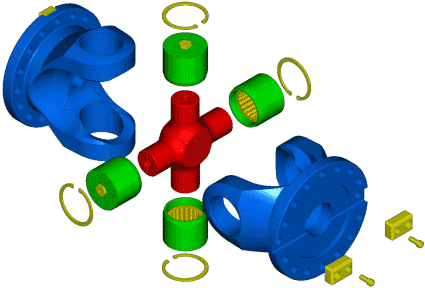
uj-explode.gif

Image from http://www.4crawler.com/4x4/CheapTricks/Driveline-101.shtml

I've done U-joints in many vehicles. USUALLY the first sign of one going out is a slight "clicking" noise when you step on the gas hard and put alot of stress on the needle bearings in the caps of the U-Joint.

I had my 96 Dodge Ram throw a cap off the transmission end U-joint because one of the retaining clips did not seat properly when I replaced them earlier that week. Was driving down the interstate, had some punk try to race me in a rustang, I propmtly kicked his ass, and at about 125 mph I hear a loud BANG and then a vibration I can not even begin to describe, I could not see because it blurred my vision, Im still amazed to this day it did not shake the truck to pieces. It shook so hard that it knocked every speck of built up road grime and dust off the tranny mount and engine mount rubber vibration dameners LOL.

And U-joints are easy to replace at home with nothing more really than a vise and a couple sockets, even easer still if you have a small hydraulic press. My problem was that I sprung one of the yoke's arms inward a tad somehow and the retaining clip groove was partly blocked and I did not notice it. I replaced the slipyoke, and the driveshaft after that ordeal, didnt want to risk it lol.

42293886.gif

Image from http://autorepair.about.com/library/images/bl275lib.htm
 
So I have a 2005 4Runner with 200,000 miles. I noticed a year ago the "Clunking" sound. I greased the U-Joint and it immediately went away. It's now back with a vengeance! I live in AZ and as it gets hotter the clunk gets worse (hot grease I guess). I'm about to get new U-Joints but want to confirm this is the problem - from what I've read and heard I'm 99% sure. Can anyone give me any advise not to, or look at something else? Thanks!!! Bob
 
So I have a 2005 4Runner with 200,000 miles. I noticed a year ago the "Clunking" sound. I greased the U-Joint and it immediately went away. It's now back with a vengeance! I live in AZ and as it gets hotter the clunk gets worse (hot grease I guess). I'm about to get new U-Joints but want to confirm this is the problem - from what I've read and heard I'm 99% sure. Can anyone give me any advise not to, or look at something else? Thanks!!! Bob

As long as you are not confusing the 'standard' drive line clunk when accelerating from a stop with a u-joint noise. Greasing the u-joint will not make the drive line clunk go away, only greasing the rear driveshaft slip joint will help with it. But, if you do have a u-joint going bad, sometimes grease will temporarily mask the problem. It is easy to check the u-joints. Just get the vehicle up on a lift or jack stands, and check each u-joint for movement when twisted. If there is any play, the u-joint should be replaced.
 
As long as you are not confusing the 'standard' drive line clunk when accelerating from a stop with a u-joint noise. Greasing the u-joint will not make the drive line clunk go away, only greasing the rear driveshaft slip joint will help with it. But, if you do have a u-joint going bad, sometimes grease will temporarily mask the problem. It is easy to check the u-joints. Just get the vehicle up on a lift or jack stands, and check each u-joint for movement when twisted. If there is any play, the u-joint should be replaced.

Thanks TechWrench!! It's more pronounced as I'm stopped at a light. After 10-15 seconds, as the engine RPM's go down, it'll make the noise as the torque is reduced - I think! Sometimes as I'm moving again, it'll do it slightly as the car shifts too. I thought it was a tranny problem, but I had it diagnosed and was told nothing is wrong. Everything seems to point to the U-Joints..... I'm taking it in to a shop Thursday, so we'll see for sure I hope!
While she's up on the rack, how bout new shocks; or do I look for leaks?? 200,000 is a lot of miles... Thanks!! Get Bent!
 
Thanks TechWrench!! It's more pronounced as I'm stopped at a light. After 10-15 seconds, as the engine RPM's go down, it'll make the noise as the torque is reduced - I think! Sometimes as I'm moving again, it'll do it slightly as the car shifts too. I thought it was a tranny problem, but I had it diagnosed and was told nothing is wrong. Everything seems to point to the U-Joints..... I'm taking it in to a shop Thursday, so we'll see for sure I hope!
While she's up on the rack, how bout new shocks; or do I look for leaks?? 200,000 is a lot of miles... Thanks!! Get Bent!

At 200k, unless they have already been changed at some time in the past, new shocks would be a good idea. You would be surprised at how much they can improve the vehicle ride. The old ones tend to wear out slowly, and one may not notice the gradual decrease in ride performance over time.
 
At 200k, unless they have already been changed at some time in the past, new shocks would be a good idea. You would be surprised at how much they can improve the vehicle ride. The old ones tend to wear out slowly, and one may not notice the gradual decrease in ride performance over time.

Yea, it's like putting new razor blades in after five weeks! All of a sudden you realize how good sharp blades feel and what a good job they do!! I'm so used to driving it now I don't notice. Thanks! Good advise.....
 

Members online

Forum statistics

Threads
278,309
Messages
3,554,067
Members
248,016
Latest member
Advally Service

Trending content

Back
Top