Valve Cover Gasket Replacement

takumi

New member
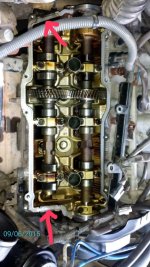
I managed to remove my valve covers, so I can replace the gaskets. And I have a few questions regarding installation of the new gaskets.

1. I'm using OEM Toyota gaskets, and I'm concerned the new gasket may shift around and not seat properly on the head. How do we keep the gasket from shifting around while re-installing?

2. Also, the wiring harness doesn't seem to have much play. I'm having trouble moving it enough to get a clear shot at placing the valve cover back on the head. What's the secret here?

Thanks for any help and tips
 
Register to hide this ad
I just did mine a few days ago. The valve cover gasket sits recessed in the valve cover a good bit. They shouldn't move around unless you are really rough on them. I ended up breaking the plastic harness cover off of the drivers side to be able to move it around more. Just be sure to re-tape or loom it back up. Having an extra set of hands to hold everything out of the way while you slide the drivers side cover back on is a plus.
 
I put a small bead of the FIPG on the inner track of the valve cover to hold the gasket in place whilst maneuvering it back into place. Wrapped a towel around around that damn wire loom to hold it out of the way. Pieces of plastic falling all over is no fun.
 
I put a small bead of the FIPG on the inner track of the valve cover to hold the gasket in place whilst maneuvering it back into place. Wrapped a towel around around that damn wire loom to hold it out of the way. Pieces of plastic falling all over is no fun.

I like this idea, but i hate cleaning fipg (in case you ever have to do the VCG again).

Spent so long cleaning FIPG off my tranny pan/mating surface that I replaced it with a rubber gasket after my last tranny filter replacement.

Probably not as good as the FIPG, maybe I'll have more patience next time.
 
Not putting FIPG is a mistake. I believe the FSM calls for it on the back half moon seals.
If you do it right you won't have to worry about getting the stuff off.
 
thanks for the ideas.

so would it be ok to put a little blue rtv silicone on both half moons of both valve covers, or is that not a good idea?

Not putting FIPG is a mistake. I believe the FSM calls for it on the back half moon seals.
If you do it right you won't have to worry about getting the stuff off.
 
thanks for the ideas.

so would it be ok to put a little blue rtv silicone on both half moons of both valve covers, or is that not a good idea?
I have no experience with the RTV. I just did this job about 3 months ago and went with FIPG. It was cheap and what Toyota suggests.
 
thanks for the tips

i just realized fipg is toyota's factory silicone /sealant. I will pick up a tube at the dealership this week. it's about $18.00, but worth every penny since i want to do the job properly.

I plan on putting everything back together this weekend. just waiting on the spark plugs and wires to arrive. figured i would do everything at once

I have no experience with the RTV. I just did this job about 3 months ago and went with FIPG. It was cheap and what Toyota suggests.
 
thanks for the tips

i just realized fipg is toyota's factory silicone /sealant. I will pick up a tube at the dealership this week. it's about $18.00, but worth every penny since i want to do the job properly.

I plan on putting everything back together this weekend. just waiting on the spark plugs and wires to arrive. figured i would do everything at once
Good call. Be careful when replacing the plug shaft seals. My brother accidentally tore one when installing it and we had an impromptu trip to the parts store.
 
well i'm an old slow poke and i haven't worked on a car in many years

it took about 2 hours to take apart and about 3 hours to put back together. i changed the spark plugs and wires, and cleaned up the valve covers, so that's why it took the extra hour to put back together.

i did not change the 3 big round seals on the valve covers ( i think they are the spark plug guide seals) because i did not see any evidence of them leaking oil onto the top of the valve covers. i also did not change the cam seals. honestly a cam seal failing is very rare, and i don't think they need to be changed as often as people claim they change them with the valve cover gaskets.

next on my list of things to do is the timing belt and water pump kit

just gonna wait another 2 months for cooler weather

Excellent.

About how long did it take you?
 
well i'm an old slow poke and i haven't worked on a car in many years

it took about 2 hours to take apart and about 3 hours to put back together. i changed the spark plugs and wires, and cleaned up the valve covers, so that's why it took the extra hour to put back together.

i did not change the 3 big round seals on the valve covers ( i think they are the spark plug guide seals) because i did not see any evidence of them leaking oil onto the top of the valve covers. i also did not change the cam seals. honestly a cam seal failing is very rare, and i don't think they need to be changed as often as people claim they change them with the valve cover gaskets.

next on my list of things to do is the timing belt and water pump kit

just gonna wait another 2 months for cooler weather

What "cam seals" are you speaking of? The camshaft seals in the front (which rarely leak) or the cam plugs in the rear which often are the main culprit of leaks. Both my runners were leaking from the plugs in the rear.
 
I dont understand Cam plugs. Why are they there? Couldn't they have designed it differently to where it would never fail and leak or not even existed? Seems like something that could have been avoided all together with a different design.

Like really why are these here?
 

Attachments

  • Screenshot_2015-09-06-00-04-05.jpg
    Screenshot_2015-09-06-00-04-05.jpg
    141 KB · Views: 507
Last edited:
Couldn't tell you to be honest? Perhaps some secret access port for something? To be honest I don't think we've ever used those cam plugs for anything at the dealership; so I have no idea why they exist.

I know on some of our older engines they threw those in because we went from distributor ignition to electronic and instead of redesigning the head, they just blocked off the distributor opening... but I don't think the 5VZ-FE ever used anything but electronic, so not sure? Perhaps a hold-over from an older engine layout the heads were modified from?
 
Maybe something needed for the casting or machining process?

I always hope the engineer that specified something like this will chime in discuss with us.
 
99% of the time, they are just an annoyance and a leaky mess. They are designed in case of engine failure, PCV / breather clogging or similar, to blow out / prevent other damage.

If someone ever does have one blow out... it can mean some pretty bad news like the rings went on a cylinder or multiple. Or it can mean the breather line(s) clogged and pressure finally built up enough to blow out one or more of the half moons.
 

Members online

Forum statistics

Threads
278,309
Messages
3,554,075
Members
248,016
Latest member
Advally Service

Trending content

Back
Top