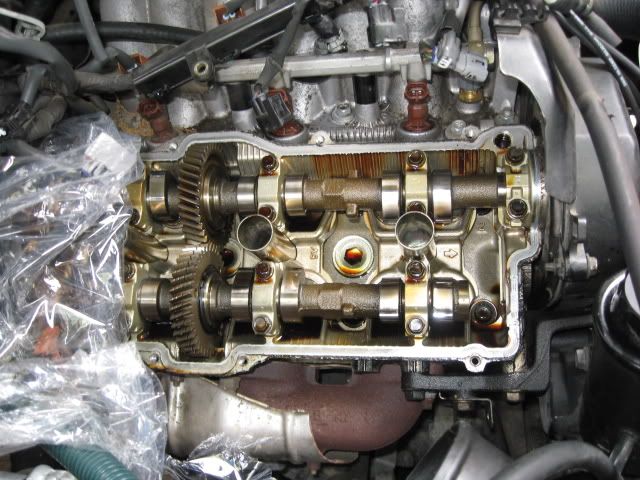
Valve Cover Removal (Sludge Check) PICS

shootmymime

New member
hello eveyone in the T4R.ORG world.

done on a 2000 limited with a K@N cold air intake

recently at the mechanic shop we had a nissan xterra come in with a big sludge problem.
4d24dcd8.jpg~original


i have owned my 4runner for about a 2 years and wanted to take a peek at my heads and upper end.
fc948e60.jpg~original


so here is a step by step on how to check your heads for sludge.
give yourself about an hour to hour and a half depending on how mechanicly inclined you are to do this job
tools you will need.
a 10mm socket with a 6 inch extension and wratchet.
a skinny flat head screw driver about 6 inches long.
a towel to keep oil drips to a minimum.
a drink so you dont over heat.

some problems i did encounter
i broke a pice of the bracket that holds the wires on the valve cover while removing the calve cover so be careful. see step 4

1st step, remove all the hoses and intake from the engine. sorry guys i didnt get to crazy about this part since mine will be a bit diffrent because of my set up. but your plugs and hoses will all be the same.
7ab0c6bf.jpg~original


2nd,remove the Posative Crank case Ventalation Valve (PCV) by pulling straight up, wiggle a bit its pretty easy
50d0e2b5.jpg~original


3rd, unplug the eletrical clip on the bottom of the throttle body
450f5e4f.jpg~original


4th with the 10 mm socket remove the 2 bolts holding down the coil pack wires and injector wires
18198daa.jpg~original


5th unclip the 3 clips on each of the coil packs
1c30ad30.jpg~original


6th remove the 3 screws holding the coil packs on the valve cover and pull the coil packs straight up out of the spark plug wells
d286c21d.jpg~original


7th remove the 8 screws holding the valve cover to the head
99b2c171.jpg~original


a picture of all the 8 screws
fca2bbd7.jpg~original


this is the part that takes the most work, so take yout time. it goes best taking the front out first followed by the rear.
with patience and alot of back and forth up and down motion with the valve cover and other wires slowly remove the valve cover from the head, there wil be a gasket attached to the valve cover on the bottom side.

and thats about it. i cleaned my valve cover and Mass Air Flow Sensor (MAF) while i had the hood open you can search on that maf cleaning

well there we go, easy job, put everything back the way you took it off.
-sincearly the mechanic
 
Register to hide this ad
That's pretty cool. I see sludge under my oil filler cap when I change the oil and I wonder what the upper engine looks like. I am a little scared to pull the valve cover and find out. Is there any way to clean up a sludge mess?
 
That is a lot of work to do just to chk if your engine is sludged up. Even if it sludged up, what good is it to see it is sludged up, you can't really clean it or you risk the chance of washing all the crap into the lower pan.

Use a flash light and look the the oil fill if you want to see the inside.
 
Mine looks very similar to yours :)

I was a bit nervous at first, but when lifted the valve cover off I was amazed on how clean it was!!!!!

I guess I always think of the worst, cause when I removed the valve covers off my Caprice I was thinking it was going to look aweful... even though I run German Castrol in it. With a 150,000 miles on it, you would of thought it had a 10th of that :)
 
I hope you replaced the gasket, plug tube seals, cam plug, and FIPG for the half moons for your effort in removing the valve cover. Good dino oil will go a long way on an engine that is easy on oil.

That X-terra must have the V6; I have changed the VC gasket on a 4 cyclinder. It has a timing chain and takes about an hour from start to finish. Odd placement of the 02 sensor IMO.

Etc., it is hard to beat Castrol Syntec 0W-30 in most cars, with the only drawback being a slight reduction in MPGs. Your 4 runner will love it (what I currently use in mine).
 
Last edited:
oil is castral synthetic, oil and filter about every 3,500 miles, you can chip away at the sludge witha screw driver and shop vac, also if you dont ahve amuch sludge u can put addatives in that will clean it up. we us BG products at work. they are better than anything u will buy at any auto parts store.

it may seem like a lot of work to take apart to check for sludge, but i had time and it didnt take me but 15 min to take it off and 15 to put it on, i spent alot of time cleaning everything else. im anal like that, but hey, ive got a Bi+chn ride
 
how much are the valve cover gaskets ? i might do this to take a peek at whats under it at 280k miles and replace the gasket since its leaking a bit.

sounds like a summer job for me!
 
how much are the valve cover gaskets ? i might do this to take a peek at whats under it at 280k miles and replace the gasket since its leaking a bit.

sounds like a summer job for me!

I paid IIRC, about $30 at Advance. Maybe less. All in all, it took me about 3 hours.
 
Etc., it is hard to beat Castrol Syntec 0W-30 in most cars, with the only drawback being a slight reduction in MPGs. Your 4 runner will love it (what I currently use in mine).

I sent the first run of GC to Black Stone and they noted I had an overage of iron. Its getting to be about that time for another oil change and I hope it went down to normal levels. I'm also sure if my commute had anything to do with it, but at the time I was only driving 3 minutes to work. Now, I'm close to 20 minutes.

About the 4runner, I will probably go with Dino till I can get my rear main seal replaced :)
 
what would cause sludge like the Exterra?

I also don't see the point in taking it apart "to check", if you had sludge, I assume you would already know something is wrong.
 
what would cause sludge like the Exterra?

I also don't see the point in taking it apart "to check", if you had sludge, I assume you would already know something is wrong.

There are many theories to why engines sludge up. Every Mechanic will tell a different reason. Theories include poor oil change interval, poor oil quality, not letting the engine get to operating temperature, exceeded oil temperature, bad PVC valve, parrifin based oil vs naphtha based oil, poor oil filters and etc.

I am not a mechanic but I play one on the internet and my theory to oil sludge is cheap ass oil.

This is my theory.

I have seen engines with sludged like the exterra pictured above (not mine) and i have seen engines clean as whistle. I believe that the brand of oil is the primary cause. i believe that switching from different brands of oils can cause sludging. Kind of like a chemical reaction between the new oil and the old oil that is still left in the engine. And now a days with the advent of the $19 oil change at a quick lube shop, even with the 3000 mile oil change interval, sludge still appears and builds up. This is because the the Quick Lube shops have to use the cheapest oil and oil filters they can find, and that people seem to change Quick lube shops depending on where they are or how long they want to wait, they subject their engines to different brands of oil all the time. If you stick with one brand of oil, (name brand) oil sludge issues should not arise.

My case and point. I am a true believer of Castrol GTX oil. I have been using it and it only for my entire driving career.

My experience. I had an Audi 4000cs quattro that I had since high school. I would change oil once a year because i was too lazy and it just wasn't a priority. During the last 10 of driving it, the odometer had crapped out so i had no actual way to measure how long to change the oil. So I changed it when the oil viscosity broke down. How do it know when the oil Viscosity broke down? When I can hear a valve tick. I would changed the oil then and the valve tick went away. Mind you, that this was my daily driver back and forth to work 24 miles each way for the last 10 years of driving it. I sold the Audi and bought a Nissan frontier. When i sold the Audi, the buyer opened up the oil fill cap (on this engine, you can see the cam and surrounding areas clearly) and noted that he did not see one bit of sludge in the head area, He asked if there was any engine work done to it and said nope. I also told the buyer that the odometer crapped out at 187,000 miles 10 years ago and that i changed oil only when the engine started to have a valve tick. I told him that i have only been using Castrol GTX exclusively. He was shocked to hear this and he bought the car anyway.

FWIW, this was the only car that I neglected this way, and my other cars, i try to change at a steady 3000 mileage interval. I had a Mercedes ML, and Mercedes recommended 10,000 miles between oil changes and the dealer took care of maintenance for the first 5 years. After the 5 years i quickly got rid of the Mercedes.

Case and point - Use one brand of high quality oil and stick with it...
 
Sludged up 4 runners (from YT members). Always check the PCV for function before buying a used car or truck. I doubt it was working in either one of these 4 runners.

IMG_2409.jpg~original


valvecoveroff.jpg~original


Change your oil often, and like Singtoe said, use a good one. Then your valves will remain clean.

IMG_0286.jpg~original
 
I find it hard to believe that ALL car manufacturers do not make it an absolute requirement to run 100% synthetic oil.

Run 100% synthetic and you will never get sludge even if you are horribly negligent at changing your oil.
If Toyota had stated 100% synthetic to be run in all their engines they would have saved themselves about a billion or two dollars because they never would have had that engine sludge fiasco they had.

I can see some sludge in my engine just looking through the fill hole, it doesn't look really bad but its there and the guy before me changed his oil regularly every 3500-4500 miles going by the 3"-4" thick pile of maintenance records that he had and came with the truck.

If he had used 100% synthetic and let it go 8000 miles it would have zero sludge.
 
My 2000 Runner had oil leaking from the valve cover gaskets so I decided to replace them. When I was taking the covers off, the bolts were only hand tight. Probably the reason it was leaking but I had already bought the gaskets and had taken the air intake plenum off.


This isn’t too difficult of a job. Just make sure you label everything as you take it apart. A couple of things I noticed were the wiring harness on the driver side crumbled when I tired to move it out of the way and a little piece of plastic fell down the oil return hole :dammit: and the old spark plug tube seals were really hard to get out. I used a large flat head screwdriver to twist them out.


Here is a pic with the cover off. I’ve got 170k on mine. I use Castrol GTX High Mileage changing every 3500 miles.
 

Attachments

  • phpW3CsCLPM.jpg
    phpW3CsCLPM.jpg
    94 KB · Views: 7,525
Looks good, don't change a thing.

My uncle has used Castrol GTX HM since 04; I think he told me it has tripled in price in close to eight years.
 
I did a Valve cover clean-up for a friend's 2002 V-6. I am not a late model or foreign car mechanic.I read over the FSMand went after it I found the job quite easy and did it in less than an afternoon, including a trip to Toyota for a back-order gasket. I was impressed with the design of the engine and Toyota gaskets. Clearly my friend over-extended their Oil Change cycle and the engine was sludged with barely over 100k on the odometer. Initial ailment was malfunctioning PCV valve and excessive oil in the Air intake resonator, supplying a consistent amount of engine oil to the Throttle body and ending up as smoke out the exhaust. The repair included extensive cleaning of the Aluminum valve covers. This allowed the engine to have properly operating Crankcase ventilation. It reduced the amount of sludge in the engine only a minor degree. However it stopped the exhaust smoke. I was not prepared to remove the oil pan and perform a washdown of the cylinder heads, which would have reduced the muck, but surely would have contaminated the Oil Pan, and possibly clogged the oil pump pick-up or oil passages.
She is happier and I have recommended a few frequent oil changes to aid in reducing the sludge. It has been 6 weeks and no more greyish black smoke, the oil is cleaner, and it is not losing/using oil any longer. It idles smooth, with no funny noises.
My Toyota Mechanic friend said trade it. She has refused, since she has fewer worries on the 4 Runner.
 
I'm going to tackle the valve cover gaskets next week. I've been running Wix filters and Royal Purple 10w-30 since 333k miles, now at 344k and just did my 3rd oil change. I am more than confident to run the Royal purple over 5k. I'd run it for 8k in my built 347 stroker Mustang. That's a car that saw the rev limiter almost every day. Poor 4Runner only sees about 2k RPM max.

Questions- How many of the half moon pieces do I need?
Got any pics?

- Should RTV be used anywhere?
 
Any difference with the sludge effect with you guys running 10W-30 versus 5W-30?
I have about 185K on the clock, and have been using 10W-30 Mobil1 Syn-Blend.
However planning on running Full Syn 5W-30 for better mileage.
 

Members online

Forum statistics

Threads
278,312
Messages
3,554,089
Members
248,016
Latest member
Advally Service

Trending content

Back
Top