watches...

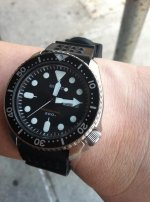
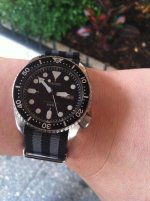
Here is a pic.......its mint.......but 27 years old......thoughts??........

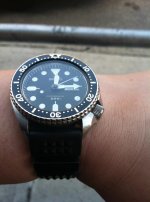
Is it Pepsi colored?? Can you take a side pic? The 4-o'clock corner looks scratched or something, but probably the angle of the camera. Mint = no scratches, nothing right??
 
It's not Pepsi..... Here's more.
 

Attachments

  • image.jpg
    image.jpg
    80.2 KB · Views: 214
I stand by my initial recommendation! :) How is the lume after all these years?? Is it me or angle of camera, but aren't the lumes kinda off-centered from the markers? Does the DAY display in English?

Are there signs of polishing?? I think that i see some signs of hard polishing on the lugs...did the owner polish the watch to make it look minty?
 
The day is displayed in Japanese which to me is the absolute coolest part.

Don't know about the lume.

What was your original recommendation?
 
My initial recommendation was to buy it.

BUT, on second (and third) look, i would pass to be honest. $350 is a lot. I think that i see hard polishing done by the owner. It is hard to impossible to see in pics. Your call, but i would pass.
 
Do you or your sons read Japanese? It's cool i guess, but it reminds me of those Hollywood celebs with idiotic saying in Japanese or Indian and misspelled words. :D
 
Do you or your sons read Japanese? It's cool i guess, but it reminds me of those Hollywood celebs with idiotic saying in Japanese or Indian and misspelled words. :D

It says "Godzilla is coming!!!"

What's wrong with some polishing?
 
like i said before id pass on thisits not 350 dollars piece, 150 maybe. Polished case alone slashes value in half. Thai i bet there is no misspelled words in calendar.
 
What's wrong with some polishing?

like i said before id pass on thisits not 350 dollars piece, 150 maybe. Polished case alone slashes value in half. Thai i bet there is no misspelled words in calendar.

What Victor says.

I can make ANY used watch "Mint" with polishing. The point of being "MINT" is that it is basically UNUSED (brand new-like). I can run my Rolex for 50 years thru rocks and then polish it just like new. Would you still buy it for $6000? No.

On a separate note, dude Victor, what Android spelling typing program are you using?!! Holy crap, that is some bad spelling!
 
The day is displayed in Japanese which to me is the absolute coolest part.

Don't know about the lume.

What was your original recommendation?

lume check is very simple expose to a bright light, then go to the bathroom in the dark,but no lume will survive 27years
 
Last edited:
but no lume will survive 27years

Is this true? I know that radioactive Tritium does not...i think 10-15 years or so for its lifespan. But, the newer non-radioactive ones (SuperLuminova for example) should last a long time, right? My Seiko Kinetic was manufactured around Jan. 2000. We are nearly 14 years old...and my SuperLuminova lume (which is the whole face of the watch) is still as perfect as new.
 
Found the answer to my question from posts on another forum:

"The afterglow of Superluminova paint is not due to radiating its internal energy. It is reradiating energy it "captures" from incident radiation (visible light). The process is called photoluminescence. This is why one has to "charge" it. There is an internal process that delays part of the reradiation and this is the "afterglow".

Also, I believe the"aging" to which Dave refers is the phenomenon of color change/patina/etc. which is not the exact thing as the lack of glow, although it is somewhat related.

The old tritium-doped zinc sulfide paints age, in part, because the radioactive "byproducts" damage the zinc sulfide crystals. This acts, via color centers, to change the color of the paint, as well as to reduce the efficiency of the fluorescence process. The fact that as radionuclides decay there are less radionuclides left to decay is a separate "aging" phenomenon that can also contribute to paint no longer glowing (but not aging in the sense of developing a patina). These paints glow via fluorescence (induced via beta decay of nuclide) not via photoluminescence.

Moisture damage is yet another cause of "aging". Also, what happens with the bonding agent used to keep the paint crystals all in one spot is another item than ages via other phenomena."

"Coincidentally, I work for those guys as a watchmaker (swatch group sav, omega among others), and as an speedy pro owner myself, and WIS, that's one of my points of interest.

any paint, does age, due to damage by (light, UV) radiation, the glowie one being no exception.

UV is another sort of radiation that eventually, gets the paint to age, not only glow paint (tritium, lumi...) but even "non-glow" paint too, white dials become creamy (remember rolex explorer II) bezels fade (on speedy's and seas, particularly on blue speedys) and some dials change colour, on speedy's and flightmasters, the black zones become brownish, and on some lacquered dial seamasters, the blue lacquer fades to reveal the metal dial, leaving all the writing and wave pattern, intact."

An interesting link: LUMINOSITY IN WATCHES

 
Is this true? I know that radioactive Tritium does not...i think 10-15 years or so for its lifespan. But, the newer non-radioactive ones (SuperLuminova for example) should last a long time, right? My Seiko Kinetic was manufactured around Jan. 2000. We are nearly 14 years old...and my SuperLuminova lume (which is the whole face of the watch) is still as perfect as new.

it depends on life time light exposure of the lume,if it it was kept in the box all it`s life then it will be OK. your watch was probably not exposed too much, I bet it`s not as efficient as it was 14 years ago. it might be bright but faded quicker in low light, lume deteriorates to some degree, nothing you can do about it, keep it in dark cold place and it will last longer. tritium tubes still used in some watches, Ball for example, while it usually dead in 10 years, just like gun sights, it can be replaced.
 
Found the answer to my question from posts on another forum:

"The afterglow of Superluminova paint is not due to radiating its internal energy. It is reradiating energy it "captures" from incident radiation (visible light). The process is called photoluminescence. This is why one has to "charge" it. There is an internal process that delays part of the reradiation and this is the "afterglow".

Also, I believe the"aging" to which Dave refers is the phenomenon of color change/patina/etc. which is not the exact thing as the lack of glow, although it is somewhat related.

The old tritium-doped zinc sulfide paints age, in part, because the radioactive "byproducts" damage the zinc sulfide crystals. This acts, via color centers, to change the color of the paint, as well as to reduce the efficiency of the fluorescence process. The fact that as radionuclides decay there are less radionuclides left to decay is a separate "aging" phenomenon that can also contribute to paint no longer glowing (but not aging in the sense of developing a patina). These paints glow via fluorescence (induced via beta decay of nuclide) not via photoluminescence.

Moisture damage is yet another cause of "aging". Also, what happens with the bonding agent used to keep the paint crystals all in one spot is another item than ages via other phenomena."

"Coincidentally, I work for those guys as a watchmaker (swatch group sav, omega among others), and as an speedy pro owner myself, and WIS, that's one of my points of interest.

any paint, does age, due to damage by (light, UV) radiation, the glowie one being no exception.

UV is another sort of radiation that eventually, gets the paint to age, not only glow paint (tritium, lumi...) but even "non-glow" paint too, white dials become creamy (remember rolex explorer II) bezels fade (on speedy's and seas, particularly on blue speedys) and some dials change colour, on speedy's and flightmasters, the black zones become brownish, and on some lacquered dial seamasters, the blue lacquer fades to reveal the metal dial, leaving all the writing and wave pattern, intact."

An interesting link: LUMINOSITY IN WATCHES

talking to yourself?:first:
 
So, in other words, if your watch is indoors a lot, then it (superluminova) should last a long long time. If your watch is exposed to UV rays (outdoor) a lot, then superluminova would age quicker.

Tritium ages no matter what.
 

Members online

Forum statistics

Threads
278,309
Messages
3,554,071
Members
248,016
Latest member
Advally Service

Trending content

Back
Top