Welding Safety Chain Loops to Hitch/Receiver

TB_T4R

New member
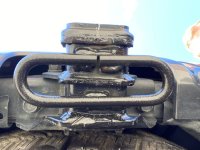
I bought my 2015 SR5 Premium used and the trailer safety chain loops attached to the rear hitch/receiver were rusted/broken off when I bought it (see photo below). Is it possible to weld on a new safety chain loop (like this one: Raw Steel Weld-On Safety Chain Loop (10,000 lbs. Capacity) SKU #49950 for $4.33 by CURT Manufacturing) to the hitch plate while it is still mounted to the frame?

I don't have any welding knowledge, but I could imagine welding near a plastic bumper could be challenging and possibly damaging. It might also have to be welded upside down. A professional welder would do the work.

I am trying to avoid taking off the rear bumper cover to remove the hitch plate. If I was forced to go that route, I would probably just order a new hitch plate to replace the current one (Toyota PN: 51909-35011).

If anyone has any alternative methods or ideas for attaching trailer safety chains to something other than the loops on the hitch, please let me know. Thanks in advance!
1kxVdxQh.jpg
 
Register to hide this ad
I believe a qualified welder could do it...you would want to make sure it could sustain a 5,000+lb yank, which is what the first set would've been engineered for.
 
Should be an easy job for someone who knows what they’re doing. I’d be more worried about electrical problems caused by wielding than the plastic bumper getting hot.
 
Should be an easy job for someone who knows what they’re doing. I’d be more worried about electrical problems caused by wielding than the plastic bumper getting hot.

Welding on a vehicle or any computerized equipment is not a problem. I have and had my maintenance people weld on countless trucks, and million dollar industrial balers, all computerized with No issues whatsoever.

that being said i would not clamp the "ground" lead to the ECU. a decent welder can weld something on with no problem. The heat is also very concentrated so just place a thin piece of sheet metal between the work area and any close paint work and you will be fine.
 
I had to re-weld one onto my hitch with no problems, anyone with some experience with welding will be able to do it.


Sent from my iPhone using Tapatalk
 
Thanks all. I appreciate all of your responses!
I'll find a local welder and get it done. I'll try to remember to post the results here with pictures and costs.
 
I finally found a welder who welded on the CURT safety chain loop for $25. He made it sound like it was a walk in the park for him. Without asking, he even removed all the rust and painted the hitch plate and added safety chain loop.

The welder did add a surge protector device across the car's battery terminals prior to welding. There was some discussion in this thread about potential electrical issues when welding to the vehicle. The surge protector device is used so you don't have to disconnect the battery terminals.

Thanks again for everyone's input.
 

Attachments

  • HitchPlate_NewSafetyChainLoop.jpg
    HitchPlate_NewSafetyChainLoop.jpg
    87.3 KB · Views: 1,435
Looks good!

Where you get into trouble welding on cars is with high frequency tig welding or maybe ac welding on aluminum. But even then it'd be rare. But even just the high frequency start on plasma cutters will cause issues for some electronics if it's too close.

If you're ever welding on a vehicle in the field - std practice is to disconnect the battery. The reason for that is because you never know when someone's going to jump in and try to start it. As unlikely as that sounds as it really does happen. And the welder gets run over. I think that's why you'll always see them do it in that situation.
 
Last edited:
Make sure you weld them on really strong!

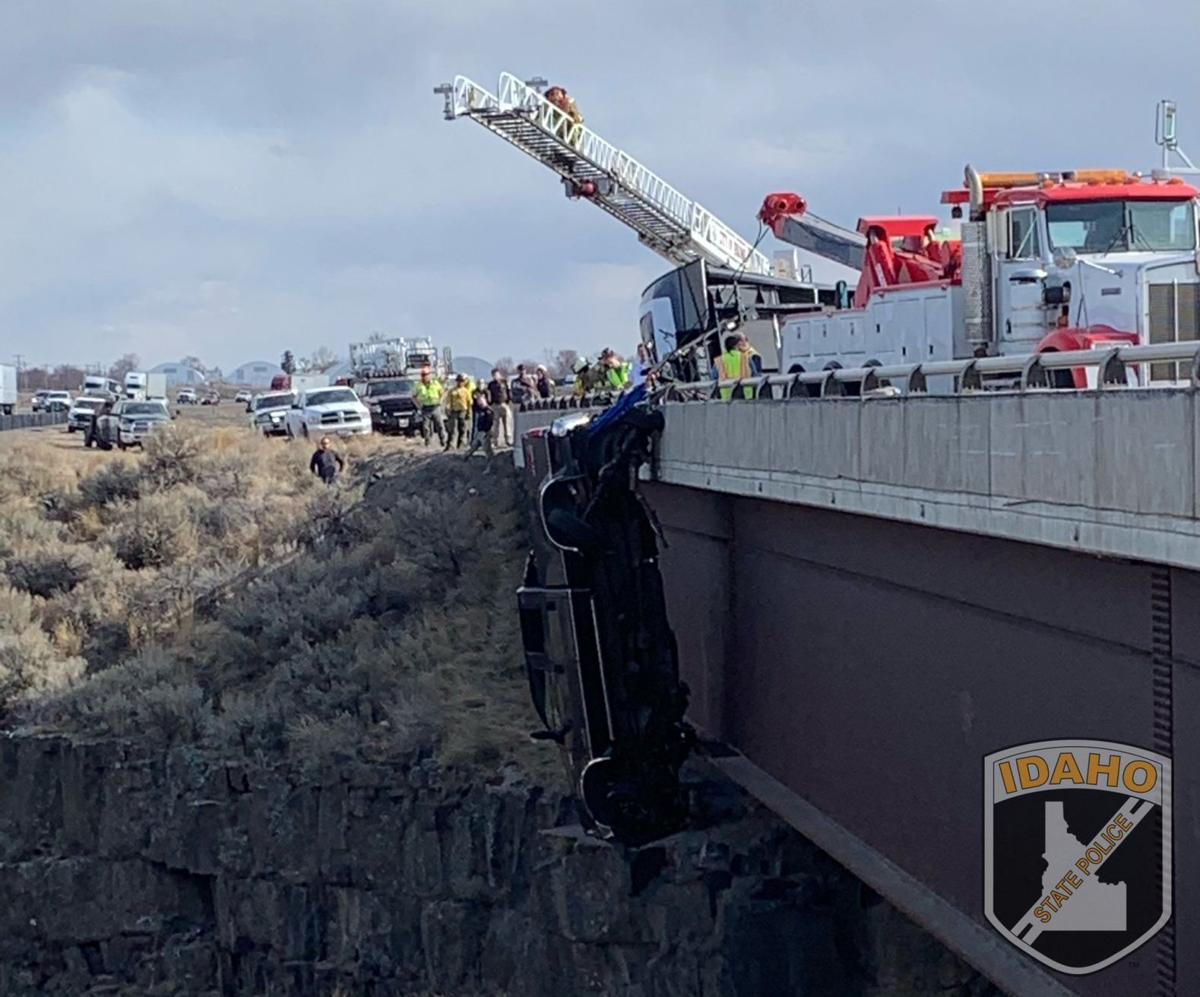
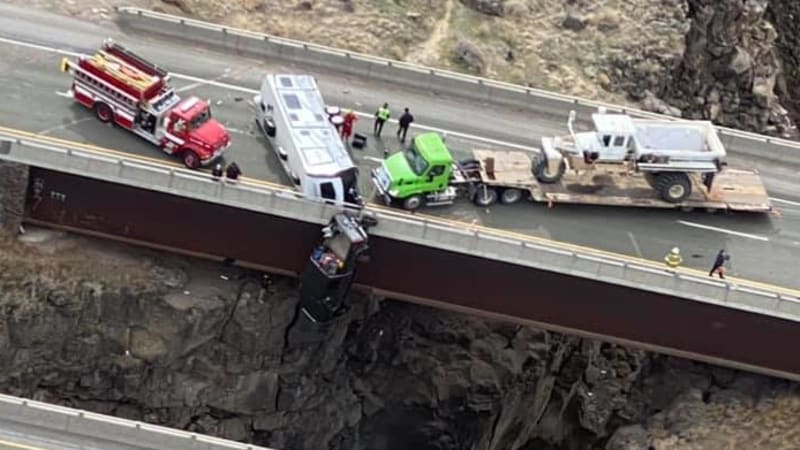
This truck is held up only by the safety chains to the travel trailer above.

It looks like the front end is on the ground and the chains are keeping it upright, which isn't that much weight, relative to holding up the full weight of the suspended truck.
 
It looks like the front end is on the ground and the chains are keeping it upright, which isn't that much weight, relative to holding up the full weight of the suspended truck.

You can see in a few other pictures that it was totally free hanging on just the safety chains. The pictures show some other bigger heavier chains going to the rear axle area - those are from the recovery team to secure it. From that I read that guy in the green semi moving the manure spreader saw it and pulled up and hooked up his truck with chains to the dangling ford. I'd say he qualifies as an everyday hero. Those folks in the truck were very lucky.


161000659_3807381695964139_8641698381007856627_n.jpg
 
Last edited:
Point taken - you're right on. Those loops are stronger than I'd have thought.

I never would have thought the loops on a typical hitch would hold an F250 up. And - I also would not have thought that the safety chains on a typical travel trailer would hold it either. And I also wouldn't have thought that a stock F250 would make it over the barrier.

I'm kind of surprised all around on this one.
 
the conspiracy, because there always is one, is that the front pass tire was wedged on the beam edge.

In another pic you can see only one chain of the pair attached.

40540006-9366201-the_only_thing_keeping_the_2004_ford_f_305_pickup_from_falling_w-a-96_1615920-jpg.773842


No matter what you believe that chain held that truck to some extent.
 
I'm trying to figure out what y'all are doing that would tear safety chain loops off a 4R hitch?
 
I'm trying to figure out what y'all are doing that would tear safety chain loops off a 4R hitch?
Going down rock ledges/steps. When the rear axle drops off the ledge, the 4runner's fat ass slams into the rock, right on the hitch
 
I have an OEM hitch receiver sitting in my garage that I'll never use again.
If you want it I'd only ask to cover shipping.
 
Looks good!

Where you get into trouble welding on cars is with high frequency tig welding or maybe ac welding on aluminum. But even then it'd be rare. But even just the high frequency start on plasma cutters will cause issues for some electronics if it's too close.

If you're ever welding on a vehicle in the field - std practice is to disconnect the battery. The reason for that is because you never know when someone's going to jump in and try to start it. As unlikely as that sounds as it really does happen. And the welder gets run over. I think that's why you'll always see them do it in that situation.

This- coming from someone hit with 120V working on a ceiling fixture when my daughter walking in and flipped the switch on.
 

Members online

Forum statistics

Threads
278,316
Messages
3,554,105
Members
248,016
Latest member
Advally Service

Trending content

Back
Top