What's causing my rear tire wear?

Ukraine Train

New member
I put new tires on last summer and the rears have really worn down already. Any suggestions on what it could be? The control arms don't appear to be bent but maybe the bushings are worn and let the axle shift? The truck drives straight and smooth, though. I don't hear any bearing noise either.
 
Register to hide this ad
Could you post a picture of the rear tire tread. It helps in determining the cause of the wear. What pressure do you run?
 
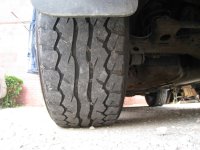
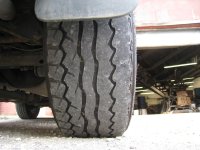
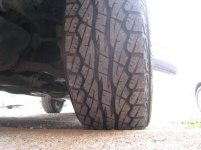
Here's the left rear, right rear, and a front for comparison. There's definitely more wear on the outside of the tread. I run 32PSI but bumped it up a couple PSI once I noticed the wear, just to get a little more load on the center part of the tread.
 

Attachments

  • IMG_0094.jpg
    IMG_0094.jpg
    131.8 KB · Views: 2,079
  • IMG_0095.jpg
    IMG_0095.jpg
    134 KB · Views: 2,047
  • IMG_0096.jpg
    IMG_0096.jpg
    132.1 KB · Views: 1,990
That looks like classic ezcessive toe-in on both front tires.

Were these rotated off the front to the rear?

If they have always been on the rear, not sure what cause is, I don't think rear toe is adjustable, but not sure how both hubs woild be out of alignment in the same toe-in manner. If the axle was that far out of alignment, you would have outer wear on 1 tire and inner wear on the other.
 
That looks like classic ezcessive toe-in on both front tires.

Were these rotated off the front to the rear?

If they have always been on the rear, not sure what cause is, I don't think rear toe is adjustable, but not sure how both hubs woild be out of alignment in the same toe-in manner. If the axle was that far out of alignment, you would have outer wear on 1 tire and inner wear on the other.

x2. It looks like these tires were on the front with a bad alignment. Not sure how you could manage to get that kind of where on the rear alone.
 
There is no way that those have been on the rear the whole time. If so you have some serious damage back there.
 
Now you guys have me second guessing myself. I put these on at the same time I did FJ struts up front and I don't think I've had them off since then. I think I would have seen the same wear on the other two tires by now. The old tires I removed were mismatched front-rear but those rears were really worn out too.
 
If you have been keeping the tire pressure at 32 PSI then I would suspect they come from the front to the rear. I would have a reputable shop check out your alignment.
 
Now you guys have me second guessing myself. I put these on at the same time I did FJ struts up front and I don't think I've had them off since then. I think I would have seen the same wear on the other two tires by now. The old tires I removed were mismatched front-rear but those rears were really worn out too.

have you ever taken it to a shop for any work?
sometimes they will rotate the tires if they notice the fronts are wearing bad, or if they are just due for a rotate. especially if the tires are already off for another reason.

I know here at the shop I have done that more than a few times.


edit: even though the rear isn't adjustable, you can still have it checked. maybe the housing is bent.
 
I've never had it to a shop. I think I should have the rear alignment checked to see what's up. Even if these were on the front, I had the alignment checked after doing the FJ springs and toe and camber were fine. They wanted to adjust caster but the adjusters are rusted solid.
 
There is one other possibility: if the "toe" of his rear wheels is off, it could cause this kind of wear. If, his truck is leaning, it will cause the axle to sit ever-so-slightly off toe. I learned this yesterday, while getting my "post-Toytec-Ultimate-lift-install-alignment" completed. I had not installed the customary driver side spacer to offset the traditional 4th gen driver side "lean" and thus, caused the rear axle to be ever so slightly offset. My alignment guy said that installing the spacer (which I plan on doing this weekend), will remove most of the toe offset, which makes perfect sense. Either that, or I'm going to have to drop $320.00 on adjustable rear LCA's. Anyway, hope that helps.

 
There is no alignment to check on the rear. There are no toe, camber, or caster adjustments to make. If those tires have been on the rear their entire life, then you probably have a bent axle. Has your truck ever been in a side impact?
 
There is no alignment to check on the rear. There are no toe, camber, or caster adjustments to make. If those tires have been on the rear their entire life, then you probably have a bent axle. Has your truck ever been in a side impact?

I understand that the rear wheels cannot have "independent" toe (unless in the case of damage), HOWEVER, the axle can be sitting at an angle which affectively, causes a "toe issue": ie. one rear wheel will have positive toe and the other rear wheel will have negative toe. This is a fact. Experiment: if you place a jack under the rear left of your truck, jack up that one side, and measure the distance of your rear tire to the front lip of the correlating rear fender, then measure the distance of the other rear tire/fender relationship, you will find a change. I'm not saying that this is the case with the OP's vehicle... Just saying it is a possibility.
 
There is one other possibility: if the "toe" of his rear wheels is off, it could cause this kind of wear. If, his truck is leaning, it will cause the axle to sit ever-so-slightly off toe. I learned this yesterday, while getting my "post-Toytec-Ultimate-lift-install-alignment" completed. I had not installed the customary driver side spacer to offset the traditional 4th gen driver side "lean" and thus, caused the rear axle to be ever so slightly offset. My alignment guy said that installing the spacer (which I plan on doing this weekend), will remove most of the toe offset, which makes perfect sense. Either that, or I'm going to have to drop $320.00 on adjustable rear LCA's. Anyway, hope that helps.

I don't think they properly explained things to you. A lean will not have any impact on rear toe. The axle is fixed so no matter how much weight you put on one side it will not change the rear toe. Think of the toe angle as the direction your feet are lined. Ideally they should be parallel. Some people are pigeon toed (or toed in). When this happens they wear the outsides because your left wants to go right and the right wants to go left. The net result is that you go straight. A similar thing happens with your tires. If they are pointed inward then you have extra force being applied because they are pointing two different directions and it is the outside shoulder that is forced to give.

In your case the additional weight on one side that causes the lean changed the height on one side. Your alignment angles change as the ride height changes. If you change the ride height, you must adjust your alignment angles.
 
I understand that the rear wheels cannot have "independent" toe (unless in the case of damage), HOWEVER, the axle can be sitting at an angle which affectively, causes a "toe issue": ie. one rear wheel will have positive toe and the other rear wheel will have negative toe. This is a fact. Experiment: if you place a jack under the rear left of your truck, jack up that one side, and measure the distance of your rear tire to the front lip of the correlating rear fender, then measure the distance of the other rear tire/fender relationship, you will find a change. I'm not saying that this is the case with the OP's vehicle... Just saying it is a possibility.

Really lopsided suspension or a bent control arm could cause a bad thrust angle, but bad thrust angle doesn't cause the outsides of both rear tires to wear faster.
 
I understand that the rear wheels cannot have "independent" toe (unless in the case of damage), HOWEVER, the axle can be sitting at an angle which affectively, causes a "toe issue": ie. one rear wheel will have positive toe and the other rear wheel will have negative toe. This is a fact. Experiment: if you place a jack under the rear left of your truck, jack up that one side, and measure the distance of your rear tire to the front lip of the correlating rear fender, then measure the distance of the other rear tire/fender relationship, you will find a change. I'm not saying that this is the case with the OP's vehicle... Just saying it is a possibility.

Find a new mechanic man. That's not at all how the rear suspension works. Not having the extra spacer on the driver side will do nothing more than make the body of the truck lean. It does not change the amount of weight on either side.
 
There is no alignment to check on the rear. There are no toe, camber, or caster adjustments to make. If those tires have been on the rear their entire life, then you probably have a bent axle. Has your truck ever been in a side impact?

not true. it can be checked, it just cant be adjusted.

by having it checked, he can find out if the housing is bent. or the rear frame is tweaked. or link arms bent...
 
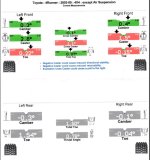
So I had the alignment checked and it confirmed there's a problem, but still no indication of what's causing it. 1.54° of toe on one of the rear tires. Since it's only on one side it seems like it's a bent axle but I think there would be other symptoms of that. The axle seal is leaky on that side... maybe a bad bearing? It drives smooth and quiet, though.
 

Attachments

  • alignment.jpg
    alignment.jpg
    58.5 KB · Views: 747

Members online

Forum statistics

Threads
278,316
Messages
3,554,111
Members
248,016
Latest member
Advally Service

Trending content

Back
Top