When to replace the heater hose?

Capnemo

New member
I just did the timing belt/water pump etc maintenance and saw the small hose
coming off the thermostat housing and running down and to the rear. Must be the heater hose. I am replacing the rad hoses and would have liked to have replaced that small hose too as it looked old, and although not bulging seemed a bit soft.

I would think replacing it during the third or so timing belt change would be easier as the housing is accessible.

Is it a PIA to swap out, front or rear end accessibility wise?
 
Register to hide this ad
I just did the timing belt/water pump etc maintenance and saw the small hose
coming off the thermostat housing and running down and to the rear. Must be the heater hose. I am replacing the rad hoses and would have liked to have replaced that small hose too as it looked old, and although not bulging seemed a bit soft.

I would think replacing it during the third or so timing belt change would be easier as the housing is accessible.

Is it a PIA to swap out, front or rear end accessibility wise?

That's actually the oil cooler hose. Cooler is located on the engine, about 18 inches directly aft of the oil filter. Any original hose on these trucks could stand a swap. I haven't done it, but it can't be too bad.
 
The way I did this was through the driver's side wheel well. I was doing the timing belt and all that jazz at the same time, so had the front of the engine torn down and the water pump off. It was still a PITA with that all off too, but wasn't terrible. IMHO, it is definitely something to do with the timing belt as it's cheap and right there.
 
Just wondering, beside the rad hoses, how many hoses there are thad would drain coolant if they went south.

Will cooler hose

How many heater hoses?

Are all of them accessible without removing a lot of parts?
 
In no particular order:
1) (Obviously) The upper and lower radiator hoses
2) The shaped hoses leading to and from the oil cooler
3) The heater hoses - back of the engine to the firewall
3a) If so equipped, the rear heater hoses - they T into the main heater hoses.
3b) 96-00(?) the steel lines leading from there to under the rear seat are painted steel and prone to rusting through in the salt belt
3c) There are short rubber lines leading through the floor to the rear heater core
4) Throttle body warmer hoses - short shaped hoses that lead from the intake manifold (IIRC?) to flow warm coolant through the throttle body so it doesn't ice up in cold weather
 
Murphy's law states that the hardest one to get to is the one that's most likely to leak. On the 2nd gens, there was a u-shaped hose on the back of the block that would leak and it was near impossible to reach with the engine in the vehicle.

I have seen the oil cooler hose leak, if it does it's usually where it connects to the water pump/thermostat housing.
 
There's the hose going from the water pump to the oil cooler, then from the oil cooler to the engine block. Mine was starting to seep, so the temporary fix was to throw another clamp on it.

When I did finally get around to replacing both hoses, it was a PITA, but accessible from the driver's wheel well without pulling the radiator (like on a timing belt job). If you're doing those two hoses, you might as well replace the O-ring and oil seal on the oil cooler. Most people don't ever do these, but mine was so brittle that it just fell apart. If I recall, it might actually be easier doing these hoses with the oil cooler removed anyways.

You'll have to drain both the oil and coolant if you want to replace all these hoses + seals. Make sure you have a wide assortment of pliers in various sizes because you'll need it.
 
You don't have to drain the oil to replace the oil cooler hoses, just the coolant.

When I replaced my hoses I replaced the oil cooler o-ring as well.
I would not replace the o-ring again unless it was leaking.
I found it a huge pain to install the cooler without the o-ring slipping out.
Maybe if I had a lift it would be easier.
 
Hoses that are subjected to vibration (one end is on the engine and the other end is on the body) is good to replace.

I replaced the heater control valve *STAY with OEM* if changing. The reason I replaced it because the inlet tube on the valve seems to worn to minimal thickness. Several reported that they saw cracked heater control valves leading to head gasket failures.

I bought the valve form Amayama.com from Japan and it was like $50 shipped to the USA.
 
I've replaced the oil cooler hoses and gaskets on at least four 5VZ-FE engines. The biggest problem for me was positioning the hose clamps properly. I could use pliers to open them and slide them back to remove the hoses, but re-installation was always difficult.

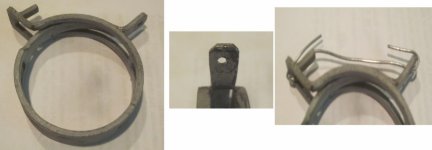
I finally hit upon a solution. I altered the clamps so they could be installed in place by hand. The photo below shows what I did, albeit with radiator clamps as I didn't have any smaller clamps to pose.

The first photo shows a standard clamp. In the second photo you can see that I've drilled a small hole in the tang on one side. The clamp is a type of spring steel, rather hard but not too hard for a drill bit. Use a new bit and cutting oil.

The third photo shows how I used mechanic's wire to hold the clamp open. (Much more easily done on the small oil cooler clamps.)

With the clamps held open by wire - I think I just did this operation on the clamps to the block - I could easily position the clamps with my hand reaching blindly back in there.

With everything in place, I used a small pair of dykes to cut the wire.

Less sweating and cursing, and the clamps were exactly as I wanted them.
 

Attachments

  • clamp1_1024x356.JPG
    clamp1_1024x356.JPG
    45.4 KB · Views: 1,834
I've replaced the oil cooler hoses and gaskets on at least four 5VZ-FE engines. The biggest problem for me was positioning the hose clamps properly. I could use pliers to open them and slide them back to remove the hoses, but re-installation was always difficult.

I finally hit upon a solution. I altered the clamps so they could be installed in place by hand. The photo below shows what I did, albeit with radiator clamps as I didn't have any smaller clamps to pose.

The first photo shows a standard clamp. In the second photo you can see that I've drilled a small hole in the tang on one side. The clamp is a type of spring steel, rather hard but not too hard for a drill bit. Use a new bit and cutting oil.

The third photo shows how I used mechanic's wire to hold the clamp open. (Much more easily done on the small oil cooler clamps.)

With the clamps held open by wire - I think I just did this operation on the clamps to the block - I could easily position the clamps with my hand reaching blindly back in there.

With everything in place, I used a small pair of dykes to cut the wire.

Less sweating and cursing, and the clamps were exactly as I wanted them.

This sir, is absolutely brilliant!
 

Members online

No members online now.

Forum statistics

Threads
278,306
Messages
3,554,045
Members
248,016
Latest member
Advally Service

Trending content

Back
Top