2001 Master Brake Cylinder Issue

Bocox

New member
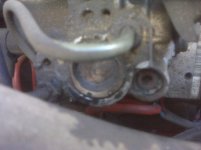
Six months new to the 4Runner life style and loving it. I have a 2001 4WD limited that I have a brake cylinder problem. After adding brake fluid the other day I tried to pinpoint what exactly was causing my fluid loss and noticed that the fluid was coming out when my brakes were being used. Fluid is coming out of the housing located on the front side of the cylinder. (large circle in middle of picture) Is it possible to just replace an O ring or do I need to replace the whole cylinder? Does anyone have a break down of the master cylinder they can send or post? Is this a job that can be done easily?

As always, thanks for the help!
 

Attachments

  • master brake 2001 4runner.jpg
    master brake 2001 4runner.jpg
    135.7 KB · Views: 5,838
Register to hide this ad
Here is one for a 2000 Landcruiser that I bookmarked because it looks like the exact same one as the one on the later 3rd gen runners....hopefully it will get you going in the right direction.....I've never priced a new master out but it has got to be spendy.

Master Cylinder Rebuild - DIY
 
Sorry, the page (or document) you have requested is not available.
Please check the address and try again

......
I don't think the online FSM has a master cylinder breakdown anyway....
 
Last edited:
......
I don't think the online FSM has a master cylinder breakdown anyway....

Yeah, you have to be logged into Google for that link to work, I guess. It does work for me, but it won't share. I fixed the post. You're right, they don't go into the MC. My bad. It's still info one should have before busting into the brake system.
 
Last edited:
I have a 2000 T4R 4WD Limited and just swapped out my master cylinder about 4 months ago. I figured I got 10 years out of it so a new one was worth it. The brakes were spongy and while I was at it, I did the Tundra upgrade. I bought my MC at Advanced and it was IDENTICAL to the OE part on the truck. (Buy it without the reservoir and use your old reservoir). The price was not bad at Advanced and it was relatively easy to put on. Just be sure to bench prime the MC before installation. Once it's on, do a full bleed on the brakes starting from rear passenger to rear driver to passenger to driver.
 
I was able to find the whole MC from a 2002 runner. $50 plus shipping. Im going to install on Monday / Tuesday. I'll keep you posted. Thanks for the help and postings.

Luke
 
final outcome

So I did order a part through a junkyard and got it in a couple days. Looked great in the box, but I did not have time to install. 36 days later and a leak that went from slow to fast, I took the time to replace it. The old MC came out quite easily. 4 nuts from the inside and removed all other attached lines. With some adult supervision (my neighbor is a mechanic) I got the replacement part installed. Come to find out the part I received was faulty. I called the junkyard and they were no help. So, I removed the new MC, robbed the parts from my old MC and swapped everything around. Overall it was more than I wanted to get into with having to install it twice, but doing it for $50 and 6 hours of work was worth it to me. Thanks for all the help! (also, I found a thread on how to bleed the MC / lines without ever having to take it to a dealer) bleed the front two with the car in the off position till you get a firm pedal, then turn car into the "on" position and bleed like you would any normal car. Here is the info below...."

You can bleed the accumulator yourself at home. Have the ignition in the "OFF" position, and repeatedly press and release the brake pedal until you get a firm pedal (if it's air in the accumulator, you should eventually get a firm pedal, if you don't, it's air elsewhere). Once you get the firm pedal, take your foot off the brakes, and turn the ignition to "ON". You'll hear the brake booster pump start. It should shut off after approx 30 or 40 seconds max. If it doesn't, turn the ignition to "OFF" again, and repeat the above procedure until it does.

After that, you bleed your brakes the same as on any other vehicle with the pump/hold method except that you do it with the ignition switch in the "ON" position. That allows pressure to your rear brakes on this type of system. Otherwise, you'll have 0 psi at the rear brakes (which you probably already know.)

As an alternative, you can build a cheap power bleeder like I did here and give that a shot. Using this method, you don't need the ignition in the "ON" position. You simply pressurize the reservoir, then crack open the bleeders one at a time. "

 

Members online

Forum statistics

Threads
278,309
Messages
3,554,072
Members
248,016
Latest member
Advally Service

Trending content

Back
Top